PublicationsThe U4 Blog
U4 Issue

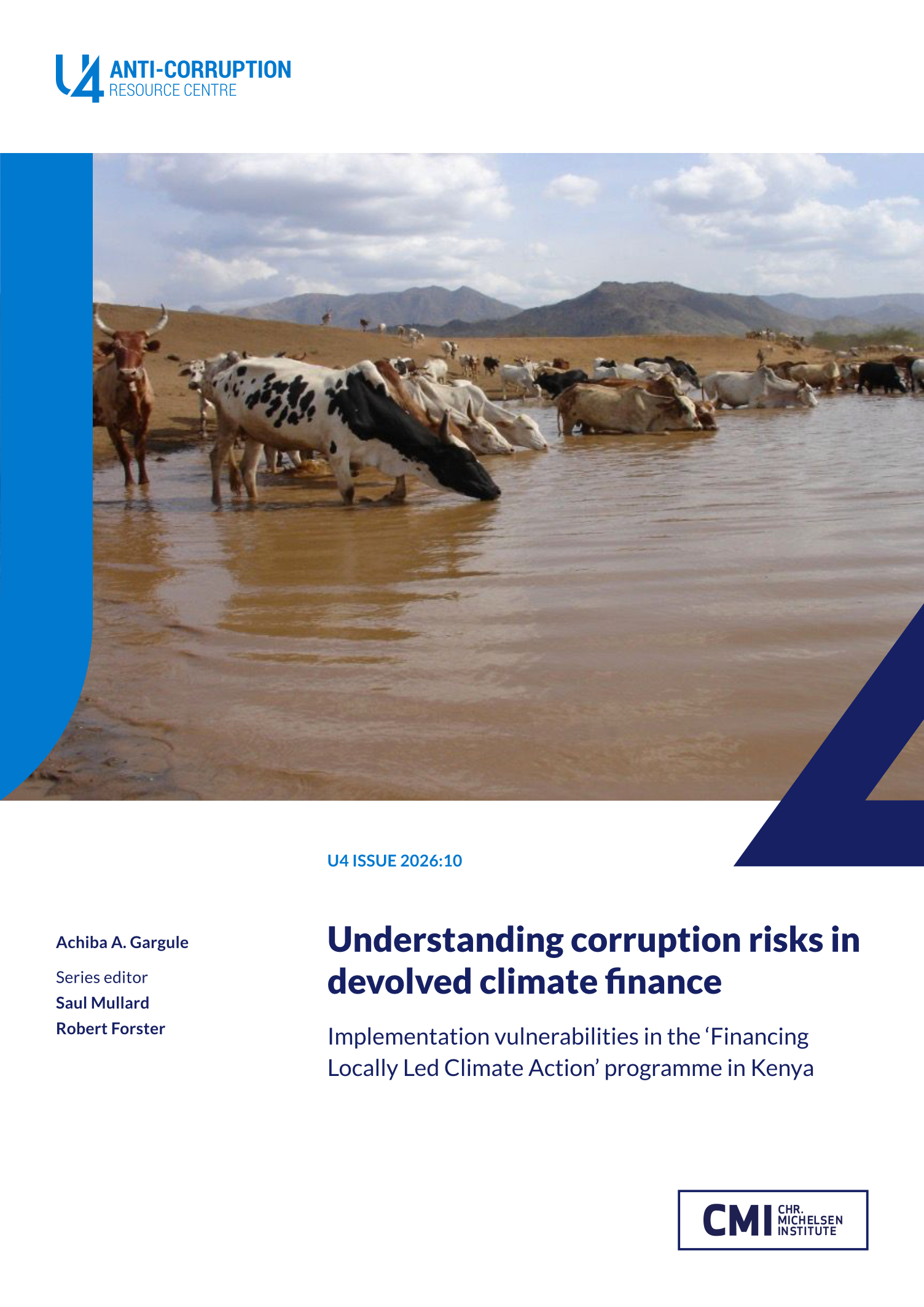
Understanding corruption risks in devolved climate finance

Implementation vulnerabilities in the ‘Financing Locally-Led Climate Action’ programme in Kenya

Kenya’s locally led climate finance model can strengthen adaptation by moving resources closer to communities. However, in counties where patronage, weak oversight, and executive discretion shape public spending, climate funds face risks of capture, diversion, and poor quality delivery. Stronger disclosure, independent oversight, and citizen monitoring are needed to ensure adaptation finance reaches vulnerable communities.

17 August 2026
Read onlineDownload PDFRead short version
Understanding corruption risks in devolved climate finance

Main points

  • Kenya’s devolved climate finance model offers an important route for locally led adaptation, but it operates within county systems where patronage, weak public financial management, and limited enforcement create significant corruption risks.
  • The main risks arise where county executives and politically connected actors can influence project selection, procurement, budget execution, inspection, and payment processes.
  • Participatory planning improves local ownership, but it does not by itself prevent elite capture. Community influence often weakens after priorities are selected, while financial and procurement decisions remain concentrated in county institutions.
  • Corruption in devolved climate finance is not only a fiduciary problem. It can also weaken adaptation outcomes by producing incomplete projects, poor-quality infrastructure, maladaptation, inequitable benefit distribution, and conflict over shared resources.
  • Safeguards in the Financing Locally-Led Climate Action programme rely heavily on county public financial management systems, grievance mechanisms, and national oversight institutions. These mechanisms are important, but they remain constrained by weak enforcement, limited public disclosure, and insufficient follow-up on audit findings.
  • Reducing corruption risks requires stronger ring-fencing of climate funds, routine publication of project and expenditure data, better coordination with oversight institutions, and sustained support for civil society and community monitoring.


Cite this publication


Gargule, A. 2026. Understanding corruption risks in devolved climate finance. Implementation vulnerabilities in the ‘Financing Locally-Led Climate Action’ programme in Kenya. Bergen: U4 Anti-Corruption Resource Centre, Chr. Michelsen Institute (U4 Issue 2026:10)

Read onlineDownload PDFRead short version

About the author

Achiba A. Gargule

Achiba Gargule is a human geographer based at the Feinstein International Center, Tufts University. Achiba served as a Senior Adviser for CMI–U4 on the Targeting Natural Resources Corruption (TNRC) project, funded by the US Agency for International Development (USAID), between 2020 and 2022. His research focuses on the intersection of political ecology and environmental politics, specialising in the governance of natural resources, development policy, land rights inequities, and frontier transformations. Achiba holds a Ph.D. from the University of Bern, Switzerland.

Disclaimer


All views in this text are the author(s)’, and may differ from the U4 partner agencies’ policies.

This work is licenced under a Creative Commons Attribution-NonCommercial-NoDerivatives 4.0 International licence (CC BY-NC-ND 4.0)

Photo


Photo: Achiba Gargule CC BY-NC-ND