Introduction
Decentralised climate finance (DCF) in Kenya channels resources directly to communities facing escalating climate risks.6480e1641703 Evidence from community-driven programmes, such as in Nepal and Ethiopia, shows that while participatory planning can improve relevance and local ownership, it remains vulnerable to elite capture and uneven capacity.eda7e7d83c12 Regarding climate action, corruption has undermined governance, adaptation outcomes and disaster recovery.eb6a216e7b10 In Kenya, climate finance is planned and delivered through devolved institutions where corruption and clientelism are persistent features.4f2a6d287400
Central to the approach in Kenya is the County Climate Change Fund (CCCF) that devolves adaptation finance to county and ward levels and enables participatory planning processes.4604e16eba4d Research on devolution in Kenya highlights patronage-based budgeting, resource diversion, and reactive anti-corruption approaches that fail to tackle underlying incentives. Over a decade after the implementation of devolution, new concerns are raised about the manipulation of budgets by country executives through patronage-based networks, ‘budgeted corruption’,a32c39ac117b and the diversion of resources from public projects. As adaptation finance expands under the Mutirão commitment,723f98c47d29 the success of the CCCF depends on participatory planning supported by safeguards that prevent misuse and enforce accountability. Yet, unchecked corruption can weaken climate action, erode trust in governments, and worsen existing inequalities among groups impacted by climate change.541cfaae189e
Drawing on documentary review, institutional analysis, and qualitative fieldwork,669917c3587a this U4 Issue provides a diagnostic assessment of corruption risks in the design and implementation of DCF in Kenya through a focus on the World Bank’s Financing Locally-Led Climate Action (FLLoCA) programme. FLLoCA aims to strengthen participatory decision-making and the integration of local knowledge, ultimately increasing the share of climate finance managed by local actors and improving the capacity, accountability, and transparency of responsible institutions. Whereas centralised climate finance is vulnerable to national-elite capture and an absence of effective legislation,b576e3bae909 DCF introduces risks related to local-elite capture, patronage, and political interference in project prioritisation and a weakness in local fiduciary oversight.
Definitions
Climate finance
Financial resources mobilised at local, national, and transnational-levels, from public, private, and alternative sources to finance climate change mitigation and adaptation actions. It supports large-scale investments to reduce greenhouse gas emissions and provides sustained funding to manage climate risks and minimise the adverse impacts of climate change.a5657b121cda
Corruption
The abuse of entrusted power for private gain.
County Climate Change Fund (CCCF)
A county-level mechanism managing climate finance through participatory planning and public financial management systems including:
A county climate change fund.
- Institutional climate planning structures at county and ward levels.
- Participatory planning tools to align investments with local priorities.
- Participatory monitoring and evaluation systems to enhance accountability and responsiveness.8af1942f210d
Devolved Climate Finance (DCF)
A decentralised approach channelling adaptation funds to local-level actors. Decision-making authority goes to those directly affected by climate change.68547f4277f6 DCF reflects the principle of subsidiarity: the idea that public functions should be exercised at the lowest effective level, so communities and local institutions have a meaningful role in adaptation finance decisions.5ab51f3f6f00 However, international intermediaries, national actors, and private-sector partners can still shape fund governance, making transparency and accountability at all levels essential.*
Grievance Redress Mechanisms (GRMs)
A structured system through which beneficiaries and the broader public can submit queries, suggestions, feedback, and complaints regarding locally managed climate funds used as a tool for early identification, assessment and prompt problem resolution.*
Scope, limitations and generalisability of findings
This U4 Issue presents an initial diagnostic assessment of corruption and governance vulnerabilities in DCF in Kenya, with a specific focus on FLLoCA‑funded CCCF investments. It examines structural and governance weaknesses that undermine transparency, accountability, and implementation across the CCCF project cycle. The scope covers key stages of FLLoCA implementation including county readiness, access to County Climate Resilience Investment (CCRI) and CountyClimate Institutional Support (CCIS) grants and county co-financing.* This study identifies corruption risks but does not assess their scale or causal impact.
The findings are subject to several limitations. First, analysis was limited by data gaps, particularly on local-level financial flows and programme performance (including FLLoCA’s annual performance assessments, monitoring and evaluation reports, and impact evaluations which were not available).7bf79f929b94
Second, governance and integrity risks discussed in this report are not unique to the FLLoCA-funded CCCF investments, but reflect broader corruption risks in Kenya. Findings, therefore, reflect risk patterns within a high-risk devolved institutional environment, rather than causal claims specific to FLLoCA or DCF mechanisms in Kenya.
Third, data is limited by scope, time and geographic coverage including a small sample of counties and investments. The evidence base is predominantly qualitative and draws on stakeholder perceptions and practitioner insights (see Methodology). As such, findings should be understood as a diagnostic of risk based on how governance actors perceive corruption vulnerabilities in the FLLoCA-funded CCCF investments, rather than a definitive assessment of the prevalence or scale of integrity breaches in Kenya’s DCF portfolio.
There are also limitations in generalisability in application of findings, although analytically relevant insights can be cautiously applied to settings in other developing countries, and Kenya’s experiences in decentralised climate finance aligns with broader patterns of global climate finance flows that are increasingly channelled to high-corruption-risk countries.4d6e9cb3cf98
The Kenyan case shows how participation in planning under County Climate Change Funds is valued, but mitigation of corruption depends on how local discretion interacts with upwards or downwards accountability.c2cd9868ac03 The aim of scaling up climate finance without matching accountability measures highlights an overreliance on local capacity-building and an overestimation of the newly established CCCF structures and their ability to hold county officials to account. These findings are relevant not only to Kenya but also to other countries with similar conditions, where local governments and elites have significant control and vulnerable populations are affected.
However, it is necessary to caveat that Kenya’s CCCF mechanisms are still developing. An important takeaway for future research is the role of informal systems which may influence resource distribution. Understanding how these informal dynamics shape climate finance outcomes is key to improving equity and effectiveness, especially for vulnerable groups.
The political economy of corruption in Kenya
Corruption risks in Kenya are rooted in a political economy shaped by historical practices of loyalty, patronage, and reciprocity. Colonial rule laid the foundations for corruption in post-colonial Kenya, wherein the colonial state relied heavily on resource extraction and coercion.b665d0bab804 This was often enforced through indirect rule by tribal chiefs, creating overlapping political and economic authorities. Some chiefs used this authority to enrich themselves by accepting ‘tea’ (bribes), forced labour, and land appropriation.59cf0d9b7243
Under Presidents Jomo Kenyatta (1963–1978) and Daniel Arap Moi (1978–2001), Kenya’s governance mirrored Jean-François Bayart’s concept of ‘politics of the belly’, where ethnic clientelism became the main pathway of political mobilisation manifested by linking access to state resources with political support.47d963c7bf5d Late colonial-era institutions continued through the over-centralised ‘bureaucratic executive state’ that had weak horizontal accountability.d81708496be8 Informal political networks often overrode formal rules, enabling misappropriation and weak oversight.21921f81f548
The 2010 Constitution introduced devolution to address centralised power and regional inequalities, thereby decentralising political authority and public finances across 47 counties.8e1deb7c17a0 Each county government was led by an elected governor with an appointed executive committee. At least 15% of national revenue was dedicated to managing devolved functions thereby strengthening accountability and responsiveness to local interests. The implementation of devolution was a contentious process shaped by conflicts of interest, centre-periphery tensions, and ethnic bargaining. The devolution of patronage-based politics and corruption created new ‘winners’ and ‘losers’, exacerbated social cleavages, and in some cases, inter-communal conflict.0617d2ad29f7
Rather than mitigating corruption, post-2010 reforms adapted pre-existing corruption practices to the sub-national-level.7eb78f305587 In some cases elected office and political appointments in county governments were dominated by a single ethnic group that reemerged as ‘tribal kingdoms’.3927e334a889 In this framing, informal interactions among the political elite are presented not as self-serving, but as moral obligations that legitimise patronage and shielded elite interests from public scrutiny.1be21959b240
This dynamic reflects what has been described as ‘everybody’s turn to eat’ where redistribution reinforces patronage and corruption.41f1710e1a27 Attempts at anti-corruption reform, producing episodic gains, were generally unsuccessful in changing underlying incentives. The control of corruption stagnated amid declining procurement integrity and recurring political interference.117c329bb0f6 The overall pattern of anti-corruption in Kenya indicates a strong formal framework with shallow implementation and limited deterrence.3a7bef0a734c
Table 1. Selected governance and corruption indicators for Kenya with regional comparison
|
Indicator (latest) |
Kenya |
Ethiopia |
Tanzania |
Uganda |
|
Basel Anti-Money Laundering Index (2024, 0–10 ↓=lower risk) |
6.87 |
5.66 |
6.08 |
5.71 |
|
Corruption Perceptions Index (2024, 0–100 ↑=cleaner) |
32 |
37 |
41 |
26 |
|
Democracy (EIU Democracy Index, 2024, 0–10 ↑=better) |
5.03 |
2.31 |
5.71 |
4.13 |
|
ESG Index Risk Exposure (environment, human rights, and health & safety) (0–100 ↓=lower risk) |
54.4 |
61.87 |
59.12 |
54.32 |
|
Freedom (Freedom House, 2025, 0–100 ↑=better) |
51 |
18 |
35 |
34 |
|
Global Corruption Index (0–100 ↓=lower risk) |
57.99 |
52.97 |
53.08 |
60.33 |
|
Press Freedom (RSF Index, 2025, 0–100 ↑=better) |
49.41 |
36.92 |
53.68 |
37.61 |
Kenya’s corruption risk profile (Table 1) reflects entrenched incentives: high-cost political competition, weak campaign finance controls, and discretionary authority over budgets. Political networks may extract rents through ghost projects, inflated contracts, and substandard delivery, reinforcing clientelism and undermining oversight.e23ae6adde84 Procurement is a central conduit for corruption, where elites can steer tenders through tailored specifications, biased shortlists, preferential invitations, or leaked information, thereby enabling state capture.35ea0aba1844 These practices endure as legal processes and institutions are repurposed to produce outcomes that consistently benefit the few.5eaa3462dcf9 These systemic features shape how climate finance is governed in practice, and explain why implementation gaps persist in Kenya’s climate sector.
The implementation gap in Kenya’s climate sector
Kenya’s climate finance governance framework combines a comprehensive legal and institutional architecture with persistent structural constraints that create a gap between formal rules and practical implementation. It is within this gap that FLLoCA-funded investments are implemented, and corruption risks arise.
The main legal framework for the governance of climate finance in Kenya is the Climate Change Act No. 11/2016 that coordinates, mobilises, and disburses climate finance on the national and county-levels.f938a0365dc3 Emphasising transparency and accountability, the Act is supported by policy instruments such as the National Climate Change Action Plan (NCCAP), the National Adaptation Plan, Vision 2030, and Kenya’s Nationally Determined Contributions (NDCs). Together, these frameworks guide sectoral priorities, institutional responsibilities, and financing approaches for both adaptation and mitigation.a4cb68d9ec0e The Act strengthens devolved climate governance by mandating that counties mainstream climate change into planning and development functions. This enabled counties to integrate climate priorities into instruments such as County Integrated Development Plans (CIDPs) thereby supporting locally led adaptation.
Institutionally, climate finance governance operates through a multi-level architecture (see Figure 1). At the national-level, the Climate Change Directorate coordinates implementation of the NCCAP, adaptation planning, and reporting, while the National Climate Change Council, chaired by the President, provides high-level oversight and coordination across government, private sector, and civil society actors. The National Treasury’s Climate Finance Unit mobilises and tracks climate finance and supports its integration into public financial management systems.
At the county-level, climate affairs are coordinated through designated executive leadership and structures such as County Climate Change Planning Committees. On the county-level, the County Climate Change Fund (CCCF) combines participatory planning with public financial management tools to finance local adaptation initiatives. Local communities may identify priorities while county institutions oversee budgeting, procurement, implementation, and reporting. This model is intended to improve local ownership, accountability, and the responsiveness of climate finance.
Kenya’s CCCF evolved from a 2011 pilot in Isiolo into a model for devolved climate finance that enables communities to shape local adaptation priorities. With donor support, it expanded to additional counties. The approach was scaled nationally through the World Bank-funded FLLoCA programme (2020–2030) led by the National Treasury to become Kenya’s flagship initiative to devolve climate finance.77d317eabdf8 The National Treasury and Economic Planning lead implementation in coordination with the Ministry of Environment, Climate Change and Forestry and with support from the World Bank and other partners.
Through the FLLoCA programme, 47 counties have access to two performance-based grants.2d3196663238 Communities identify and prioritise local adaptation initiatives through county-led participatory climate risk assessments and County Climate Change Action Plans. These are consolidated into ward-level plans and reviewed by County Climate Change Planning Committees and Steering Committee for funding through the County Climate Change Fund (CCCF) to ensure alignment with county planning and budgeting cycles.
According to the World Bank’s Implementation Status and Results Report, FLLoCA currently supports 2,245 projects across 1,137 wards, surpassing its initial target of 700 wards.4de913607195
Figure 1. Institutional landscape and coordination of climate finance in Kenya
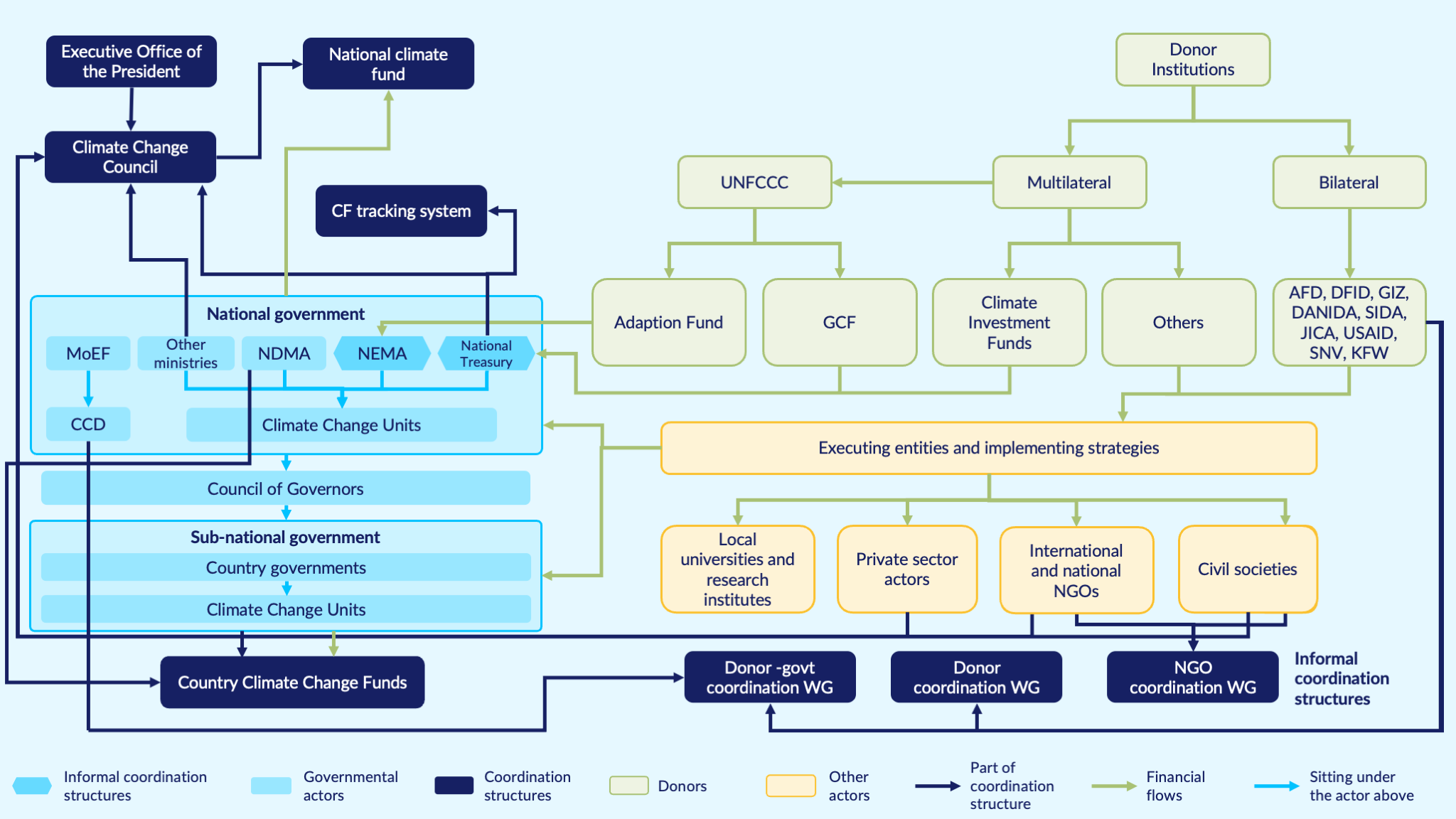
Source: Adapted from Dzebo et al 2020.
Despite a strong legal and institutional framework, there are several challenges. The majority of research on corruption in climate finance focuses on mitigation, particularly in the energy sector which faces significant risks due to the focus on large-scale infrastructure projects that rely on substantial capital flows. Practices such as land grabbing and resource capture; violations of free, prior, and informed consent; informal deals between local governments and national elites; dispossession of indigenous peoples; environmental crimes, and greenwashing, have contributed to pollution, a loss of biodiversity, and climate degradation across Kenya.e42384e78b96 Climate adaptation shares many of the same corruption risks as developmental assistance and humanitarian operations by rapidly introducing substantial resources into resource-poor contexts.805a99ea1ef3 Pressure to disburse resources rapidly, in a context of fragmented funding streams, heighten opportunities for embezzlement, diversion, and elite capture, particularly in contexts with weak fiduciary oversight and underdeveloped accountability mechanisms.
Adaptation finance in Kenya is particularly vulnerable to corruption because of how capital flows are structured, the sectors in which it is spent and the geographic location of projects. First, climate finance flows from the national- to county-level travel through multiple agencies that have a relatively broad discretion by officials that may exploit opaque procedures tied to approvals, procurement, and reporting. Second, adaptation funding primarily flows to sectors that are already prone to corruption. For instance, the Arror and Kimwarer dam scandal in Elgeyo-Marakwet County, Rift Valley, described as an ‘unparalleled display of corruption’,071ea56bf011 is a striking example of how corruption can distort climate-related investments. Third, remoteness can prove a significant challenge to anti-corruption oversight.bcfc556fc3b4 In Kenya, this is illustrated through the experience of the World Bank’s Arid Lands Resource Management Project (1996–2010) in the Arid and Semi-Arid Lands region which was characterised by inflated procurement costs, nepotism, kickbacks, and the creation of non-existent community groups to siphon donor funds.3fa465415bb3 Similar risks were raised by national participants in relation to FLLoCA in remote regions at a U4 Anti-Corruption Resource Centre workshop in Nairobi, Kenya in October 2025.c3dcfa1246f2
Corruption risks in decentralised climate finance
What corruption risks arise in the wider governance of, and the processes through which decentralised climate finance is accessed, allocated, and implemented on the county-level in Kenya? The following section analyses:
A. Risks related to climate finance investments taking place in a devolved context characterised by weak public financial management and oversight.
B. Corruption risks through the decision-chain related to decentralised climate finance including county preparedness and readiness to access grants, decision-making within the County Climate Change Funds, and the implementation of investments.
C. Limitations of FLLoCA safeguards with a focus on gaps in accountability and risk management that may allow for leakage, capture, or misuse of funds.
While DCF improves local relevance, scaling finance without stronger safeguards increases corruption risks.bd3fadbe6bb7 Anti-corruption efforts remain largely prosecutorial and fail to address underlying drivers.f7ce910991eb There are further concerns related to how corrupt practices have adapted to new governance structures, becoming more sophisticated and harder to detect, with critical implications for the effectiveness of DCF mechanisms.a721054580f8
A. Risks from the devolved governance context
The first major contributor to corruption risks is the implementation of climate finance programming in a high-risk environment. In Kenya, DCF flows through county governments and this devolved model heightens corruption risks for FLLoCA-funded CCCF investments because key decisions sit with a small set of county offices. In particular, county executives exercise wide discretion over budget execution including cash-flow prioritisation, and procurement timing, which can be used to steer project selection and contract awards.41d2986d5513 While communities and local accountability committees help identify and prioritise projects, their influence tends to diminish after planning, especially during implementation, supervision, and audit, where most financial and operational discretion lies. The Auditor-General’s FY2023/24 report reflects the broader risk environment, citing recurrent fiscal indiscipline, weak value for money, misallocation, and losses of public funds across counties.e94906d11e89
Day-to-day administrative weaknesses within county systems further widen these exposure points. According to several CCCF coordinators, for FLLoCA-funded CCCF activities, the main vulnerabilities cluster around procurement and records management including incomplete documentation and inconsistencies between plans and expenditures. Delayed fund releases can reduce competition, weaken traceability, and make it easier to justify payments without clear evidence of delivery. In such settings, bid rigging, non-competitive awards, and cost inflation become more feasible, raising the likelihood of leakage, political capture, and project underperformance.
Stakeholders flag weak accountability, especially at the county-level, as a significant driver of corruption risks for the FLLoCA-funded CCCF investments.cb1a2e98ebd8 According to civil society organisations (CSOs) operating at the county-level, accountability deficits, both horizontal (within county institutions) and vertical (to citizens) reduce deterrence. Oversight reports repeatedly flag low fiscal transparency, slow audit follow-up, constrained public participation, under-resourced internal audit units, and limited enforcement when irregularities are identified. The Ethics and Anti-Corruption Commission (EACC) likewise reports high exposure to bribery in county service delivery, suggesting that informal payments can become normalised within local bureaucracies. These contextual factors create a permissive environment in which DCF flows and budgets can be diverted, captured, or delivered at substandard quality.
B. Risks along the decentralised climate finance decision chain
The CCCF is embedded within the devolved county system and proceeds through three interlinked phases shown in Table 2.
- The preparation phase establishes legal, policy, and institutional frameworks.
- The decision-making phase is where Ward Climate Change Planning Committees (WCCPC) and other local stakeholders prioritise investments through participatory consultations.
- The implementation phase is where county governments oversee procurement, contracting, monitoring, and delivery.96f6b9f00348
Each phase involves a diverse set of actors, national and county governments, donor agencies, multilateral development banks, private contractors, civil society organisations, community groups, and local citizens, whose interactions create both opportunities for inclusive, accountable governance and points of vulnerability to capture, misallocation, and misuse of DCF flows.
Table 2. County Climate Change Fund decision points and project cycle
|
Preparation >> |
Decision-making >> |
Implementation |
|
The preparation stage establishes legal and institutional structures such as ward and county adaptation planning committees and allocates 1–2% of the county development budget to climate action. It further entails readiness measures including opening a special project account; appointing a fund administrator and County Executive Committee member for climate change; creating a County Climate Change Unit; and developing an approved work plan and budget. |
Budget formulation Decision-making involves allocating an equal share of the county budget to each ward. Consultation Review & approval |
Implementation Audit & evaluation |
County readiness conditions
Counties seeking FLLoCA grants faced corruption risks during the preparation and readiness phase, particularly where systems had to be established from scratch. Several counties relied on informal and expedited processes to meet eligibility requirements. Evidence from informants indicates that this included behind-the-scenes arrangements between county executives, Members of County Assemblies (MCAs), and aligned stakeholders. Inducements such as high-end retreats financed through unbudgeted public expenditure were reportedly used to accelerate CCCF legislation.
Establishing the CCCF also saw risks linked to the discretionary powers of county executives where governors can appoint CCCF personnel and local planning committee members. Under pressure to meet FLLoCA readiness conditions, appointments to key roles such as fund administrators and ward adaptation planning committees, was frequently based on political loyalty rather than merit – undermining institutional credibility and reducing technical capacity.
The readiness phase involved significant financial flows allocated to capacity building and planning activities that were often managed by politically connected consultants and local elites creating opportunities for elite capture, conflicts of interest, and the manipulation of participatory processes. According to CSOs on the ground, community engagement in marginalised areas was vulnerable because of information asymmetries and limited oversight. Combined with the pressure to meet funding conditions, these factors were seen to increase the use of procedural shortcuts.
Decision making in the County Climate Change Fund
The decision-making phase of Kenya’s DCF is intended to operationalise locally led adaptation by embedding transparency, participation, and accountability in the establishment and implementation of the CCCF at the county-level. It involves three key stages: (1) allocation of budgets to ward adaptation planning committees, (2) prioritisation of projects at the ward level, and (3) technical review and approval by county adaptation planning committees. Despite this structured approach, significant corruption risks persist across the decision chain.
Corruption risks at the CCCF decision-making stage could be motivated by ethnic, patronage, or rent seeking. Resource allocation by the bureaucracy may be prioritised for the kickbacks they generate rather than their potential to improve citizens’ well-being.e3f15daf0532 For example, county executives may allocate ward budgets to curry favour with the MCA and area residents.7db1d2c78743 Key risks include the broad discretion afforded to county executives over ward allocations, persistent asymmetries in information, capacity, and expertise, and the opaque participation processes that undermine transparency and accountability.*
National and county-level stakeholders identified elite capture in CCCF participation processes as a significant concern. At the local level, local elites – particularly local businesspeople, contractors, and educated community members – influenced ward adaptation priorities toward high-value construction and water projects. In some counties, county executives applied pressure on ward adaptation planning committees to direct CCCF allocations to high-cost infrastructure projects using the implicit threat of cancelling allocations if directives are not followed.
One key informant recounted a case in which a local development committee manipulated the ward adaptation planning committee’s decisions. The local peace committee complained to the county adaptation planning committee arguing that ‘a planned water pan would attract migrating pastoralists and cause conflict; we would rather have a borehole, which we can control better.’ The county adaptation planning committee reversed its decision accordingly. The informant added with surprise, ‘What shocked us was how quickly the contractor moved in – the work on the borehole started immediately, almost as if he had been waiting just around the corner.’
Integrity risks arise from asymmetries in information, resources, and expertise between external actors, on the one hand, and county governments and local communities on the other. Climate finance flows have introduced a wide range of stakeholders including donors, the private sector, policy actors, NGOs, and research institutions. Their involvement can take multiple forms – from sub-contractual agreements with county governments; to joint planning and implementation of community adaptation projects; to more limited roles focused on capacity building and technical support.
In many cases, donors and technical experts drive the design of mechanisms, policies, regulations, and technical capacities for participatory climate risk planning, leaving county institutions and communities in subordinate roles without the knowledge or bargaining power to shape outcomes. This imbalance increases the risk of tokenistic participation in which communities are formally consulted but lack the capacity to scrutinise or challenge technical decisions.5f2835917c19 Such dynamics undermine accountability and weaken the inclusivity of planning, implementation, and monitoring processes in climate adaptation initiatives.
Vulnerabilities in the implementation of County Climate Change Fund investments
Fiduciary risks become observable during the implementation of CCCF investments. While earlier stages emphasise multistakeholder participatory planning and prioritisation, implementation is driven by county administrative and technical systems that can be manipulated when controls are weak. Key risks explored below include:
- Discretionary appointment of tender committees.
- Non-transparent procurement (eg restricted competition, bid rigging, opaque awards).
- Delays in FLLoCA transfers and diversion or reprioritisation of county contributions.
- Collusion in inspection and evaluation that may certify incomplete or substandard work.
Discretionary selection of county tender committees
The County Tender Committee is the principal body with multiple discretionary powers, which reviews solicitation documents, ratifies evaluation outcomes, and recommends contract awards on the county-level that offers multiple opportunities to manipulate the process.a1e4da02a392 County Tender Committees are statutorily required to conduct procurement and asset-disposal decisions in a systematic and structured manner, and to apply preferences and reservations for small and micro enterprises, as well as other disadvantaged groups domiciled in the county.f9c36e23dbe6 However, county executives may have significant control over these committees through hierarchical influence or socially embedded systems of loyalty, reciprocity, and obligation that distort formal accountability mechanisms.4ad2565f8042 Moreover, according to informants, the concentration of powers at the county executive level, including making appointments (conducted with limited screening for subject-matter competence or conflicts of interest), can foster patronage and nepotism with appointments linked to politicians, service providers, or community leaders.35558158a94f
Non-transparent procurement processes
Closely linked to abovementioned issue are non-transparent procurement practices whereby contractors – often connected to the executive – collude with County Tender Committee members to tailor specifications, eligibility criteria, and evaluation weights to preselected bidders.
On the county-level, there is a committee-based workflow designed to reinforce transparency: A Tender Opening Committee formally opens CCCF tenders that are evaluated against the criteria established by the Tender Evaluation Committee. The Tender Opening Committee also forwards, via a report, their opinion to the County Tender Committee and the Chief Officer in charge of the climate change portfolio who together award the contract and notify the awardee. After notification and a statutory standstill, the contract is finalised and published. Project delivery is verified by an Inspection and Acceptance Committee before payment. Oversight is furthered by quarterly implementation reports that capture implementation status and allow for corrective action.
In practice, however, discretionary powers by the county executive undermine accountability. Informants report bid rigging among affiliated contractors linked to county executives that is facilitated by collusion between procurement committees and suppliers by shaping contractual terms and concessions and conferring preferential treatment on allies, proxies, and relatives. Bid-rigging can take place through the manipulation of technical specifications, selective application of responsiveness checks and evaluation criteria, and biased award determinations.
Transfer delays from National Treasury and the diversion of county contributions
A notable governance risk flagged by informants was the opacity in the transfer of county contributions from the county revenue fund to the County CCCF account and the disbursement of funds from the County treasury to the county CCUs.83a5ed71213a While CCCF legislation requires county contributions to the budgeted, the transfer of funds to the special purpose accounts is regularly delayed. More importantly, informants voiced concern that the county contributions to the CCCF are not properly ring-fenced and are vulnerable to reallocation through supplementary budgets. The County Executive regularly exercises discretion to reallocate, delay, or repurpose funds which undermines the financial viability of approved CCCF projects.
Closely connected to delays in transferring money from the county revenue fund is the broader pattern of delayed exchequer issues to the counties. In a liquidity-stressed environment, the county executives frequently gain discretion to reprioritise cash flows, divert ring-fenced CCCF funds, and selectively queue payments, which allows room for kickbacks and patronage. Procedural workarounds, such as emergency procurements, variations, and off-budget spending, further weaken controls. Meanwhile poor record-keeping obscures accountability for delays and arrears. The result is a systemic misalignment between planned adaptation outcomes and realised delivery, with heightened exposure to leakage and incomplete projects.
Another complex concern is the causal link between the multi-year pending bills resulting from delayed transfers and the risk of misuse and diversion of pending bills’ budgets. Office of the Attorney-General reports indicate massive pending bills in the counties. This is enabled by the weak segregation of duties, incomplete bank reconciliations, and limited real-time visibility over county sub-ledgers. Diversion typically occurs through:
- Transfers from CCCF funds to recurrent expenditures, eg wages, travel, and operating shortfalls.
- Cash sweeps from the CCCF Special Purpose Account to general county pools during liquidity stress.
- Misclassification within the Integrated Financial Management Information System obscuring the movement of funds
- Pre-commitments that outpace available cash.
Collusion in project inspection and evaluation
The officials who assess completed projects may have a personal interest in those same contracts. Informants highlighted risks in monitoring and evaluation including officials issuing completion certificates for unfinished projects, demanding bribes or other facilitation payments to conduct inspections or colluding with private contractors to circumvent quality standards. In extreme cases, county staff falsify completion certificates to justify disbursements. Such collusion is possible due to weak oversight as well as systemic vulnerabilities. Informants reported that audit and integrity committees rarely function effectively, and that legal frameworks provide inadequate checks against collusion between officials and contractors. Through such avenues contractors can directly influence project evaluations, manipulate inspection outcomes, and obtain completion certificates for incomplete or substandard work. Informants further revealed local participation in climate adaptation projects, although well-intentioned, often lack controls to regulate contractor involvement.
C. Limitations of the ‘Financing Locally-Led Climate Action’ programme safeguards
Participatory planning and community-led priority setting in the FLLoCA programme aims to reduce corruption risks in the planning stage by aligning authority and beneficiary interests. Interviews with community representatives and CSOs indicate that these mechanisms are widely valued and may establish structural incentives to safeguard resources through increased transparency and ownership of project selection. Nevertheless, qualitative evidence indicates that participatory safeguards cannot prevent elite capture when county-level actors retain discretion over final approvals and budget allocations, and planning processes are susceptible to informal influence and political bargaining.
The procurement stage, characterised by executive discretion over tendering, contractor selection, and contract management, is most susceptible to corruption. CSO respondents observed that FLLoCA does not have a programme-specific corruption risk assessment or a dedicated anti-corruption strategy to proactively address integrity challenges. Corruption risk management is embedded within county public financial management systems and national oversight frameworks. The application of the World Bank’s Anti-Corruption Guidelines establishes formal reporting and referral mechanisms. Nonetheless, informants indicate that this approach frames anti-corruption as an external enforcement function and offers limited deterrence.
During implementation, weak internal controls significantly undermine FLLoCA safeguards. Informants further indicate how internal audit functions are often under-resourced, lack independence, and focus on compliance instead of risk. Meanwhile, limited follow-up on audit findings further weakens oversight.
Finally, at the oversight stage, county grievance redress mechanisms (GRMs) are formally established but are ineffective as anti-corruption tools. CSOs and community members report limited understanding of GRM procedures, executive control over GRM focal points, and performance metrics that prioritise activity over outcomes. Inadequate escalation to external oversight bodies further diminishes deterrence and GRMs are unable to address broader shortcomings in anti-corruption enforcement. As a result, counties rely on self-monitoring. Across each of these stages, FLLoCA safeguards are structurally constrained by weak enforcement and systemic governance deficits.
Conclusions
Kenya’s devolved climate finance architecture has created an important opportunity to bring adaptation finance closer to communities most affected by climate change. Through the County Climate Change Fund model and the FLLoCA programme, counties can finance locally identified priorities, strengthen participation, and build climate resilience through public institutions. This is a significant achievement. However, the same devolved systems that make locally led adaptation possible also expose climate finance to corruption risks when oversight, transparency, and enforcement are weak. Indeed, it appears as if the ‘use of public office for personal gain’ is the norm with practices evolving to the new institutional context.148c788e472c
The evidence presented in this report suggests that corruption risks in FLLoCA-funded County Climate Change Fund investments are rooted in the wider political economy of devolution. County executives and their networks often hold significant discretion over appointments, budget execution, procurement timing, project sequencing, contractor selection, inspection, and payment.1e41ad68b791 In this context, formal participatory structures can be weakened by informal patronage, political bargaining, and elite capture. Corruption risks are primarily facilitated by the discretionary powers conferred on the county executive in the constitution and these risks impact decentralised climate finance across the country that intersect with informal networks of patronage and social influence.315bc4681eff Community members may help identify adaptation priorities, but their influence often declines once projects move into technical review, procurement, implementation, inspection, and audit.
Evidence on the long-term impacts of corruption in CCCF investments is still limited, but several stakeholders believe that the diversion of climate funds, implementation of poor-quality projects, and neglect of vulnerable communities have immediate harmful effects on local adaptation outcomes. According to CSO and community respondents, FLLoCA-funded CCCF projects are vulnerable to political interference by county executives, leading to investment decisions that favour allies of the county executive or specific constituencies over the most climate-vulnerable areas. Further evidence suggests that weak CCCF financial governance – including delays in funding flows from the National Treasury, non-remittance of county contributions to the CCCF Special Purpose Account, and discretionary payment decisions – leads to multi-year pending bills that carry a greater risk of diversion and embezzlement and result in incomplete or poor-quality adaptation projects. Finally, limited transparency and weak citizen oversight further allow inefficiencies and fund misuse to persist in completed CCCF investment management.fece4c6e0d94
These risks matter because corruption in climate finance does not only result in financial leakage. It can also undermine adaptation itself. When projects are selected because they generate rents rather than because they respond to climate vulnerability, funds may be diverted away from the communities most at risk. When procurement is manipulated, projects may be overpriced, delayed, incomplete, or technically unsuitable. When inspection and evaluation are compromised, poor-quality work can be certified and paid for. In ASAL counties and other fragile settings, corruption around shared resources such as water infrastructure may also heighten local tensions and undermine the legitimacy of locally led climate action.
FLLoCA’s safeguards provide an important foundation, but they remain too dependent on county systems that are themselves vulnerable to political interference and weak enforcement. Grievance redress mechanisms, internal audit units, public participation forums, and national oversight institutions can all strengthen accountability, but only if they are adequately resourced, independent, visible to citizens, and linked to credible sanctions. The central lesson is therefore that scaling up locally led climate finance must be matched by scaling up integrity systems. Without stronger transparency, ring-fencing, oversight, and citizen monitoring, increased adaptation finance may reproduce the same inequalities and governance failures that locally led climate action is intended to overcome.
Recommendations
With adaptation finance expected to grow significantly, stronger local governance, transparency, and citizen oversight are crucial to ensure funds deliver fair and lasting resilience outcomes. Tackling corruption risks in decentralised climate finance requires a coordinated, multi-level approach, supported by targeted policy actions for governments, donors, civil society, and communities to improve accountability across programmes like FLLoCA.
Policy options to enhance transparency and accountability in Kenya’s DCF
1. Establish robust sub-national governance of LLA funds flows
Strengthening transparency and accountability practices across national and county government systems, particularly through proactive, routine disclosure of FLLoCA project data, budgets, and performance reports, is central to driving accountability and mitigating corruption risks. To advance this agenda, priority enabling actions for the national and county governments could include the following:
- Address recurrent and potential delays in FLLoCA disbursements by the National Treasury including systemic bottlenecks that lead to resource fragmentation due to delayed timely county contribution to the CCCF project delivery. Strengthen county processes for managing pending bills to reduce fiscal pressure points that heighten corruption risks and compromise project implementation.
- Develop guidelines for hard ring-fencing and prompt disbursement of county contributions to CCCF Special Purpose Accounts. This will curb resource fragmentation, enhance funding predictability, and safeguard county contribution intended for locally led climate action.
- Develop guidelines for counties to publish CCCF project data, procurement documentation, and budget execution reports in open, user-friendly formats that enable public scrutiny and strengthen transparency in the project cycle.
2. Strengthen coordination and collaboration with oversight institutions
Kenya has a solid institutional architecture for public oversight and anti-corruption enforcement, yet these bodies face significant constraints in effectively safeguarding DCF from corruption. Limited technical expertise in climate adaptation and finance, uneven enforcement of regulations, and persistent political interference weaken their ability to monitor and ensure accountability for FLLoCA funding flows. Addressing these gaps and strengthening integrity across the FLLoCA programme will require coordination and collaboration between national and county governments and key oversight institutions, including the Office of Auditor-General, Office of the Controller of Budget (OCB), and EACC. Priority enabling actions include:
Cross-government recommendations
- Create a comprehensive intergovernmental system to track OCB, OAG, and EACC inquiries on the use and management of FLLoCA funds at the county-level, monitor county responses, aggregate recurring issues, and regularly report on complaint types and resolution status.
- Embed shared oversight processes, such as joint audits, structured intergovernmental dialogues, and coordinated data-sharing protocols, to identify corruption risks early, accelerate corrective actions, and support referrals for prosecution and recovery of misused FLLoCA funds.
- Design and implement a cross-government accountability framework that embeds corruption-risk mitigation measures throughout the CCCF project lifecycle, operationalises existing integrity and oversight standards, and clearly delineates the roles and responsibilities of all actors.
National government–specific recommendations
- Strengthen OAG, OCB, EACC, and related bodies by developing targeted expertise in climate adaptation, climate finance audit, and climate finance integrity systems to improve the quality and depth of oversight over FLLoCA investments.
- Expand the Monitoring, Reporting, and Verification (MRV+) platform to include mandatory tracking of climate finance flows, outputs, and outcomes at both the county and community levels, enabling more robust monitoring and accountability.
County government–specific recommendations
- Develop and operationalise county mechanisms to track queries from OCB, OAG, County Assemblies, and the Senate regarding FLLoCA funds, document county responses and corrective measures, and publish aggregated information in accessible formats.
- Enhance the capacity of county internal audit units to oversee the efficient and effective use of FLLoCA funds, conduct post-implementation audits of CCCF investments, and report findings to the National Treasury to support system-wide learning and accountability.
3. Build capacity for citizen oversight and civil society engagement
As DCF flows expand in Kenya and similar countries across Africa, a critical safeguard to ensure integrity will be the role of CSOs and community oversight mechanisms. These actors provide an independent channel for verifying funding flows at the national-level and generating credible, ground-level data on how resources are allocated and spent at the county-level. CSOs and community-based CCCF planning structures can reinforce transparency, accountability, and integrity, particularly at county and project implementation levels, in the following ways:
- Support CSOs to conduct civic education to enhance public understanding of the roles, functions, and responsibilities of CCCF committees, county assemblies, and county executives in CCCF planning and implementation. This includes supporting local CCCF committees and CSOs to lead expenditure tracking, independent audits, and participatory monitoring of climate investments to reinforce downward accountability and deter misuse of FLLoCA resources.
- Invest in training local committees on basic financial management, record-keeping, procurement oversight, and grievance documentation to strengthen last-mile integrity and reduce leakage risks. This includes investing in the technical capacity of CSOs to translate CCCF budgets, procurement plans, and performance data into accessible formats, such as scorecards, infographics, community radio content, and local-language briefs, to enhance citizen understanding and enable informed scrutiny.
- Equip CSOs and local CCCF committees to help citizens lodge complaints, track progress, and escalate unresolved cases, making grievance redress more inclusive and effective. This should include expanding citizen access to county GRM channels through community-level reporting hubs and simplified digital platforms co-managed with CSOs.
- Enable CSOs and community structures to actively verify that CCCF-funded projects align with local priorities, adhere to approved plans, and deliver intended results, thereby closing gaps that enable leakages or elite capture.
- Encourage citizens and community groups to use county public participation platforms (budgets, CIDPs, etc.) and digital disclosure portals to request information, flag concerns, and hold county executive, contractors, and local officials accountable for the management of FLLoCA funds.
4. Donor opportunities to strengthen transparency in funding flows
Donors and other development partners can support transparency and accountability in DCF in general and the planning and implementation of FLLoCA projects in particular, in the following ways:
- Provide targeted assistance to national implementing agencies to strengthen corruption-risk analysis within DCF and champion the development, adoption, and enforcement of donor safeguards and anti-corruption guidelines for the planning and implementation of FLLoCA-funded CCCF investments.
- In collaboration with government counterparts, co-design conditional access criteria for the County Climate Resilience Investment (CCRI) grant to reward timely county contributions, comprehensive budget and procurement disclosures, and clean audits by oversight institutions. Require all FLLoCA-supported counties to publish standardised project, budget, and performance information through open-access digital platforms, consistent with open-data norms, as a prerequisite for continued funding.
- Invest in enhancing the technical capacity of county audit sections to assess the quality, integrity, and results of FLLoCA-funded CCCF investments. In remote ASAL counties, complement audit support with targeted funding for civil society and third-party monitoring mechanisms to reinforce on-the-ground transparency and independent oversight.
- Coordinate and provide funding support for structured cross-county and intergovernmental peer review mechanisms to promote shared learning, harmonise transparency standards, and reinforce accountability norms across the DCF ecosystem.
- Fund independent impact evaluations to assess how corruption risks shape the achievement of adaptation priorities, potential maladaptation, and the impacts on vulnerable groups, including pastoralists, indigenous groups, women, ethnic minorities, and persons with disabilities.
- Increase long-term support for the FLLoCA civil society engagement framework by providing dedicated support to local CSOs, especially in remote ASAL counties, to enhance their capabilities in community-level CCCF planning, procurement oversight, and monitoring of the quality and results of FLLoCA-funded investments.
- Hesse 2016. DCF is a financing model that channels adaptation funds to local-level actors, including county governments and community planning structures, shifting decision-making authority closer to communities most directly affected by climate impacts (Patel et al. 2020).
- Darjee et al. 2021; World Bank 2026.
- Ndii 2020; Maina 2019; Duri 2021; Fritz and Kolstad 2008.
- Nest and Mullard 2025; Nakhooda, Watson, and Schalatek 2016; D'Arcy and Cornell 2016; Williams and Dupuy 2016.
- Hesse and Pattison 2013.
- Ndii 2020.
- Wubet, Soderberg and Thwaites 2026.
- Nest, Mullard, and Wathne 2020; Singh, Karaho and Adhikari 2025.
- Primary data was collected through semi-structured interviews with donors, national institutions, civil society organisations and county governments that explored integrity challenges in planning, procurement, financial management, monitoring, and grievance handling across the FLLoCA-funded CCCF project cycle (see the Methodology section). Using evidence from the three counties of Makueni, Isiolo, and Kiambu, the study examines integrity vulnerabilities in FLLoCA-funded CCCF investments and assesses how anti-corruption and safeguard mechanisms work in practice.
- World Bank 2025.
- Only World Bank implementation reports, periodic updates from the National Treasury and Planning were publicly available.
- TI 2025.
- The expansion of community-driven development programmes in the 1990s showed how countries with high-risk environments face integrity challenges, including procurement manipulation, nepotism in recruitment, and kickbacks in fund management (Ensminger 2017). Contemporary evidence from participatory climate projects in Bangladesh shows how participation can enhance aspects such as legitimacy and community priorities but does not automatically reduce corruption risks. Effectiveness, rather, depends on how informal power holders use their influence during implementation.
- Reno 1995.
- Bogonko 1985; Bayart 2009.
- Nistotskaya et al. 2024.
- Branch and Cheeseman 2006.
- World Bank 2007.
- Muwonge et al. 2022.
- Rohwerder 2015.
- Nistotskaya et al. 2024.
- Burbidge 2016.
- Burbidge 2015.
- D'Arcy and Cornell 2016.
- World Bank 2006. The anti-corruption architecture in Kenya expanded after 2003 with legislation such as the Anti-Corruption and Economic Crimes Act and the Public Officer Ethics Act, as well as reforms under the 2010 Constitution, the Ethics and Anti-Corruption Commission Act (2011), Leadership and Integrity Act (2012), and the Bribery Act (2016) (Otieno 2005).
- In 2024, Kenya scored 32/100 on Transparency International’s (TI) Corruption Perception Index and was ranked 121 of 180 countries (TI 2024). On ‘control of corruption’, the World Bank’s Worldwide Governance Indicators place the Kenya below the global median (World Bank 2023).
- Onyango 2023.
- Fritz, Levy and Ort 2014; Odhiambo and Kamau 2003.
- Maina 2019.
- Republic of Kenya 2016.
- Murphy and Oduol 2019.
- Caravani et al. 2017; Soikan 2020.
- County Climate Institutional Support (CCIS) grants facilitate the establishment of basic governance and financial systems at county-level; and County Climate Resilience Investment (CCRI) grants finance community-prioritised adaptation investments linked to performance metrics (eg climate planning, citizen engagement, and reporting requirements). See Shen et al. 2025.
- Kinuthia 2025. Investments focus on flood-control infrastructure, catchment restoration, energy-saving stoves, climate-smart agriculture, and renewable energy, thereby enhancing resilience across Kenya’s water, agriculture, environment, and disaster management sectors.
- See Osman & 164 others (Suing on Their Behalf and Behalf of Residents of Merti Sub-County, Chari, and Cherab Wards in Isiolo County) v Northern Rangelands Trust & 8 others [2025] KEELC 99 (KLR); Mohamud Iltarakwa Kochale & 5 others v Lake Turkana Wind Power Ltd & 4 others; Aaron Iltele Lesianntam & 4 others (Interested Parties) [2021] KEELC 1453 (KLR); Gargule 2025; Sovacool 2021.
- Thorpe and Ogle 2011; Walker and Maxwell 2009.
- Kahura and Bagnoli 2022.
- Williams and Dupuy 2016.
- Ensminger 2017.
- Participant, ‘Leveraging knowledge to build integrity in Kenya’s county climate programme (FLLoCA)’, Workshop facilitated by U4 Anti-Corruption Resource Centre, Nairobi, hosted by Royal Embassy of Denmark in Kenya, 13–14 October 2025.
- Nest and Mullard 2025.
- Maina 2019.
- Ibid.
- Sharma et al. 2014.
- Republic of Kenya 2025.
- Participants, ‘Leveraging knowledge to build integrity in Kenya’s county climate programme (FLLoCA)’, U4 Workshop, 13–14 October, 2025.
- Orindi et al. 2018.
- Onyango 2023.
- Githongo 2006.
- A CSO report on the governance of FLLoCA highlighted particularly low participation in the inception phase, as well as implementation and evaluation phases of FLLoCA projects (n=748). See Kenya Platform for Climate Governance et al. 2025, p. 61.
- To favour a particular bidder, solicit kickbacks, or produce different outcomes such as single bidding or repeat awards to the same company.
- Kenya’s 2010 Constitution mandates a procurement framework that can incorporate affirmative action (Art. 227). Pursuant to this, the Public Procurement and Asset Disposal Act, 2015, requires procuring entities to reserve at least 30% of annual procurement budgets for enterprises owned by youth, women, persons with disabilities, and other disadvantaged groups, implemented through the AGPO scheme.
- Baez-Camargo and Ledeneva 2017.
- Participants, ‘Leveraging knowledge to build integrity in Kenya’s county climate programme (FLLoCA)’, U4 Workshop, 13-14 October 2025.
- Panellist, ‘Leveraging knowledge to build integrity in Kenya’s county climate programme (FLLoCA)’, U4 Workshop, 13-14 October 2025.
- Ensminger 2017; Nistotskaya et al. 2024.
- D'Arcy and Cornell 2016.
- D'Arcy and Cornell 2016.
- Panellist, ‘Leveraging knowledge to build integrity in Kenya’s county climate programme (FLLoCA)’, U4 Workshop, Nairobi, 13-14 October, 2025.
- Standing Committee on Finance 2024.
- Orindi et al. 2018.
- Crick, Gargule and Suji 2019.
- Jagwanth 2026.