
Project background and rationale
International guidance increasingly calls for anti-corruption approaches that are context-sensitive, gender-responsive, and locally led. This U4 Practice Insight examines what such an approach can look like when it starts from the knowledge, priorities, and practices of grassroots feminist organisations. It draws on Global Fund for Women’s Grassroots Feminists’ Anti-Corruption Learning Project, a multi-country initiative funded by the Swedish International Development Cooperation Agency (Sida) and implemented in Armenia, Colombia, Guatemala, Haiti, India, Kenya, Mexico, Nepal, Syria and Uganda.6b3d9fd0613b
These countries were selected partly because Global Fund for Women already had grassroots partners there, and partly because many are affected by conflict, displacement, political volatility, fragile governance, low scores on the Corruption Perceptions Index or other conditions that intensify women’s exposure to gendered and discriminatory forms of corruption.
The project set out to understand corruption as feminist grassroots organisations encounter it, and to support them to respond on their own terms. Across the different contexts, they described corruption not only as bribery or misuse of public office, but as a set of practices embedded in unequal access to services, safety, documentation, land, humanitarian assistance, and political voice.
Women may be asked for sex in exchange for services. Refugees may pay informal fees to obtain assistance. Indigenous women may be denied access to land or identity documents. Community-based organisations may face bureaucratic obstruction or demands for bribes. Organisations led by lesbian, gay, bisexual, transgender, and queer (LGBTQ+) people may be subjected to punitive administrative scrutiny. Activists may be unable to speak openly about corruption without risking intimidation. For many of the women and communities involved, corruption is therefore inseparable from gender-based violence, economic insecurity, exclusion from rights, and political repression.
What is understood by grassroots feminist organisations?
The term grassroots feminist organisations is used here to describe formal or informal groups, collectives, and networks that are led by, rooted in, and accountable to the women, girls, and gender-diverse people most affected by gendered injustice. Drawing on feminist movement scholarship, the term emphasises constituency, collective action, shared political purpose, gendered analysis, women’s leadership, and efforts to transform unequal power relations.7b00c21744ef It is also informed by definitions of women-led and women’s rights organisations in localisation debates, which focus on women’s leadership, women’s rights objectives, self-identification, and the transformation of gender inequalities.4a5090df71ab
In this U4 Practice Insight, grassroots feminist organisations are therefore not defined primarily by legal form. Some are registered NGOs, while others are community-based organisations, networks, collectives or less formal initiatives. Their legitimacy derives from lived experience, movement relationships, community trust, and their practical capacity to support people in claiming rights, navigating services, seeking safety and holding institutions to account.c226008da5b7
Why focus on grassroots feminist organisations?
This project focused on such organisations because funders and anti-corruption initiatives targeting civil society organisations often privilege those that can demonstrate formal registration, administrative capacity, written policies, audit readiness, and familiarity with compliance procedures. These requirements are important for accountability, but they can also screen out smaller groups that are closer to the communities most affected by gendered injustice and better placed to understand how corruption operates in everyday life.2e01e071772c
The chronic under-resourcing of feminist organising further limits the ability of such groups to participate in policy spaces, access funding, and sustain their work.0a8c6363c772 One aim of the project was therefore to apply feminist funding principles by directing flexible resources to grassroots organisations and to learn from their experiences and methods, rather than simply treating them as implementers or beneficiaries.c03cd01c85d9
The organisations funded under the project used different but often overlapping approaches to feminist anti-corruption practice. They included supporting people affected by corruption, creating safer ways to discuss abuse of power, and strengthening collective voice and action in contexts where formal accountability channels are often inaccessible, distrusted, or unsafe.
Table 1. Grassroots feminist anti-corruption approaches used in the learning project
|
Approach |
Main methods |
Contribution |
|
Making corruption visible |
Media, journalism, documentation, storytelling, research |
Brings gendered experiences of corruption into view, including harms that are often treated as private, marginal, or too risky to discuss openly. |
|
Supporting people to claim rights safely |
Legal aid, accompaniment, referrals, psychosocial support, survivor-centred assistance |
Helps people affected by gendered violence and corruption navigate services, protection systems, and justice pathways. |
|
Building collective voice and agency |
Creative arts, sport, dialogue, collective healing practices |
Creates spaces for women, girls, and gender non-conforming people to discuss abuse of power, address trauma, build confidence, and act with others. |
The varieties of approaches, geographies, and political contexts required a project design that could effectively accommodate the differences. The project sought to do this through feminist, participatory, and trust-based principles, including flexible funding, simplified reporting, participatory decision-making, and relational forms of accountability.
Project design: feminist, participatory, trust-based and relational accountability principles
The project embodied Global Fund for Women’s founding commitments to trust-based philanthropy, feminist philanthropy, and participatory grant-making. Trust-based philanthropy seeks to shift power towards grantees through flexible funding, lighter reporting, open dialogue, and partnership rather than control.7d66c188d463 Feminist philanthropy begins from an analysis of power and works to redistribute resources to women-led, LGBTQ+-led, and other marginalised groups whose political agency is often overlooked.9bf21bc4b9ce These approaches were reinforced by relational accountability – a form of accountability grounded in reciprocal, trust-based relationships rather than one-way compliance between funders and grantees.
In accordance with these principles, grantees received flexible, unrestricted grants with reduced and simplified reporting, so that they could allocate resources according to their own assessment of need and opportunity. Selection was weighted deliberately towards the groups favoured by feminist philanthropy. Grant decisions also considered how firmly an organisation was rooted in an affected community, how relevant its proposed work was to gendered corruption, whether the activities were feasible in the political context, and whether flexible support could strengthen community-led accountability.
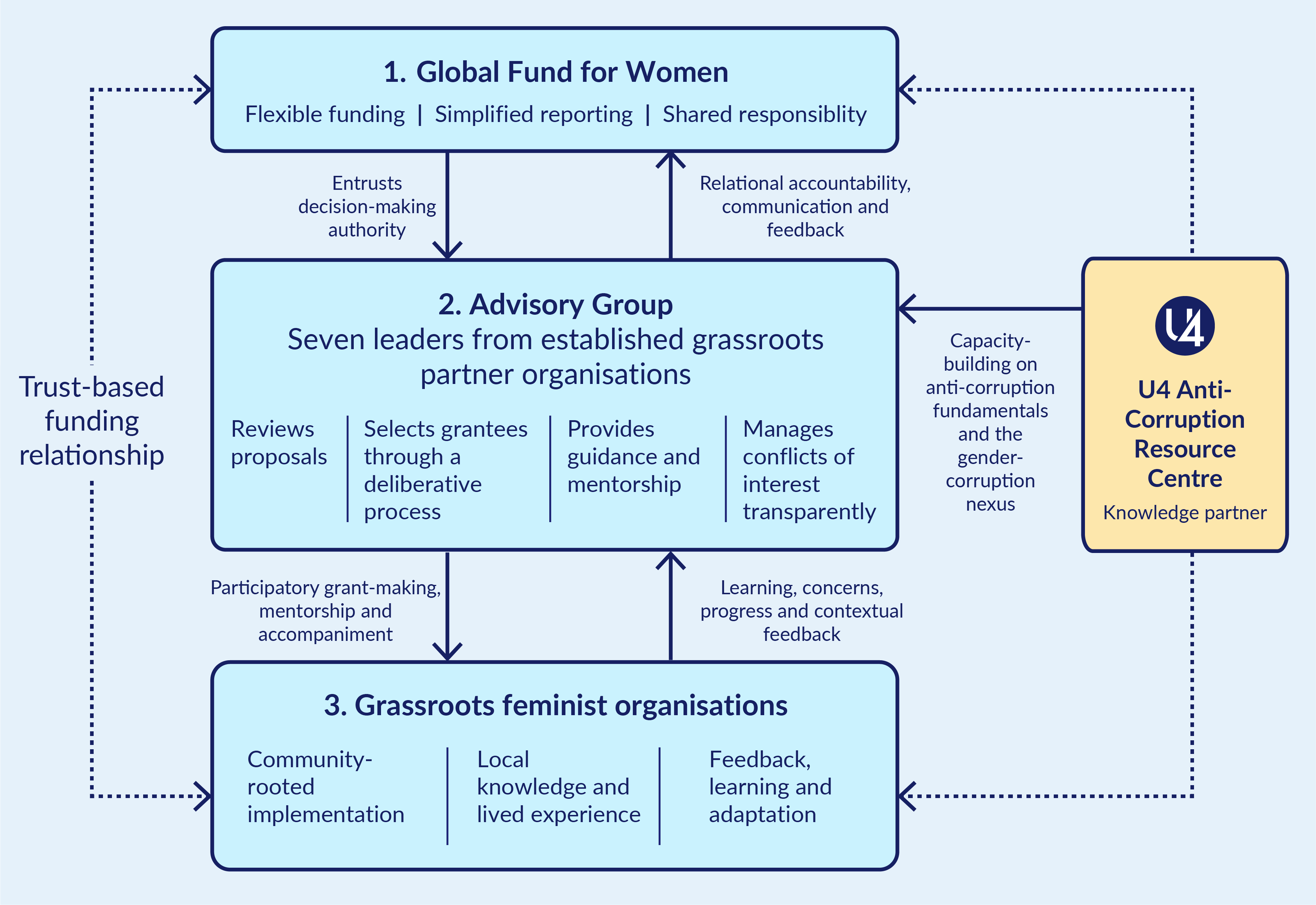
An Advisory Group of seven leaders drawn from established grassroots partners led participatory grant making and management for the project. The group reviewed proposals, selected grantees through a deliberative process, and subsequently mentored them, acting as a trusted intermediary between grassroots organisations and the funder. This arrangement made accountability more relational by placing decisions, dialogue, and ongoing support in the hands of people familiar with the organisations, communities, and political contexts involved. The U4 Anti-Corruption Resource Centre took part as knowledge partner, providing grounding in anti-corruption fundamentals and in the links between gender and corruption.
Placing grantee selection in the hands of people embedded in the same networks as applicants carried a risk of bias or favouritism. The project managed this through explicit conflict-of-interest protocols. Advisory Group members declared prior relationships with applicants in a face-to-face meeting, signed conflict-of-interest forms, and stepped aside from decisions where conflicts existed. In this way, the project placed formal safeguards within a broader trust-based accountability framework focused on creating a secure atmosphere in which problems could be anticipated and addressed candidly.
Figure 1. Relational accountability and participatory grant-making model
Feminist grassroots perspectives on corruption: discrimination, sexualised corruption, and repression
Corruption is often defined as the abuse of entrusted power for private gain. Anti-corruption analysis, law and policy often focus on private gain as financial and material benefits gained through bribes, embezzlement, fraud, conflicts of interest, and so on. This project recognised from the start that because entrusted power is exercised within existing power relations, power abuse affects women, Indigenous communities, refugees, and LGBTQ+ people in coercive and discriminatory ways. Where an official or gatekeeper controls access to services, documents, land, or protection, and where gender, ethnicity, poverty, or displacement weaken a person’s bargaining position, the corrupt exchange reflects that inequality: the demand may be for money or for sex, and interactions may involve stigma, violence, intimidation, or the threat of losing a service on which survival depends. At the same time, political and bureaucratic gatekeeping prevent organisations representing those affected by corruption from accessing the institutional mechanisms meant to address it.
Feminist grassroots organisations’ experiences and descriptions of corruption therefore reflected patterns of discrimination and exclusion, sexualised corruption, and the repression of civic space.
Corruption as discrimination and exclusion from rights, services, and resources
Feminist grassroots organisations understood corruption through everyday encounters with power in their communities. They described:
- Services being withheld unless money was paid or sexual demands were met.
- Public authority being used to exclude women and gender non-conforming people from documentation, land, healthcare, legal protection, or humanitarian aid.
- Regulatory systems being applied selectively against feminist organisations.
- Corruption as embedded in patriarchal, racist, and elitist power structures.
As one partner put it: ‘To me, corruption isn’t just embezzlement; it’s a lot more than that. It’s situations where women or girls are denied services unless they pay a bribe or partake in sexual favours.’
Organisations consistently linked corruption to barriers that prevent women, girls, gender non-conforming people, Indigenous communities, refugees, and other marginalised groups from accessing rights and resources. In Kenya, for example, a women-led network reported that corruption within land adjudication processes prevents women from securing ownership, reinforcing economic dependence. In Guatemala, they described how the diversion of public funds from health and social programmes deprives Indigenous women of essential services, deepening both gender and ethnic inequalities. In both Guatemala and Armenia, transgender communities face discrimination and hate speech, and meet significant difficulties in accessing basic public services. One participant shared: ‘Trans women often have to pay bribes to avoid military service or to receive medical care, and they are charged high fees for basic services that others receive for free or at regular prices.’
These experiences show corruption working through gendered and discriminatory power relations, enabled by violence and by administrative gatekeeping that is experienced as exclusionary and coercive. They are consistent with feminist political economy, which examines how governance systems are structured by gendered, racialised, and class-based power relations,4608131a5b88 and with work linking corruption to social injustice more broadly.07cb3b6f5c10 Earlier research showed that grassroots women locate corruption within a wider landscape of sexual exploitation, physical abuse, non-delivery of services, and extortion.e6cbee64cbc3
Research has also shown that corruption and discrimination can be mutually reinforcing, as discrimination makes some groups more exposed to corrupt demands, while corruption deepens unequal access to rights, services, and justice.f0d5d93de288 The perspectives from the community level emerging from the project further illustrate how discrimination and inequality are interlinked with the abuse of power. As one participant observed: ‘Corruption is so overwhelming – affecting every part of life – that it’s easy to forget how disproportionately it impacts women, and how deeply patriarchal elements are embedded within this culture of corruption.’
Sexualised corruption and other forms of gendered abuse and oppression
Bjarnegård et al. define sexual corruption as the abuse of entrusted authority through a quid pro quo exchange in which a service or benefit is conditioned on a sexual favour.c20db3ea2620 Several organisations identified sexual corruption as pervasive but often invisible, with officials, gatekeepers, service providers, and local authority officials exploiting gendered vulnerability to control access to services, protection, documentation, or assistance.
In Uganda, Indigenous Batwa women and girls, often displaced from ancestral lands, face particular risk of sexual exploitation compounded by discrimination in public services. One organisation noted that ‘the Batwa indigenous communities are exploited in all areas, including sextortion, labor, and without enough access to social services, while living in a tourism hotspot (...), which is the number one income generator in the region.’ Women in refugee camps in northern Uganda are also exposed to sexualised forms of corruption when accessing refugee assistance or seeking justice. These experiences are difficult to report because survivors may fear stigma, disbelief, retaliation, or the loss of the services they need.
Gendered power relations not only enable sexual corruption but also create risks for women who speak out against corruption of any kind. Rising femicide and sexual violence deter women from public advocacy in parts of Latin America. In Kenya, gender-based intimidation within community forums silences women’s voices. As one participant explained:
One of the most pressing and unexpected challenges has been the rising cases of femicide and GBV, which have instilled fear among young women. This climate of insecurity significantly limits their ability to engage in public forums, advocacy spaces, and anti-corruption efforts. The threat to their physical safety has created psychological barriers, discouraging many from speaking out or taking leadership roles within the movement.
Sexual corruption is therefore sustained not only by individual abuses of authority but by other factors that make reporting dangerous. These include dependency on services, fear of retaliation, social stigma, and the exclusion or sidelining of women and gender-diverse people from the spaces where corruption can be denounced or challenged. These experiences show that anti-corruption strategies should comprehensively address civic space issues and other factors that enable safe complaining and reporting.
Corruption, bureaucracy, and restricted civic space
Corruption is enabled by, and can itself contribute to, the restriction of civic space. Civil society is fundamental to anti-corruption work, yet civil society organisations often operate under repressive laws, opaque bureaucratic procedures, political interference, and the selective or abusive use of legal and regulatory tools.d51f988f011d Previous U4 research shows how lawfare, including restrictive laws, abusive lawsuits, false accusations, and the misuse of anti-money laundering and counter-terrorist financing rules, can be used to silence anti-corruption defenders and civil society organisations.2e9616464971 Tax authorities and audits may be misused to repress civil society and independent media, even though such measures can also be legitimate forms of oversight.447a800ed257
In Mexico, organisations reported that anti-money laundering regulations have been applied selectively to impose punitive audits on feminist organisations, constraining their operations. This followed the government’s designation of civil society organisations as ‘risk actors’, alongside for-profit enterprises engaged in gambling, precious stones trading, real estate, and armouring services, which has opened the door for anti-money laundering rhetoric to be used to limit human rights work in the country.
In Nepal, organisations explained how unclear administrative procedures compel civil society organisations to pay informal fees to access public funding or project approvals, and even after paying, they may wait months for funds. The Social Welfare Council, the government body responsible for approving NGO access to donations, frequently requires personnel to be invited to events or to receive gifts in order to disburse funds. This places a significant burden on all NGOs, especially rural and gender-diverse organisations that have less access to funding. Instruments for upholding integrity, such as audits, registration requirements, and financial regulation, can thus themselves be used to abuse entrusted power, with administrative systems used to restrict participation, weaken accountability, and punish organisations that challenge power.
Such risks are particularly acute in politicised and volatile contexts. In Armenia, anti-corruption advocacy during elections attracted hate speech and disinformation that marginalised feminist narratives. These campaigns raised the cost of speaking at the moment when public scrutiny of power mattered most and pushed feminist perspectives to the margins of national debate. Feminist grassroots organisations responded by changing strategy, partnering with other organisations to counteract harmful discourse.
In Syria, post-conflict volatility compelled feminist journalist organisations to suspend investigations and reorganise operations, while ensuring the safety and security of their staff and publications. As the country navigates a transitional phase following the fall of the Assad regime, one partner gave its Syria-based colleagues final say over sensitive publications, even though they are not formally part of its editorial management, so that those closest to the danger decided what could safely be made public.
In Guatemala, transgender activists faced online defamation, digital monitoring, and state-sponsored intimidation. Surveillance of this kind narrows the space in which corruption can be denounced, because every public statement must be weighed against the risk of retaliation.
In Mexico and Kenya, the dismantling of oversight institutions, the reduction of open data, and restrictive legal reforms have reduced civil society’s capacity to monitor corruption, as information becomes increasingly difficult to access and organisations operate in an increasingly hostile environment. As one participant noted: ‘In Kenya and elsewhere, because of corruption, open data that governments had signed on to share is no longer accessible. That access allowed us to quickly identify issues around healthcare, education, and budgets. Now, we can’t, and we’ve realized how deeply corruption has eroded those systems.’
These examples show that safe and open civic space is a precondition for anti-corruption work by making it possible to document wrongdoing, amplify the experiences of affected communities, and demand accountability without exposing grassroots organisations or the people they support to further harm. This understanding shaped the project’s approach to accountability and risk. Where corruption is experienced through discrimination, sexualised abuse of authority, bureaucratic gatekeeping, and civic repression, risk management should focus not only on proper grant management but should also include safety and care considerations. The next section explains how the project applied feminist principles of safety, care, flexibility, and relational accountability to manage risks and ensure project effectiveness and impact.
Feminist and trust-based approaches to corruption risk management
The project offers lessons about how funders and development partners can manage risk when supporting community-based organisations that work close to affected communities. International guidance encourages development actors to manage corruption risk while looking beyond narrowly fiduciary concerns,abe0e1fc7a80 and to simplify compliance in support of locally led development.40b2f9e34f9a Additionally, effective corruption risk management should combine compliance with values-based, integrity-centred approaches rather than relying on controls alone.19ec286c7285 Applying such guidance in practice with small organisations in volatile settings is a continuous challenge that the project addressed through flexible funding, relational accountability, community-centred methods, and collective action, safety, care, and psychosocial support; as well as proportionate controls and a carefully considered approach to misconduct allegations.
Flexible funding and adaptive management
Flexibility supported safety as well as effectiveness. As one participant reflected: ‘There were sudden shifts and events that required us to adapt our plans very quickly, and having the freedom to adjust our activities and budget accordingly was essential. It allowed us to stay effective despite the constant changes on the ground.’
In Syria, as post-conflict conditions shifted, one organisation had to suspend sensitive investigations and reorganise how it worked. Because the funding was flexible and the relationship was one of trust, it could decide quickly to grant local staff authority over which findings to publish and when, so that those closest to the risk retained control over their own exposure. A conventional grant, requiring prior approval for each change of plan, would have delayed decision-making and might have put people’s safety at risk. Adaptation of this kind sometimes revealed unexpected sources of protection. One Syrian participant observed that women’s visible leadership of the work itself reduced official scrutiny: ‘Somehow, that seems to be helping on the ground, because… there is less attention given to the work that women are doing, which is actually helping protect them from too much scrutiny and censorship.’ Flexible funding also helped organisations absorb sudden external shocks, including reductions in donor funding resulting from the closure of USAID, without abandoning their work. In hostile or fast-moving settings, the freedom to shift methods, locations, and timelines therefore functions as a safeguard for staff and communities.
Relational accountability
Accountability was grounded in regular telephone check-ins with Advisory Group members and in-person supervisory visits. These were not only compliance checks but occasions for dialogue, support, and learning, which allowed the project to respond quickly to internal grant management challenges as well as external threats. Because the relationship was not confined to monitoring, organisations could raise a difficulty without immediately fearing the withdrawal of support. The project’s experience suggests that this approach can surface problems earlier than periodic written reporting alone, although this claim would require more systematic testing before it could be generalised.
Community-centred methods
Some organisations used community dialogue, storytelling, theatre, and radio to raise corruption in ways that did not begin with a public accusation against a named official. This proved valuable where open confrontation could provoke backlash.
Theatre as a safe means of naming corruption
A group from Kenya shared: ‘One of our theatre outreaches portrayed the story of a woman denied justice due to bribery and connections. The play resonated deeply. After the performance, several audience members shared similar stories. This opened up a wider conversation with community leaders, and one woman who had stayed silent for years reported her case to authorities the following week, supported by our team.’
The performance made corruption visible without beginning from a formal complaint. It reframed a private grievance as something the community recognised as shared, which reduced the risk of retaliation against any single person for speaking out.
Collective action and partnerships for protection and leverage
Grassroots organisations rarely confront corruption from a position of institutional power, and partnerships helped to redress this. By connecting with human rights coalitions, journalist protection groups, and legal networks, organisations gained protection, legitimacy, and a platform for advocacy.
For example, in Mexico, a partner trained women leaders to identify and map corruption in their municipalities, develop proposals, and prepare to engage the relevant authorities, turning scattered complaints into organised advocacy. A feminist leader from Mexico recounted:
Our organisation conducted training with women leaders from across our region, which allowed us to identify cases of corruption in their municipalities. Once these situations were mapped out, we began generating proposals, and next month we are scheduled to meet with the authorities responsible for addressing these problems. In this way, we are challenging the corruption that has been plaguing our region.
This example shows how grassroots-based coalitions can use collective action to address corruption as structural and collective problem, as opposed to individual complaints that could expose people to retaliation. This allows feminist grassroots organisations to collectively carry the risk of retaliation, promoting the anonymity and safety of individual victims.
Safety, care, and psychosocial support
The project treated safety and care as central to corruption risk management, not just as separate safeguarding or wellbeing concerns. It invested in safety protocols, digital protection, confidential reporting channels, and access to psychosocial and legal support. These measures were co-designed with grassroots leaders in Kenya, Mexico, and other project countries so that they reflected the specific risks faced by feminist grassroots organisations in their own contexts, including surveillance, retaliation, stigma, administrative harassment, and threats to survivors or community members who spoke about abuse of power.a51606442389 The aim was not only to prevent financial misuse, but to create conditions in which organisations could document corruption, support affected people, and raise accountability concerns without exposing themselves or others to avoidable harm.
This approach reflects a feminist ethics of care, which understands responsibility as relational and contextual. Rather than relying only on abstract rules, formal procedures or after-the-fact sanctions, care ethics asks how institutions respond to vulnerability, dependency, unequal power, and the concrete circumstances in which people act.58904ee51152 Applied to anti-corruption work, this means recognising that the burden of accountability does not fall evenly. Grassroots feminist organisations may be expected to comply with donor rules while operating with limited staff, scarce funding, weak infrastructure, insecure legal status, and significant personal risk. A care-informed approach therefore asks how accountability can be effective without becoming extractive, punitive, or unsafe.
Joan Tronto’s account of the elements of care helps to explain how this worked in practice. For Tronto, good care requires attentiveness to need, responsibility for meeting it, competence in doing so, and responsiveness to how care is received.80bd03fdb845 Accordingly, attentiveness was reflected in regular relational contact with organisations, which helped identify concerns early and understand them in context. Responsibility was shared through the Advisory Group and mentorship relationships as participatory structures, rather than being located only in the donor–grantee compliance relationship. Competence involved supporting organisations to strengthen appropriate and proportionate systems for bookkeeping, audits, documentation, and internal decision-making, instead of assuming that smaller organisations should immediately meet the same administrative standards as larger NGOs. Responsiveness was built into the use of graduated responses, agreed in advance, so that problems could be addressed in ways that were fair, proportionate, and sensitive to the risks facing feminist grassroots organisations and communities.
Internal integrity and proportionate controls
The feminist grassroots organisations involved in the project were willing to strengthen their own transparency and controls, but they encountered practical barriers, notably limited technical capacity and high audit costs. With flexible funding, organisations in Kenya, Uganda, Nepal, and Guatemala improved their financial management, conducted audits, organised their accounting, and acquired basic equipment. These changes made them more transparent and more credible. Internal controls should therefore be proportionate to an organisation’s capacity and risk. Small groups need simple systems that reduce reliance on individual discretion and make disclosure straightforward. Excessive surveillance or unrealistic documentation requirements may produce the appearance of accountability while weakening the work that accountability is meant to protect, a pattern documented in wider critiques of results-driven and paperwork-heavy aid administration.*
For funders, a care perspective does not imply lower standards; rather, it recognises that accountability is most effective when it is adapted to context, protects those facing the greatest risks, and strengthens the capacity of grassroots organisations over time. In dangerous and politically constrained environments, this matters for the effectiveness and legitimacy of anti-corruption measures.
Addressing misconduct in trust-based relationships
Critics of trust-based philanthropy argue that reduced oversight can create room for misallocation or fraud.8448a3ed3cd5 Trust-based approaches therefore cannot assume that grantees will always act appropriately. Trust will sometimes be violated, and any funding model that does not address that possibility remains incomplete. At the same time, proponents of trust-based philanthropy are right to emphasise that trust does not mean the absence of accountability. Relational accountability can, in some circumstances, reveal concerns earlier than periodic compliance checks, because it creates regular contact, contextual knowledge, and channels through which problems can be discussed before they escalate.6ab97fa8e5ff
The difficulty is that while much of the trust-based philanthropy literature focuses on how to build relationships, simplify compliance, and end grants respectfully when strategic priorities change,120366b48a61 it pays less attention to what funders should do when a grantee is found to have engaged in fraud, financial misconduct, or a serious ethical breach. This is a significant gap, as funders need procedures that protect fiduciary responsibilities, ensure fairness to the organisation concerned, and avoid disproportionate harm to the communities or movements that depend on the grantee’s work. They also need ways to distinguish deliberate abuse from irregularities that arise from weak systems, contextual pressure, coercion, insecurity, or differing norms around documentation.
These issues are particularly acute for feminist funders working with grassroots organisations in fragile, conflict-affected, or politically repressive contexts. In such settings, organisations may face extortion, informal fees, coerced payments, administrative harassment, or sudden security threats. These conditions can blur the line between victimisation, survival strategies, and complicity. A feminist ethics of care does not excuse misconduct, but it does require responses that are contextual, proportionate, and oriented towards accountability rather than punishment alone. It also recognises that funders have obligations not only to their own donors, but also to other grantees, affected communities, and the integrity of the wider funding ecosystem.
Through the project, Global Fund for Women developed guidelines on how organisations can develop feminist approaches to anti-corruption. These guidelines offer a practical way to address misconduct within a trust-based funding model, through:
- Transparent investigation processes that protect the dignity of all parties.
- Graduated responses that distinguish minor irregularities from serious fraud.
- Opportunities for remediation where appropriate.
- Clear communication when relationships must end.
- Attention to the consequences of termination for staff, communities, and movements beyond the organisation itself.
They illustrate that trust-based funding and corruption risk management can complement each other. With appropriate safeguards, they can be combined in a more humane, proportionate, and contextually grounded approach to accountability.
Beyond the project: practical lessons for policy, practice, and research
The project offers some lessons about strengthening the role of grassroots feminist organisations in anti-corruption initiatives and designing context-and gender-responsive corruption risk management systems. It also raises interesting hypotheses that could be the subject of further research as explained below.
Recognising and strengthening the role of grassroots feminist organisations as accountability actors
Grassroots feminist organisations often work in places where formal accountability institutions are absent, distrusted, unsafe, or inaccessible. Yet they may also be excluded from funding because they cannot meet audit-readiness thresholds designed for larger organisations, or because banking, due diligence, and registration requirements treat smaller or politically exposed groups as high risk.657dd1064bd0 More broadly, feminist organising remains chronically under-resourced, despite repeated commitments to fund it more sustainably.*
The project shows grassroots feminist organisations doing anti-corruption work through documentation, community monitoring, referral mechanisms, survivor support, sport, theatre, outreach, research, and data collection. These approaches may not always look like conventional anti-corruption programming, but they can provide accountability routes where formal systems are inaccessible or unsafe. Funders and development partners should therefore support these organisations not only as beneficiaries, but as accountability actors, in line with UNCAC–COSP Resolution 10/10, which encourages engagement with women’s organisations in anti-corruption work.1ff8143f2ac2
Designing flexible, proportionate and safe systems for managing corruption risks
Flexible funding does not have to mean weak corruption risk management and accountability. It works best when paired with clear guardrails, conflict-of-interest protocols, basic financial management systems, confidential reporting channels, appropriate documentation, and graduated responses to misconduct agreed before problems arise.c7b787a1a6aa The aim is not to weaken accountability, but to make it realistic, safe, and effective for organisations operating in fragile, volatile, or repressive settings.
A do-no-harm approach to compliance and due diligence requires funders to consider who carries the burden of compliance, whose safety may be affected by documentation or reporting, and whether oversight mechanisms strengthen or undermine grassroots organisations. In dangerous environments, integrity should be based on proportionate demands, safe reporting channels, flexible responses, and relationships that allow problems to be raised without fear. This also means applying a presumption of investigation before sanction, distinguishing between deliberate abuse and situations involving coercion or extortion, and assessing the likely consequences of funding termination for staff and for the communities the organisation serves.
A learning and research agenda for feminist anti-corruption practice
U4 Practice Insights are not evaluations or objective assessments. They allow practitioners to share lessons from their own vantage point. Both authors are connected to the institutions whose work is described here: Global Fund for Women and U4 Anti-Corruption Resource Centre. The examples should therefore be read as illustrative, and the lessons as working hypotheses for further testing rather than findings that can be generalised.
Some of the lessons that merit further research include whether relational accountability can indeed detect misconduct and operational problems earlier than periodic written reporting alone, and whether flexible funding in volatile contexts can reduce, rather than increase, fiduciary risk by allowing partners to adapt openly when circumstances change.
Conclusion
The feminist grassroots organisations’ accounts show corruption operating as an abuse of entrusted power, exercised in coercive and discriminatory ways that reinforce existing inequality. They also show communities finding ways to name, navigate, and resist corruption where formal institutions are absent, unsafe, or unable to help.
The participants in the learning project understand corruption because they live with it. They must obtain services, documents and protection from the same systems that seek to exploit them. For them, the costs of speaking out are often personal and immediate. Support for them must pay attention to who carries risk, whose knowledge counts, and what forms of accountability are both effective and safe.
The project shows how feminist principles can be applied in practice: through flexible funding, proportionate compliance, relational accountability, care, and psychosocial support, and by recognising and resourcing grassroots organisations as accountability actors in their own right.
- Global Fund for Women 2024.
- Batliwala 2012.
- GBV AoR and Trócaire 2023; IASC 2024
- Global Fund for Women 2024.
- Nazneen and Sultan 2009.
- Morena, Michaeli, and Staszewska 2025.
- Canadian Women’s Foundation, Community Foundations of Canada and Equality Fund 2020.
- Trust-Based Philanthropy Project 2021; Bearman 2008.
- Morena, Michaeli and Staszewska 2025; Dobson 2019.
- Roberts and Elias 2016.
- Sumpf 2015.
- UNDP and Huairou Commission 2012.
- You and Khagram 2005; Transparency International and Equal Rights Trust 2021.
- Bjarnegård et al. 2024.
- CIVICUS 2024; Katusiimeh and Bekoreire 2025.
- Lemaître 2022.
- Maslen 2024.
- OECD 2024.
- OECD 2016.
- Nicaise 2023.
- Front Line Defenders 2011.
- Gilligan 1982; Tronto 1993; Held 2006; Razavi 2007.
- Tronto 1993.
- GHJ Advisors 2024.
- Trust-Based Philanthropy Project 2023.
- Norris 2018; Trust-Based Philanthropy Project 2021.
- FATF 2023.
- UNCAC-COSP 2023.
- Strand 2020.