PublicationsThe U4 Blog
U4 Practice Insight

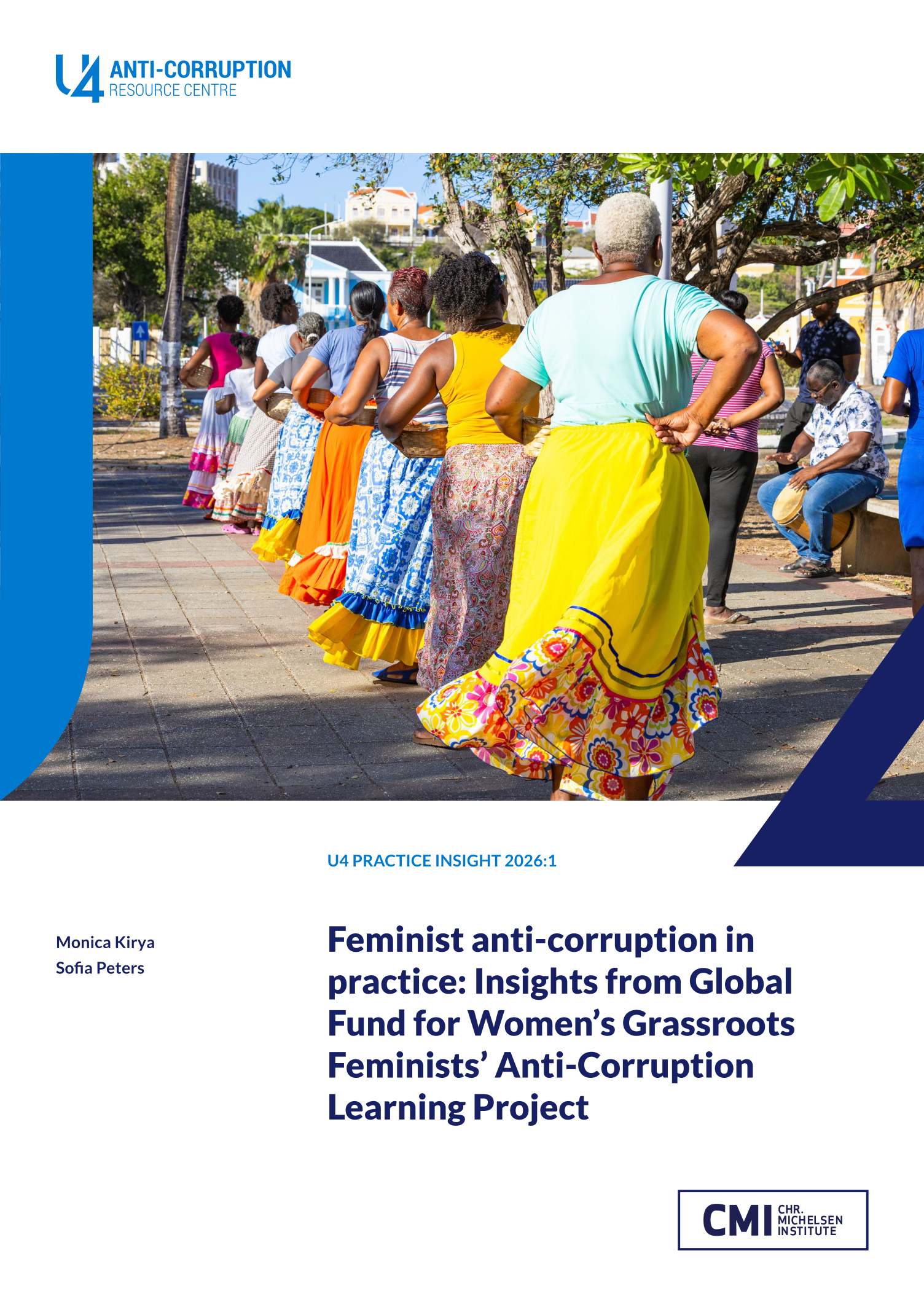
Feminist anti-corruption in practice: Insights from Global Fund for Women’s Grassroots Feminists’ Anti-Corruption Learning Project

Between 2023 and 2025, Global Fund for Women worked with grassroots feminist organisations in ten countries to learn how they understand and confront corruption. Partners described it as a coercive and discriminatory exercise of entrusted power, demanding responses attentive to the safety of survivors. Trust-based funding and relational accountability sustained this work in volatile settings. The project draws practical lessons for gender-responsive anti-corruption at community level.

13 August 2026
Read onlineDownload PDF
Feminist anti-corruption in practice: Insights from Global Fund for Women’s Grassroots Feminists’ Anti-Corruption Learning Project

Main points

  • International guidance increasingly calls for context-sensitive, gender-responsive and locally-led approaches to anti-corruption. Global Fund for Women Grassroots Feminist Anti-Corruption Learning project illustrated a practical way of doing this – it was grounded in the lived experiences of those most affected by corruption and attentive to power dynamics at community level.
  • Grassroots feminist organisations experience corruption as an abuse of entrusted power exercised in coercive and discriminatory ways such as sexual corruption, extortion, the denial of services, and bureaucratic or political gatekeeping. In many contexts these practices are connected to violence, intimidation, and exclusion.
  • These organisations are accountability actors in their own right. They document, monitor, refer cases, and support survivors, and they use methods such as theatre, sport, and community dialogue to name and resist corruption where formal institutions are absent, distrusted, or unsafe to approach.
  • Flexible, unrestricted funding allowed organisations to adjust activities, budgets, and timelines in accordance with changing political and security conditions. This helped to protect continuity and safety in volatile environments.
  • Relational accountability, built through regular contact, mentorship, and shared responsibility, created conditions in which participating grassroots organisations could raise difficult questions about governance and grant management openly. This might not have been possible with written reporting alone.
  • Trust-based funders working in fragile contexts should agree in advance on graduated and fair responses to suspected misconduct, attentive to the wider harm that abrupt or punitive funding decisions can cause to staff and communities.


Cite this publication


Kirya, M.; Peters, S. 2026. Feminist anti-corruption in practice: Insights from Global Fund for Women’s Grassroots Feminists’ Anti-Corruption Learning Project. Bergen: U4 Anti-Corruption Resource Centre, Chr. Michelsen Institute (U4 Practice Insight 2026:1)

Read onlineDownload PDF

About the authors

Monica Kirya is a lawyer and scholar-practitioner working at the intersection of anti-corruption, gender justice, and institutional reform. She is Deputy Director and Principal Adviser at the U4 Anti-Corruption Resource Centre, and holds a PhD from the University of Warwick, UK.

Sofia Peters

Sofia Peters is a Senior Programs Officer at Global Fund for Women, based in Bogotá, Colombia, where she leads work on sexual and reproductive justice and anti-corruption. Since 2023, she has coordinated the Feminist Anti-Corruption Learning project. She holds an MA in Education, Gender, and International Development from University College London, and has previously worked on refugee inclusion and civil society initiatives across Latin America.

Disclaimer


All views in this text are the author(s)’, and may differ from the U4 partner agencies’ policies.

This work is licenced under a Creative Commons Attribution-NonCommercial-NoDerivatives 4.0 International licence (CC BY-NC-ND 4.0)

Photo


Photo:
Sergii Zhmurchak
COPYRIGHTED