PDF
Main points
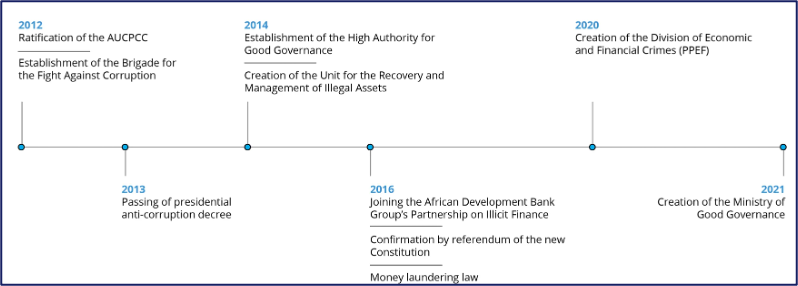
- Since the end of the 2010-2011 conflict, Côte d’Ivoire has achieved substantial political stabilisation and rapid economic growth, supported by large infrastructure investments, economic reforms and increased foreign investment. It has also strengthened its formal governance framework through new anti-corruption institutions, legislation and strategies.
- While the country has avoided renewed large-scale conflict and relaxed some exclusionary citizenship rules, the concentration of power under the president, the exclusion of leading opposition candidates and the governing party’s electoral dominance have increasingly restricted meaningful political competition.
- A substantial gap persists between formal reforms and their enforcement. Relatively few corruption allegations, particularly those involving senior or politically connected figures, result in prosecution or sanctions, while perceptions of selective enforcement, fear of retaliation and doubts that authorities will act continue to undermine public confidence in anti-corruption institutions.
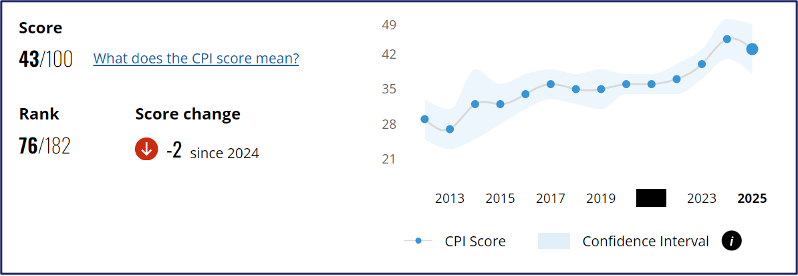
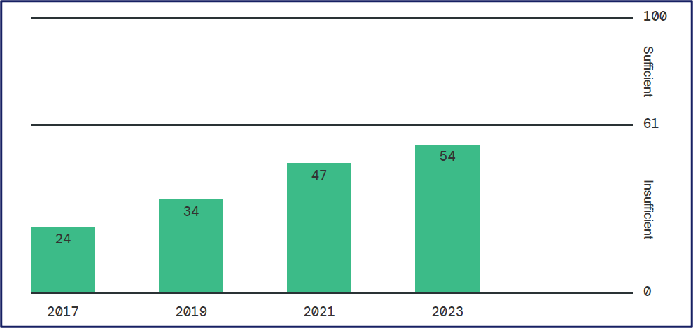
- Available international indices indicate overall progress in controlling corruption, although improvements have been uneven. At the same time, public-opinion and business surveys continue to reveal widespread perceptions of institutional corruption, limited confidence in reporting mechanisms and serious concerns about the impact of corruption on the business environment.
- Bribery in Côte d’Ivoire affects interactions between citizens, businesses and public officials across numerous sectors, ranging from informal payments for routine services to larger schemes intended to obtain regulatory or commercial advantages.
- The embezzlement and misappropriation of public resources in Côte d’Ivoire involve officials at different levels, including senior officeholders and managers of public entities, although the political sensitivity of some prosecutions has raised concerns about selective and politicised enforcement.
- In the police and security sector in Côte d’Ivoire, corruption ranges from routine extortion at checkpoints to organised misconduct involving illicit markets and the diversion of seized goods, with evidence suggesting hierarchical pressure and uneven accountability for senior officers.
- In the customs and tax administration in Côte d’Ivoire, corruption risks arise in routine encounters with businesses as well as through more complex manipulation of customs clearance, cross-border trade and tax-relief procedures, while limited transparency about investigations weakens accountability.
- Judicial corruption risks in Côte d’Ivoire include informal payments, susceptibility to bribery and political interference, selective enforcement and limited transparency surrounding investigations and judgements, all of which undermine public confidence in the country’s justice system.
- Despite reforms to the procurement framework which have strengthened the regulatory and institutional framework, non-competitive procedures, official discretion, overlapping institutional responsibilities and inadequate oversight continue to create opportunities for favouritism, corruption and the misuse of public funds in Côte d’Ivoire.
- Côte d’Ivoire has developed an extensive anti-corruption framework comprising specialised laws, oversight bodies, investigative institutions, reporting platforms and financial crime agencies. However, its effectiveness is constrained by limited institutional independence of HABG and ARCOP and resources, weak coordination and inconsistent follow-up on investigations, audit findings and recommendations. The effectiveness of the system could be enhanced through better coordination among relevant institutions, strengthening of their capacity and resources, clarification of responsibilities and more systematic follow-up on the outcomes of investigations and audits.