PublicationsThe U4 Blog

U4 Issue

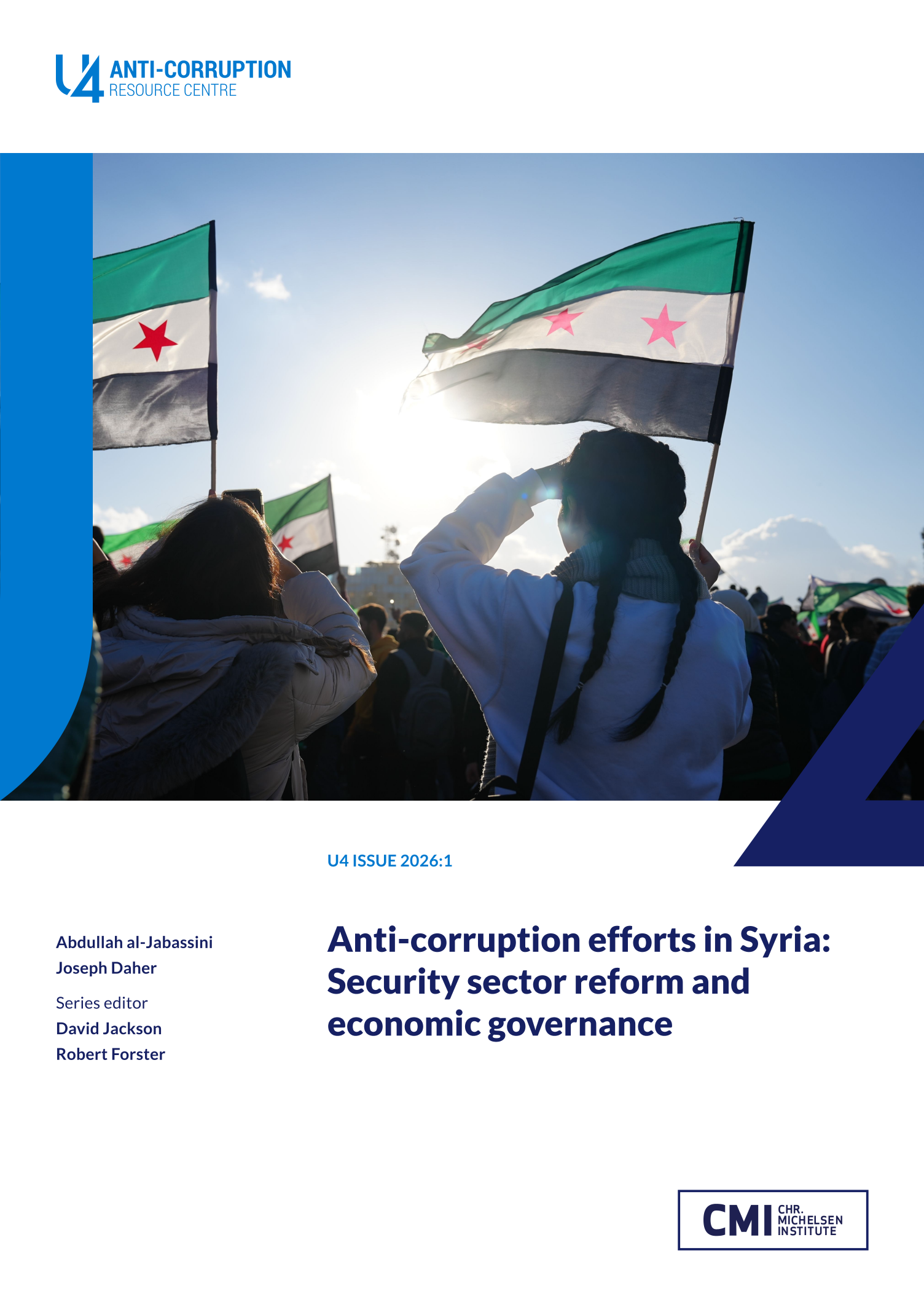
Anti-corruption efforts in Syria: Security sector reform and economic governance

To create and implement meaningful anti-corruption reform, the Syrian Transitional Government (STG) should focus on strengthening institutional capacity, accountability, and civic participation in the security and economic sectors, where decision-making remains concentrated, transparency is uneven, and public participation is limited.

2 February 2026
Read onlineDownload PDF
Anti-corruption efforts in Syria: Security sector reform and economic governance

Main points

  • Despite early commitment to transparency, accountability, and justice, the new Syrian Transitional Government (STG) faces the challenge of translating rhetoric into tangible institutional reform.
  • Our findings highlight trends and practices in reform in the security sector and economic governance.
  • While the MoI has attempted to position civil participation as part of its reform portfolio, the MoD has largely avoided inclusion.
  • In the economic sector, the current concentration of power centralises decision-making in the hands of the president and his close affiliates.
  • While some transparency initiatives have emerged, it remains unclear how to incorporate public input into decision-making. Questions remain about the independence and representativeness of key economic institutions.
  • Patterns of elite capture and favouritism have emerged. There are issues around former regime affiliates and how they have reconciled with the new authorities. Some remaining links to the former regime have seen no legal action and remain unprosecuted for economic crimes.
  • New economic institutions concentrate power within the presidency, and limit independent oversight.
  • Other ministerial responsibilities have shifted to the presidency, consolidating decision-making authority in the hands of the president and his close affiliates – including the president’s brother, former Syrian caretake government ministers, and other individuals linked to the Hayat Tahrir al-Sham network.
  • To enhance the credibility, effectiveness, and sustainability of anti-corruption initiatives, the STG should focus on reforms that strengthen institutional capacity, formalise accountability, and expand genuine civic participation.


Cite this publication


al-Jabassini, A.; Daher, J. 2026. Anti-corruption efforts in Syria: Security sector reform and economic governance. Bergen: U4 Anti-Corruption Resource Centre, Chr. Michelsen Institute (U4 Issue 2026:1)

Read onlineDownload PDF

About the authors

Abdullah al-Jabassini

Abdullah al-Jabassini holds a PhD in International Relations from the University of Kent in Canterbury, UK. He is a Postdoctoral Fellow at the Central European University in Vienna, Austria, a Visiting Fellow at the European University Institute in Florence, an Associate Fellow at the Middle East Institute in Washington DC, and an Associate Researcher at the Bonn International Centre for Conflict Studies. Al-Jabassini specialises in research on political violence, wartime social order, authoritarian conflict management, peacebuilding and reconciliation, and security sector reform.

Joseph Daher

Joseph Daher holds a PhD in Development Studies from the School of Oriental and African Studies, University of London and a PhD in Political Science from the University of Lausanne, Switzerland. He is an Associate Researcher at the Bonn International Centre for Conflict Studies. Daher specialises in the political economy, with a focus on neoliberalism, development, sectarianism, and political Islam in Syria and the Middle East.

Disclaimer


All views in this text are the author(s)’, and may differ from the U4 partner agencies’ policies.

This work is licenced under a Creative Commons Attribution-NonCommercial-NoDerivatives 4.0 International licence (CC BY-NC-ND 4.0)

Photo


Photo:
Mohammad Bash/Shutterstock
COPYRIGHTED