Ukraine must encourage broad-based domestic ownership of an open and collaborative policy arena to ensure sustainable anti-corruption progress.
Blog
Four scenarios for Ukraine’s anti-corruption future
Ukraine’s anti-corruption reforms cannot be understood as a straightforward march towards functioning institutions. Their future depends on who shapes the policy arena and how open it remains.
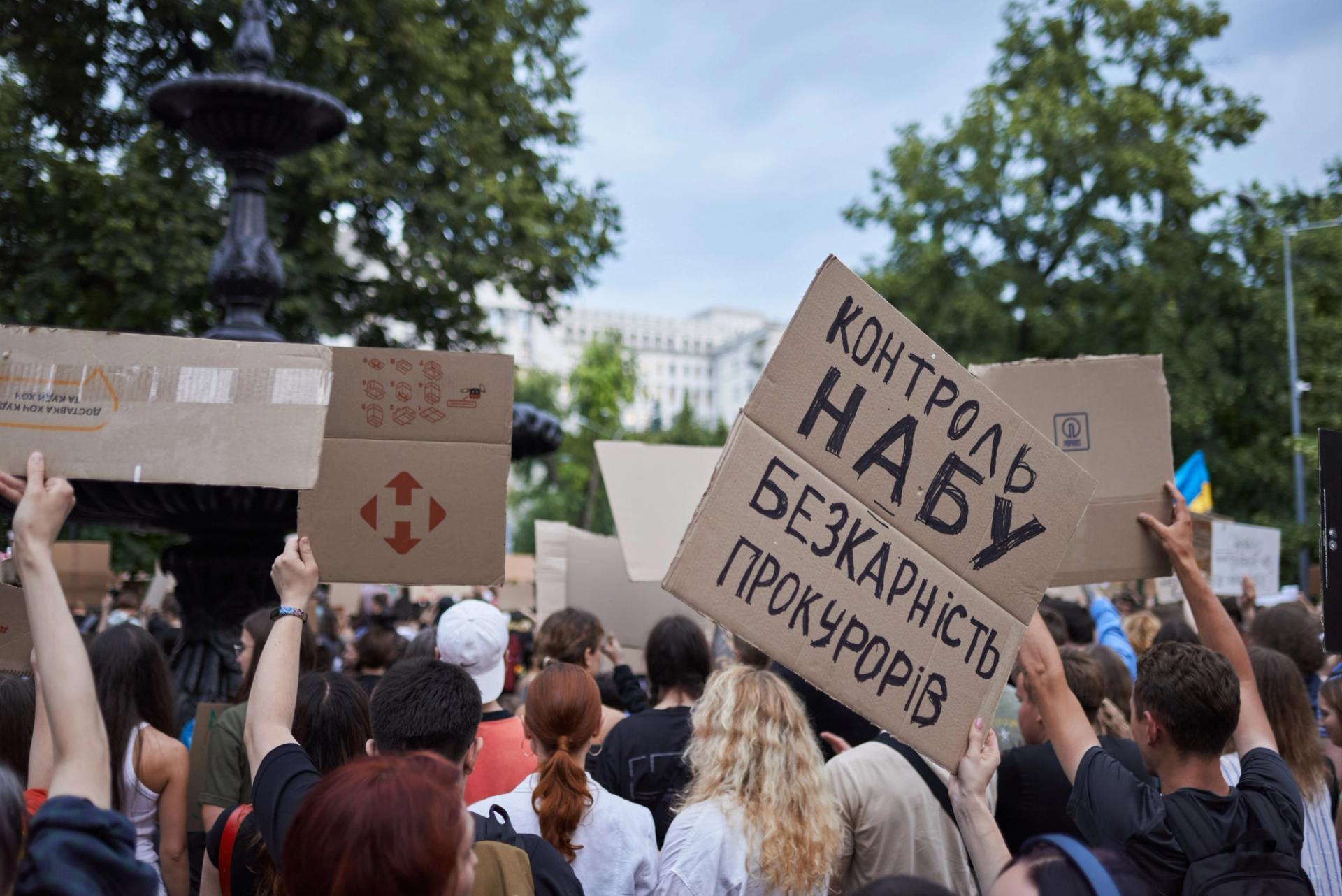
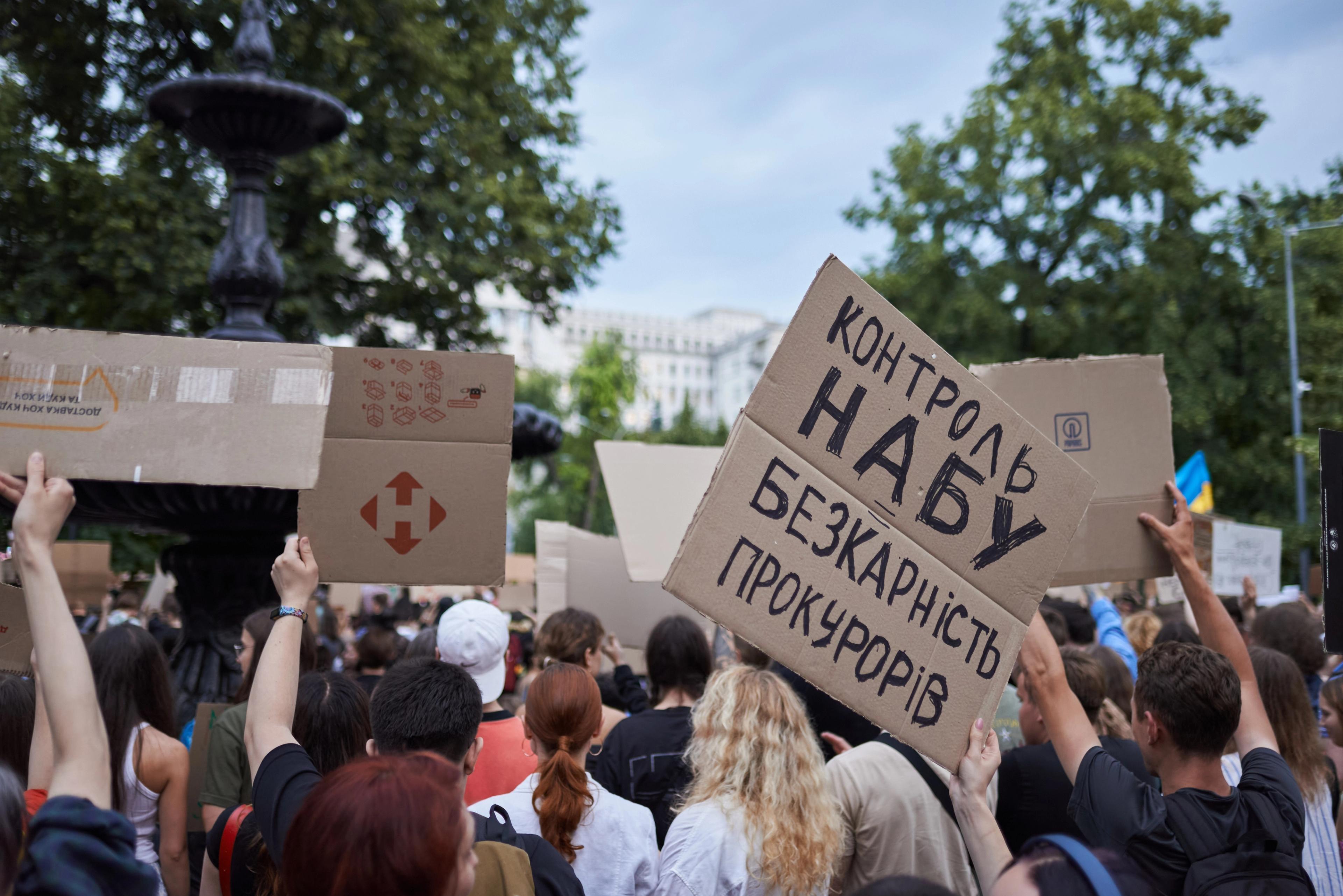
Ukraine's anti-corruption progress could be assessed through the 'health of the anti-corruption policy arena' by examining whether anti-corruption is becoming embedded in Ukrainian society rather than remaining a series of externally driven compliance exercises. Photo:
Vitaliy Holovin/Shutterstock.com
COPYRIGHTEDUkraine has made remarkable anti-corruption progress during wartime. New institutions have matured, legal frameworks have expanded, and EU accession has created strong incentives for further reform. Yet none of this means progress will continue in a straight line.
Anti-corruption reform is never complete. Institutions need political protection, public legitimacy, capable staff, resources, and constant renewal. War adds pressure by concentrating executive power, limiting transparency, and pulling people and resources towards national survival. International support is also less predictable than it was a few years ago.
Given this uncertainty, with colleagues Oksana Huss and Oleksandra Keudel, we have envisioned in the June 2026 paper Sustaining Ukraine’s anti-corruption future the different ways anti-corruption in Ukraine may play out.
[This blog post has also been published in Ukrainska Pravda.]
The policy arena perspective: looking beyond the reform checklist
To do this, we shift the perspective from tracking implementation to understanding the broader policy arena in which these reforms are made.
The conventional way to assess anti-corruption progress amongst Ukraine’s international backers is to understand progress via the completion of reforms tasks. Review reports ask: Has a law been adopted? Has a new agency been created? To what extent has Ukraine met an international benchmark? This approach is useful because it gives governments and international partners concrete measures of progress. But it can imply that reform follows a steady path towards a known destination.
The reality is more political and less predictable. Laws can exist but be weakly implemented. Agencies can retain formal independence while losing influence. Reforms to organisations can meander, resulting in superficial change.
Implementation and functioning institutions depend on social and political foundations. The policy arena perspective can help understand the robustness of these. Instead of asking what reforms have been adopted, a policy arena perspective says reforms reflect who shapes the system, whose ideas count, where power sits, and how adaptable the overall policy making and implementation process is when facing evolving challenges.
Since 2014, Ukraine’s anti-corruption policy arena has expanded into a diverse system linking specialised institutions, government bodies, civil society, local authorities, international partners, and political decision makers across enforcement, prevention, public finance, service delivery, and reconstruction. Two forces shape the type of policy arena.
Legitimate political interference and openness matter most
The first is political interference. Some political involvement is normal and legitimate. Elected leaders set priorities and make choices. Problems arise when power is used to protect allies, target opponents, weaken independent bodies, bend procedures, or restrict resources.
The second is openness. An open policy arena allows institutions, civil society, journalists, businesses, experts, local authorities, and citizens to influence debate. Competing ideas can be tested and challenged. A closed arena concentrates influence among a smaller group and makes adaptation harder.
Figure 1. Ukraine’s possible anti-corruption futures will be defined by the level of political interference and the level of openness
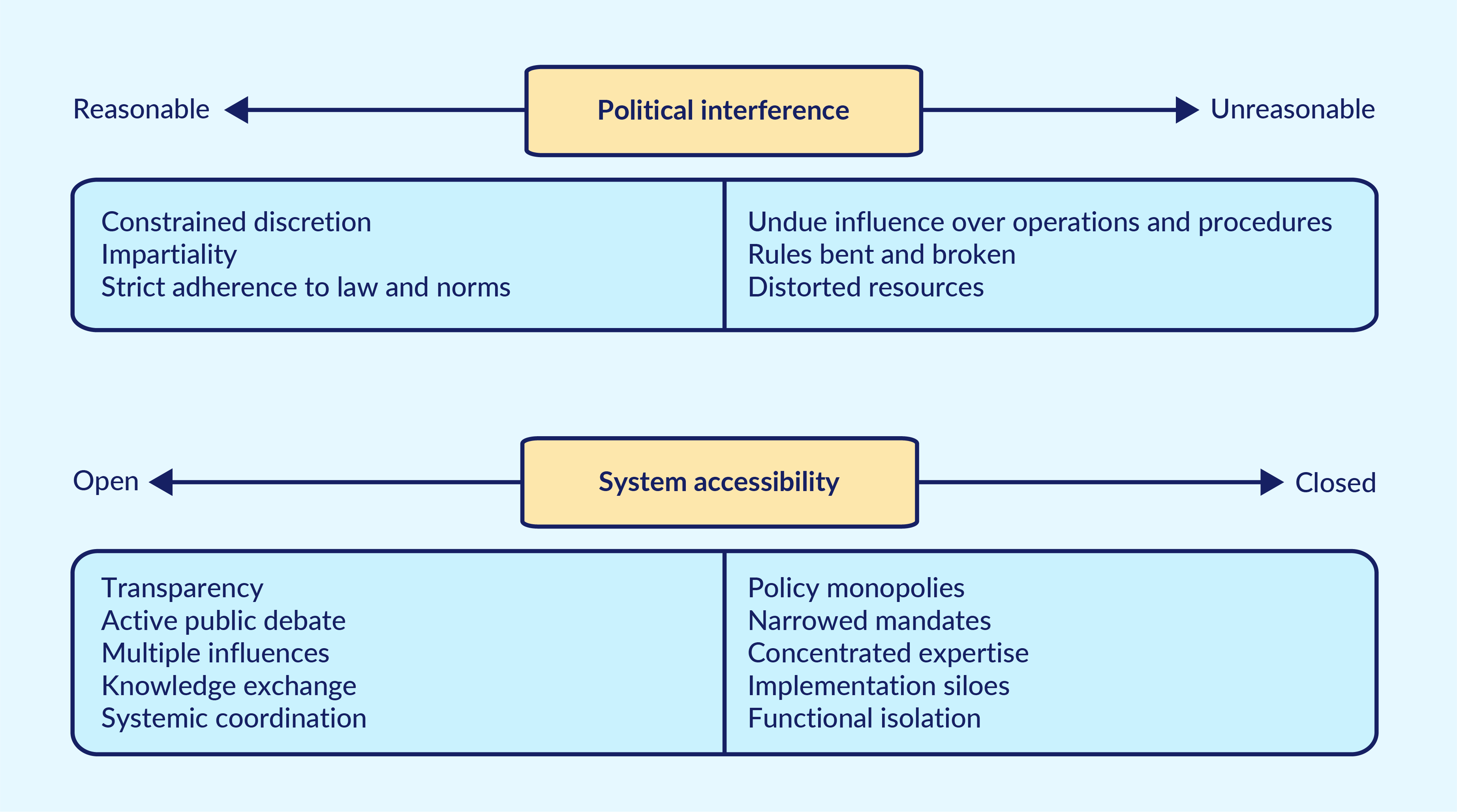
Based on these dimensions of political interference and openness, we have imagined four different policy arena scenarios. These are not predictions. Ukraine can contain elements of several scenarios at once. The usefulness of this framework it that it can make different directions visible before they become entrenched.
Figure 2. There is one desirable policy arena for Ukraine’s anti-corruption future – and three that should be avoided
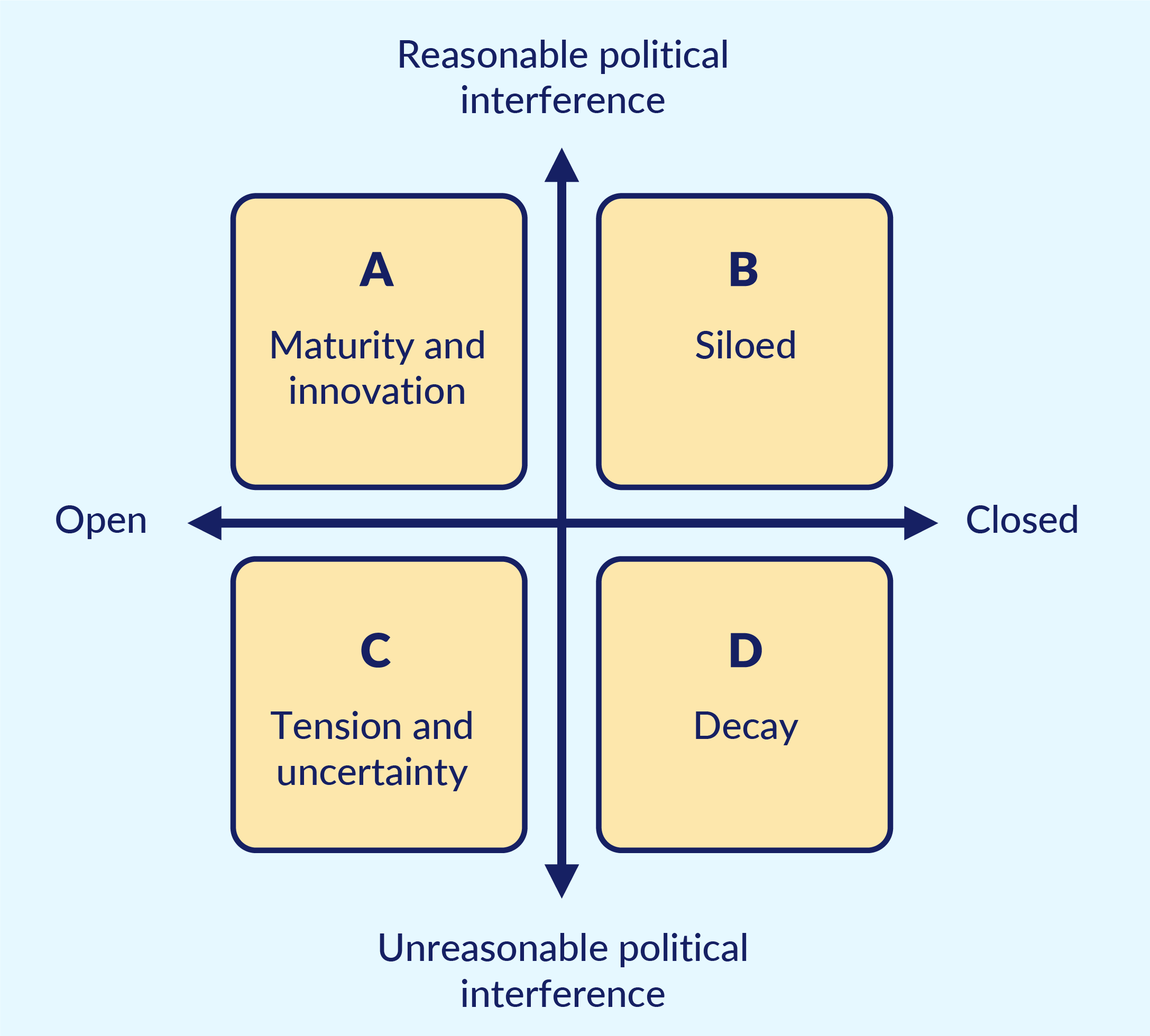
Maturity and innovation
This is the most sustainable future when openness is high and political interference is low. Anti-corruption institutions are independent, trusted, and able to influence the wider state. Integrity becomes part of reconstruction, public finance, sector policy, local government, and public services.
- Reform is no longer mainly about meeting external benchmarks.
- Ukraine starts generating approaches that others can learn from.
- Citizens see more evidence that rules apply and that reporting wrongdoing can matter.
Siloed
Here, Ukraine keeps much of the formal reform architecture, but anti-corruption institutions are increasingly isolated as the policy arena becomes closed. They may still perform their mandates, yet struggle to change how ministries, reconstruction, public services, or local government work.
- EU related reforms continue, but become more technical and detached from wider political and social processes.
- Anti-corruption work survives, but its broader impact weakens.
Tension and uncertainty
This is an open but highly contested arena with a high degree of politicisation. Civil society, media, institutions, and political actors remain active, but each reform becomes a struggle.
- Progress is possible, but depends on shifting coalitions, public mobilisation, and individual leaders.
- Trust rises and falls with each scandal or court decision.
- The system remains alive, but maintaining progress is costly.
Decay
This is the most damaging scenario. Formal institutions and reform language remain, but their substance is hollowed out as more political control is accompanied by gradual side-lining of social voices.
- Independent bodies are constrained, appointments become politically controlled, and enforcement becomes selective.
- Reconstruction and public spending become more vulnerable to rent seeking.
- International engagement may continue, but mainly as a source of legitimacy rather than meaningful pressure.
What does this mean practically?
One task is analytical. Ukraine’s anti-corruption progress should not be judged only by how many reforms it completes, and the European Commission could reflect this in its accession monitoring. Alongside legal benchmarks and enforcement statistics, its annual assessment could include a ‘health of the anti-corruption policy arena’ test:
- Are independent institutions genuinely protected from political interference?
- Are civil society, businesses and citizens increasingly involved in shaping and monitoring reform?
- Does the system respond when wrongdoing is exposed; and is anti-corruption becoming something Ukrainians themselves demand and use?
These are indicators of whether anti-corruption is becoming embedded in Ukrainian society rather than remaining a succession of externally driven compliance exercises.
A second task is to ensure that there is a balance of attention between technical aspects and the social and political underpinnings of reform. The strategic task is to keep the arena open, connected, and politically resilient.
Achieving that leads to a focus on finding initiatives and policies that broaden domestic ownership. The biggest long-term risk is not simply that Ukraine stops reforming, but that anti-corruption efforts become isolated from the wider state and society. An important aspect of this is that Ukraine needs a shared domestic vision of what anti-corruption reforms are ultimately for.As ‘zero tolerance’ has lost some of its force as a unifying normative goal, especially in the face of the security threat, Ukrainian society has not yet articulated a new, common framework to guide institution building, democratic consolidation, and resilience in wartime.
U4 has written elsewhere how domestic ownership can be achieved through a focus on norms and cultural spaces.Theatres, libraries, and community art centres across Ukraine are doing serious anti-corruption work. International donors should recognise and support these efforts, as they offer a route to lasting change. Anti-corruption efforts also need to reach further into sectors that shape everyday life, such as housing, energy, education, and reconstruction. Sectoral approaches are emerging but more needs to be done.
Participation must broaden too. Civil society organisations remain vital, but businesses, professional groups, experts, officials who support reform, and community organisations also need meaningful routes into the policy arena. International partners should support this process rather than substitute for it.
Disclaimer
All views in this text are the author(s)’, and may differ from the U4 partner agencies’ policies.
This work is licenced under a Creative Commons Attribution-NonCommercial-NoDerivatives 4.0 International licence (CC BY-NC-ND 4.0)