PublicationsThe U4 Blog

U4 Issue

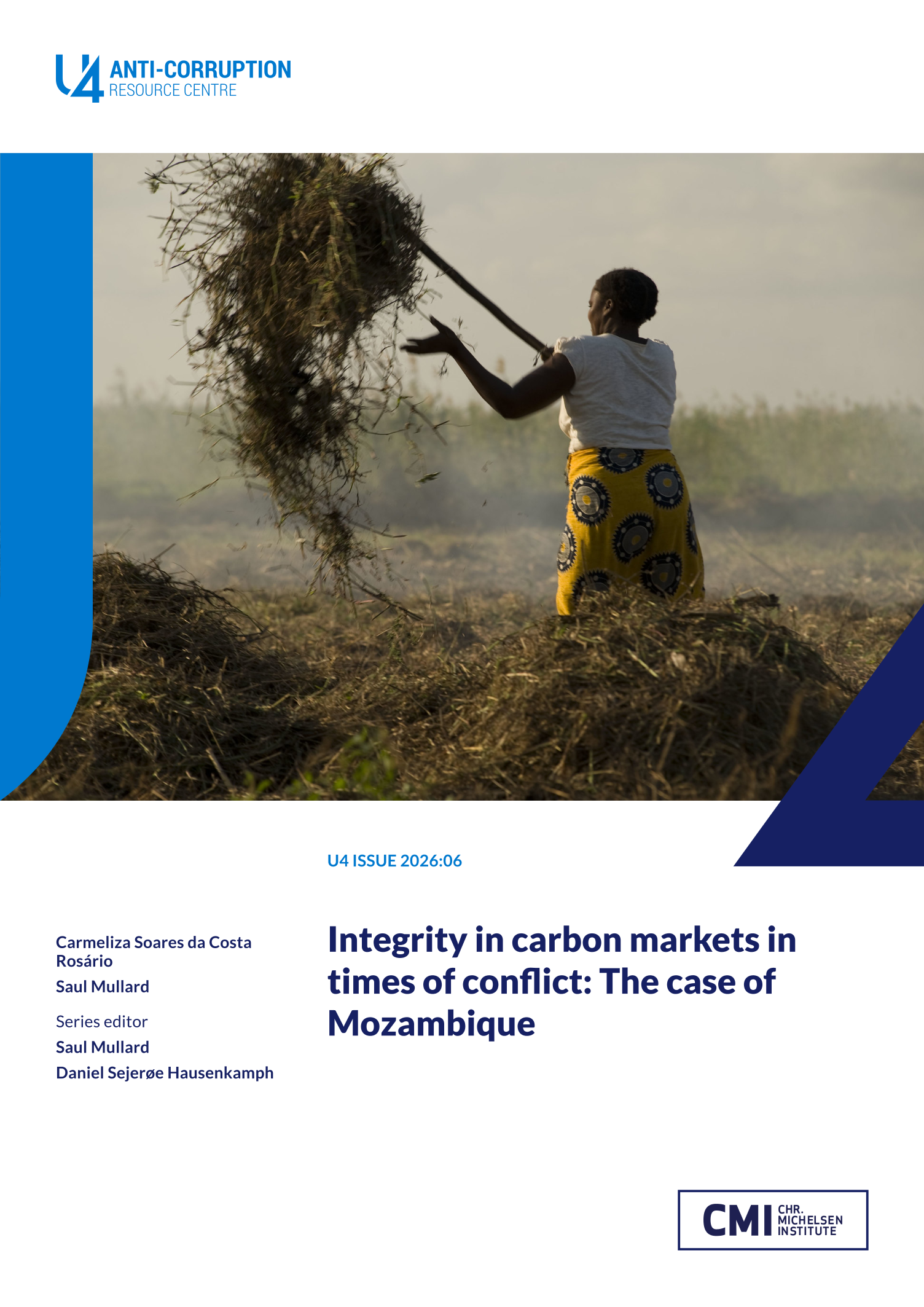
Integrity in carbon markets in times of conflict: The case of Mozambique

Carbon markets are expanding rapidly in fragile contexts, but without strong integrity safeguards they risk fuelling corruption, conflict and exclusion. This study shows how aligning carbon finance with governance reform, community participation and conflict sensitivity can turn carbon markets into tools for sustainable development, trust-building and resilience, rather than new sources of inequality and instability

9 March 2026
Read onlineDownload PDFRead short version
Integrity in carbon markets in times of conflict: The case of Mozambique

Main points

  • Integrity is a governance issue, not a technical fix. Carbon standards alone cannot prevent harm in fragile settings; investments must tackle weak institutions, land governance and political incentives that enable corruption and elite capture.
  • Land rights are the backbone of credible carbon markets. Without secure, transparent land tenure and accessible land data, carbon projects risk land grabs, conflict and loss of legitimacy with communities and investors.
  • Community consent is non-negotiable. Free, prior and informed consent (FPIC) and meaningful participation are essential to avoid grievances, ensure fair benefit-sharing and sustain long-term project viability.
  • Fragility and conflict shape carbon outcomes. Projects in unstable areas must be conflict-sensitive and aligned with peacebuilding and livelihood priorities, or they may worsen insecurity and displacement.
  • Transparency builds trust and market credibility. Public carbon registries, open project data and independent audits are critical to prevent double counting, fraud and reputational risks.
  • Civic space is a safeguard, not an obstacle. Supporting civil society and community monitoring strengthens accountability and helps detect integrity failures early.
  • Benefit-sharing must reach people directly. Linking carbon revenues to inclusive, transparent payment systems, supported by financial inclusion, reduces leakage and reinforces local support.
  • Donor coordination matters. Fragmented external interventions can weaken governance; aligned, long-term support for national systems is essential for high-integrity carbon markets.


Cite this publication


Soares da Costa Rosário, C.; Mullard, S. 2026. Integrity in carbon markets in times of conflict: The case of Mozambique. Bergen: U4 Anti-Corruption Resource Centre, Chr. Michelsen Institute (U4 Issue 2026:6)

Read onlineDownload PDFRead short version

About the authors

Carmeliza Soares da Costa Rosário

Carmeliza Rosário is a Social and Development Anthropologist, with extensive experience researching poverty, vulnerability, inequality, and gender. In addition, she has conducted research on social media and commentary, sexuality, sexual and reproductive rights, and governance. Currently, she is focusing on decolonial knowledge production through research on African female traditional leadership. Her main country of research is Mozambique. She holds a PhD in Anthropology from the University of Bergen (Norway).

Saul Mullard is a senior adviser at the U4 Anti-Corruption Resource Centre and a civil society specialist with a background in historical sociology, development studies, and South Asian studies. His research interests include the relationship between corruption and climate change and the role of local communities and indigenous peoples in addressing corruption and environmental protection. Mullard holds a doctorate and master’s in South and Inner Asian Studies from the University of Oxford, as well as a BA in Development Studies from the School of Oriental and African Studies (SOAS) in London.

Disclaimer


All views in this text are the author(s)’, and may differ from the U4 partner agencies’ policies.

This work is licenced under a Creative Commons Attribution-NonCommercial-NoDerivatives 4.0 International licence (CC BY-NC-ND 4.0)

Photo


Photo:
CIFaction on flickr.
CC BY-NC-ND