PublicationsThe U4 Blog

U4 Issue

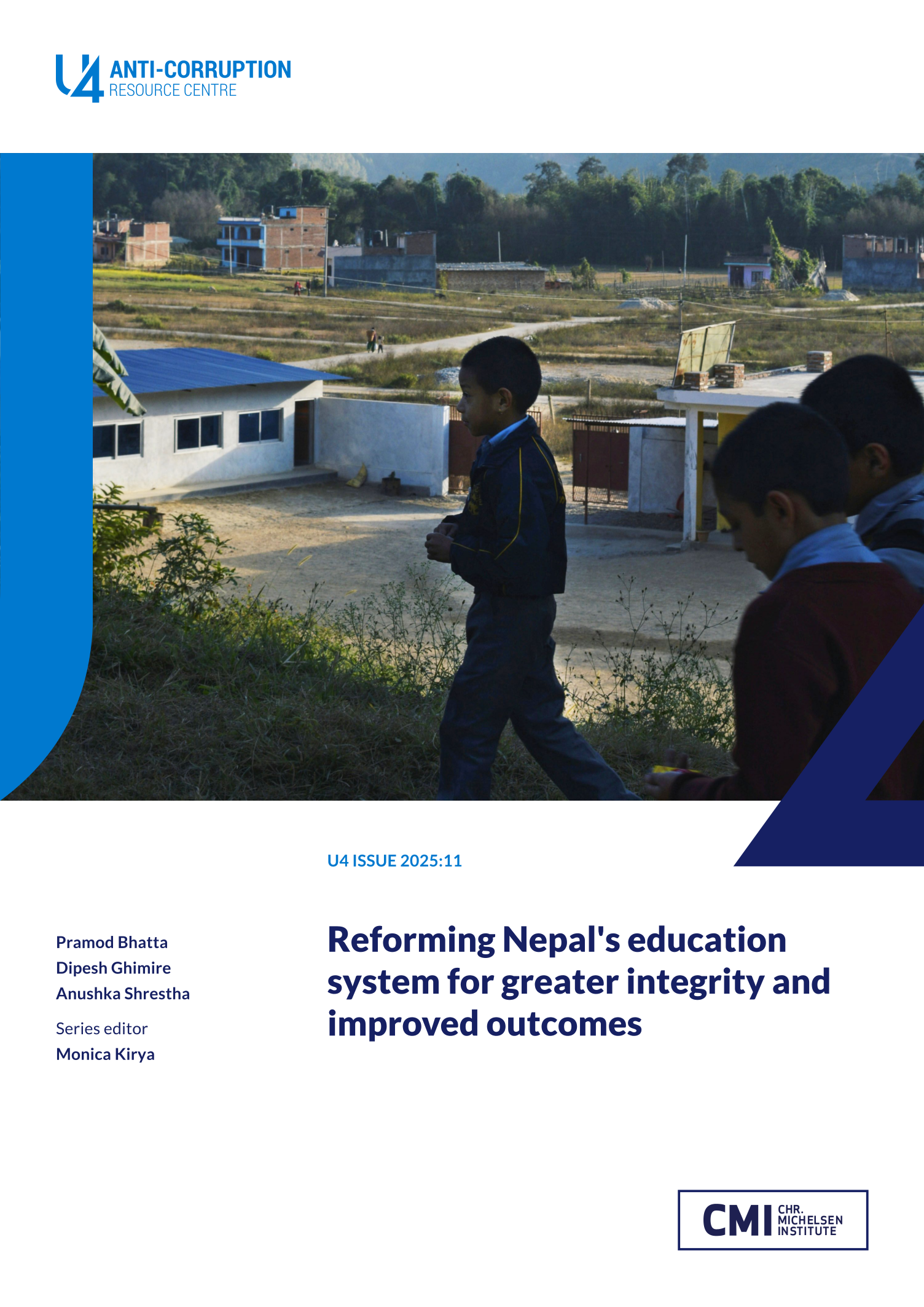
Reforming Nepal's education system for greater integrity and improved outcomes

Nepal has been investing heavily in education since federalisation under the 2015 Constitution, but integrity risks continue across the sector. Weak accountability and local capacity gaps are allowing corruption and inefficiency to persist in teacher management, procurement, and student support schemes. Stalled legislation exacerbates the situation but – if enacted – the Federal Education Bill would consolidate conditional grants, strengthen local audit and accountability committees, introduce direct beneficiary verification for student schemes, and ensure school management committees and parent–teacher associations are functioning as intended. This would help to ensure that the investments being made in education achieve their intended goals of improving access to a high-quality education for all.

28 November 2025
Download PDFRead short version
Reforming Nepal's education system for greater integrity and improved outcomes

Main points

  • Nepal is allocating more than 10% of its national budget to education, yet integrity risks remain widespread and are continuing to undermine efficiency and trust in the sector. Large flows of resources are managed at the local government (LG) and school level, where accountability systems are not keeping pace.
  • Teacher management, school construction, procurement, and student support schemes are all vulnerable to misuse. Cases of fake credentials, ‘ghost’ teachers and students, political patronage in recruitment, collusion in contracts, inflated costs, incomplete projects, and diversion of scholarships and funding for menstrual products illustrate how loopholes are exploited in practice.
  • Oversight and accountability mechanisms remain weak and inconsistent. More than half of local governments lack functional internal audit units, while accounts and education committees often do not meet or resolve arrears through ad hoc measures. At school level, many school management committees (SMCs) and parent–teacher associations (PTAs) exist only on paper or conduct audits in a ritualistic way, with little link to real accountability.
  • Underlying these risks are stalled legislative reforms, including the delay in passing the Federal Education Act, and overlapping mandates between federal, provincial, local, and school authorities. Rigid conditional grant systems leave little flexibility for schools and LGs to respond to needs, while inconsistent application of financial rules, combined with limited staff and technical capacity, continue to drive irregularities.
  • Suggested reforms include finalising the Federal Education Act to clarify mandates, consolidating conditional grants into broader categories, strengthening local audit and accountability committees, introducing direct transfers and beneficiary verification for student support schemes, and enforcing minimum standards and audits for SMCs and PTAs. Together, these measures can help close the gap between policy and practice, reduce leakage, and strengthen accountability.

Cite this publication


Bhatta, P.; Ghimire, D.; Shrestha, A. 2025. Reforming Nepal's education system for greater integrity and improved outcomes. Bergen: U4 Anti-Corruption Resource Centre, Chr. Michelsen Institute (U4 Issue 2025:11)

Download PDFRead short version

About the authors

Pramod Bhatta

Pramod Bhatta is an independent researcher who has extensive experience of working in education sector reforms in Nepal. He has published on various aspects of Nepal’s school and higher education, and is deeply interested in the functioning of public institutions from the perspectives of policy and planning, decentralised governance, equity, and privatisation.

Dipesh Ghimire

Dipesh Ghimire is an assistant professor of Sociology at the Central Department of Sociology, Tribhuvan University, Nepal. He has published extensively on various aspects of corruption in Nepal.

Anushka Shrestha

Anushka Shrestha is a research project coordinator at Kathmandu University School of Arts. Her research interests include transnational labor migration and gender equality and social inclusion in education

Disclaimer


All views in this text are the author(s)’, and may differ from the U4 partner agencies’ policies.

This work is licenced under a Creative Commons Attribution-NonCommercial-NoDerivatives 4.0 International licence (CC BY-NC-ND 4.0)

Photo