The technical and procedural barriers to civil society inclusion in UNCAC reviews are well-documented, and so are the solutions.
Blog
A double win on political finance and environmental protection at CoSP11
Two historic resolutions proved there is still space for multilateralism in addressing corruption.
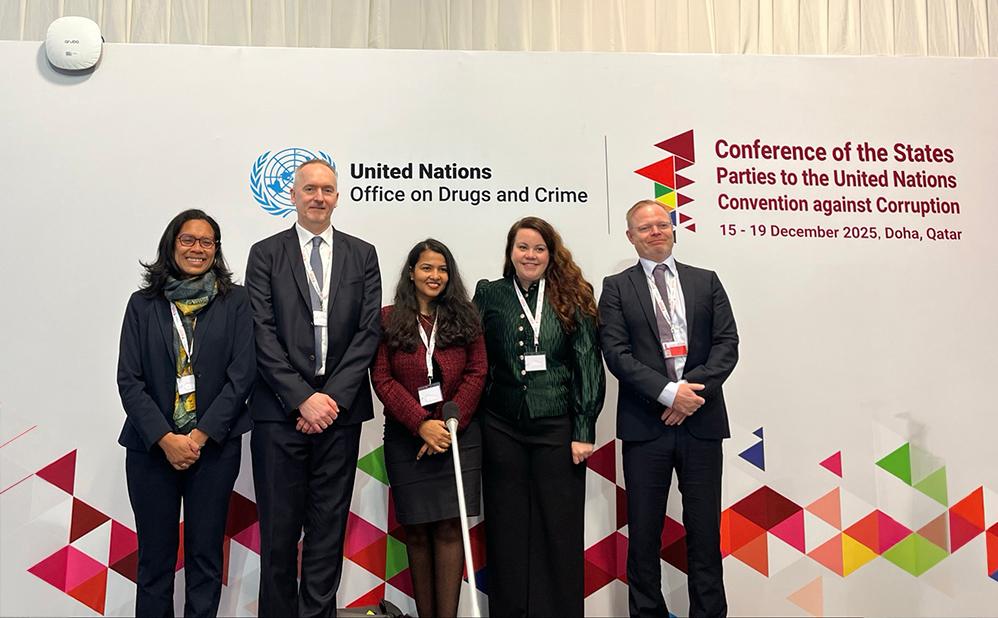
Ketakandriana Rafitoson (Vice-Chair, Transparency International), Aled Williams (Principal Adviser, U4), Stine Renate Håheim (Norway’s State Secretary for International Development), Khushbu Agrawal (Adviser, International IDEA), and Harald Mathisen (Senior Adviser, Norad, and Chair, OECD Anti-Corruption Task Team). Photo: U4 CC BY-NC-ND
The 11th Session of the Conference of the States Parties (CoSP11) in Doha (15–19 December 2025) will be remembered as a landmark meeting for the UN Convention against Corruption (UNCAC).
With multilateralism daily tested by geopolitical frictions, the conference delivered two historic consensus-based resolutions that will help tackle some of the most critical challenges of our time: money in politics and environmental crime.
The conference delivered two historic consensus-based resolutions that will help tackle some of the most critical challenges of our time: money in politics and environmental crime.
As with CoSP10 in Atlanta, U4 was embedded in Norway’s delegation in Doha, directly feeding evidence and advice into the negotiations. Alongside the Norwegian delegation – and with the involvement of Transparency International and International IDEA – we co-organised a side event on ‘Political finance transparency for a green transition’ (watch the event recording).
A global breakthrough for political transparency
The headline success was the adoption of a resolution on transparency in political finance.
Political finance transparency is recognised as a foundational element in anti-corruption efforts, while opacity in political finance allows corruption to thrive.
A 2024 UNODC report had previously highlighted that 80 UNCAC signatory countries received recommendations to strengthen measures in this area. These included recommendations to address:
a lack of comprehensive legislation or administrative measures to regulate the funding of candidates for elected office and the funding of political parties, including in relation to adequate limits to private donations and restrictions of anonymous and foreign donations, effective disclosure obligations and oversight and audit mechanisms.
Then, in early December 2025, more than 100 civil society organisations issued an open call for States Parties to prioritise and enhance political finance transparency as part of the UNCAC.
This call was heeded at Doha.
For the first time, the international community agreed on a set of global minimum standards for the transparency of political parties, candidates, and election campaigns. As noted by Transparency International, who were deeply involved in supporting the new resolution, this is a major achievement.
For the first time, the international community agreed on a set of global minimum standards for the transparency of political parties, candidates, and election campaigns.
By securing support from 60 states, the four co-sponsors (Norway, Ghana, Mongolia, and Albania) proved that it is still possible to reach a consensus on politically sensitive issues in these tumultuous times.
The new resolution provides a framework to curb the influence of ‘dark money’ on democratic processes worldwide.
Among other important points, the resolution:
- Calls on States Parties to ensure the existence of oversight bodies to monitor and supervise the funding of political parties and electoral campaigns
- Urges that public funding to political parties is given on the basis of objective and transparent criteria
- Calls on States Parties to consider setting limits on donations to political parties, candidates and campaigns
- Calls for measures against undue advantages via funding of foreign political parties, candidatures for public office, and electoral campaigns.
The new environment resolution
In tandem with the win on political finance, CoSP11 saw the adoption of a resolution on corruption as it relates to crimes that affect the environment.
Though not the first time an UNCAC resolution has addressed the environment, this new resolution, co-sponsored by Brazil and Namibia, recognises that corruption is a primary enabler of environmental degradation, illegal logging, and wildlife trafficking.
This new resolution recognises that corruption is a primary enabler of environmental degradation, illegal logging, and wildlife trafficking.
At U4, we have long argued that climate and environment goals are unreachable without anti-corruption measures. With Professor Luca Tacconi at the Australian National University, we previously reviewed the evidence on corruption in extractive industries, irrigation, agriculture, forestry, fisheries, and conservation, finding that corruption in these sectors is systemic and has significant negative environmental and economic impacts, as well as negative social impacts.
Though the new environment resolution was weakened during negotiations (for example, references to supporting environmental human rights defenders were removed following objections by some States Parties), it still:
- Strengthens international cooperation to prevent corruption in the management of natural resources.
- Encourages states to integrate anti-corruption safeguards into environmental and climate policies.
- Builds on years of evidence linking corruption and environmental degradation, including from U4.
Smart diplomacy and the road ahead
The success in Doha was driven by smart diplomacy from co-sponsoring states, with strong support from civil society and academia. This diplomatic push increases the likelihood that the next round of UNCAC reviews will have a stronger focus on how states handle these complex, intersecting forms of corruption.
These outcomes are not an endpoint but a call to further action.
For U4, these outcomes are not an endpoint but a call to further action.
Whether and how States Parties choose to adopt the measures contained in the new resolutions will be a decisive factor. How, for instance, will states operationalise oversight bodies for political finance? What limits will they set on political donations? And how will they integrate anti-corruption safeguards into their environmental and climate policies?
Much work lies ahead. At U4, we will continue to support our partners and other collaborators in translating these high-level resolutions into practical reforms and impacts.
Disclaimer
All views in this text are the author(s)’, and may differ from the U4 partner agencies’ policies.
This work is licenced under a Creative Commons Attribution-NonCommercial-NoDerivatives 4.0 International licence (CC BY-NC-ND 4.0)
Keywords
Photo
Photo: U4 CC BY-NC-ND