Query
Please provide a summary of aid diversion and corruption affecting the development sector in Somalia, as well as its link with terrorist financing, and an overview of mitigation measures.
Caveat
Some significant reports on aid diversion in Somalia from United Nations entities have been kept confidential. When referring to the content of these reports, this Helpdesk Answer cites and relies on other sources’ descriptions about what they contain.
Introduction
Country context
Located on the Horn of Africa, Somalia has, in recent decades, been in the throes of what the United Nations Office for the Coordination of Humanitarian Affairs (OCHA) calls one of the world’s most complex humanitarian situations (OCHA n.d.a). Climate change has triggered oscillating periods of drought and widespread flooding that contribute to a severe food security crisis, exposing more than half of the country’s population of around 19 million people to hunger and malnutrition risks (Concern US 2025). In the past decade, Somalia has been declared at risk of famine on three separate occasions, namely during droughts occurring in 2017, 2022 and 2023 (Concern US 2025).
Furthermore, the ongoing Somali civil war, political instability and increasing impacts of climate change have caused widespread displacement, often concentrated in urban and peri-urban areas (Concern US 2025). By the end of 2024, there were an estimated 3.1 million internally displaced people (IDPs) in the country (IDMC 2025), many with acute humanitarian needs.
Somalia is widely considered a fragile state, ranking first place globally in the Fragile States Index 2024 (The Fund for Peace 2025). Longstanding conflicts between the federal government and the insurgent armed group Al-Shabaab, which has been designated as a terrorist organisation by the UN Security Council, and between federal and various state authorities as well as clan groups, all generate humanitarian needs while also obstructing efforts to respond to them (Tronc et al. 2018).
A complex architecture of humanitarian actors is active in Somalia, including UN agencies, international and local NGOs, as well as private contractors (Majid and Harmer 2016: 11). Many of the efforts are coordinated by the Somalia Humanitarian Country Team (HCT), led by the UN humanitarian coordinator, and the Inter-Cluster Coordination Group (ICCG), chaired in turn by OCHA and financed by the multi-donor pooled Somalia Humanitarian Fund (SHF) (OCHA n.d.b). The Somali Disaster Management Agency (SODMA) is the national emergency management agency of the federal government.
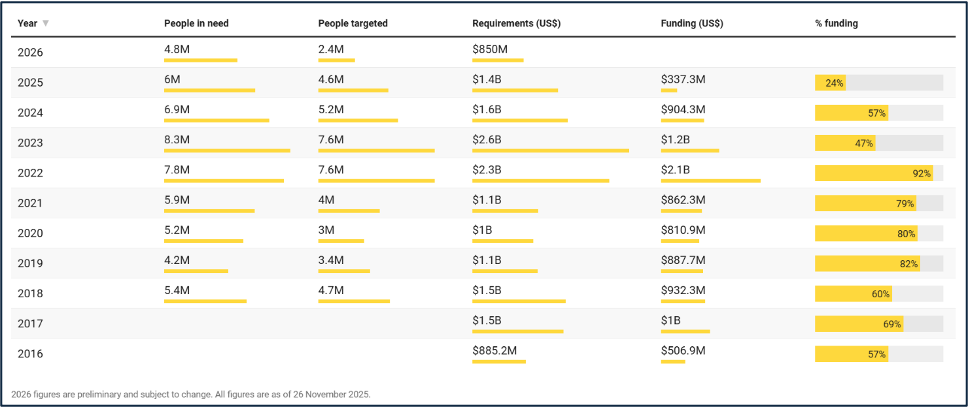
International donors have allocated a high volume of funds to these actors to respond to the humanitarian crisis in Somalia, often dwarfing that of the overall Somali federal government budget (Tindall 2024:2), and reaching a recent peak of US$2.1bn in 2022. Nevertheless, since then, the level of funding has declined, even if estimated requirements remain high (see Figure 1).
Figure 1: Overview of humanitarian needs and funding in Somalia 2016-2026
Source: Humanitarian Action 2025b.
Corruption and diversion of aid scandals
Among other factors, the recent decline has been tied to heightened concerns among donors that diversion and corruption practices prevent aid from reaching beneficiaries as planned. It should be noted that aid diversion is not unique to Somalia and is a reported issue in many other conflict affected and fragile countries, such as Afghanistan, Ethiopia and Yemen (Jackson and Majid 2024: 5).9ff397ff4003
Corruption has been described as systemic and pervasive in Somalia (Majid and Abdirahman 2024: 1) and there is a long history of allegations of diversion of aid. In the 1980s, the authoritarian leader Siad Barre interfered to distribute aid contracts as rewards to political supporters (Hussein 2024: 216). Large-scale diversion reportedly persisted during the 1990s and 2000s (Counter Extremism Project 2024) and received renewed attention when the country experienced a famine in 2011. Reports circulated that more than half of the food aid over seen by UN's World Food Programme (WFP) had been diverted (Mungcal 2010). The WFP acknowledged diversion risks but cast doubt on the scale of the problem (Tran 2011); nevertheless, concerns led some key donors to withdraw from the SHF (Devine 2021).
The issue received renewed focus after the 2023 leak of a UN report commissioned by the secretary general to investigate the diversion of aid in the humanitarian response to the 2022 drought (Lynch 2023). This investigation was conducted in part by UN entities and in part by an independent audit firm and sampled 55 IDP camps (IAHE 2025: 88). While the report is confidential and is not available in the public domain, various media sources reported on its findings, which reportedly included evidence of the diversion of cash and in-kind assistance such as food supplies occurring at all 55 camps (Lynch 2023; Sheikh 2023). According to media sources, the report states that “the findings of an independent assessment suggest that post-delivery aid diversion in Somalia is widespread and systemic” although, in contrast, the UN entities were more cautious about estimating the scale of the issue (Lynch 2023). Nevertheless, the scandal triggered a loss of donor confidence; for example, the European Commission temporarily suspended funding for the WFP (Baczynska et al. 2023).
In response, in 2023 the HCT endorsed what has become known as the post-distribution aid diversion or post-delivery aid diversioncb760904efca (PDAD) action plan, a list of ten priority actions, and established a PDAD Task Force to implement it, composed of donor agencies, UN agencies and NGOs which lead on different workstreams (IAHE 2025: 88). The PDAD action plan is also a confidential document that is not accessible to the public, but a 2025 Inter-Agency Humanitarian Evaluation (IAHE) reported that the HCT was making progress against the ten priority actions, while also recognising that lasting change would take more time because the issues are deep-rooted and systemic (IAHE 2025: 88).
In the meantime, allegations of aid diversion persist, sometimes becoming part of contentious, politicised disputes. In late 2025, US authorities announced it was suspending all forms of aid to Somalia after it alleged that Somali federal government officials destroyed a WFP warehouse and seized food aid; the federal government has strenuously denied the allegations and officials from the WFP stated that, while the warehouse was partially demolished on account of expansion work, no food aid had been diverted (BBC 2026). Some sources framed the allegations as part of the Trump administration’s rhetoric targeting the Somalia community in the US (Al Jazeera 2026). In late January 2026, the under-secretary for foreign assistance, humanitarian affairs, and religious freedom (2026) announced the US would resume support to WFP after the federal government reportedly made further commitments to safeguard aid.
The significance of the discourse around these diversion and corruption allegations is only underlined by the fact that, at the time of writing, Somalia continues to face pressing humanitarian needs; in November 2025, the federal government declared a national drought emergency and the WFP has estimated up to 4.4 million people could experience a food insecurity crisis between January and March 2026 (IFRC 2025: 2).
This Helpdesk Answer focuses on the aid sector (primarily the provision of humanitarian aid which has been subject to more policy, media and scholarly attention but also drawing some insights from broader forms of development support where evidence is available)fd2f4aaf78f8 and exclusively on the Somali context. It first gives an overview and disaggregates the different kinds of risks of corruption and diversion in the sector – including but not limited to issues flagged in the leaked 2023 report – largely as it occurs in territories controlled by the federal government. It then considers how diversion overlaps with terrorist financing risks in areas under the control of Al-Shabaab. The next section concerns drivers of these issues, speaking to the complex, context-sensitive set of underlying conditions giving rise to corruption and diversion in Somalia. The final section reviews existing policy responses and expert recommendations on how to mitigate these risks and better safeguard the delivery of aid to beneficiaries.
Risks of corruption and aid diversion
This section provides an overview of key corruption and aid diversion risks in the humanitarian and wider development sectors in Somalia.
While corruption and aid diversion are often conflated – and there can be significant overlap – the academic literature generally suggests that they are not identical. For example, Seferis et al. (2024:22) argue that corruption refers to “aid providers abusing their power to influence or retain aid for personal and financial gain”, standing in contrast to aid diversion which “relates to armed groups or other external parties keeping or demanding a portion of assistance”. Jackson and Majid (2024: 7) alternatively argue “diversion happens when aid does not reach those aid actors the donors intend it to”, which can be linked to forms of corruption such as bribes and kickbacks, but not exclusively so: for example, aid can also be diverted by insurgent groups to fund their military operations or even be caused by natural acts such as weather related disruption. In contrast, Jackson and Majid state that corruption is always marked by self-serving behaviour, but note it can be difficult to discern the motivations of actors and therefore to distinguish between corruption and diversion (Jackson and Majid 2024: 7).
Key policy documents in the Somali context also observe these distinctions. The PDAD action plan reportedly distinguishes between five sets of issues: coercion, collusion, ghost recipients, bribery and diversion (Levine et al. 2025: 7), but given the plan is confidential, it is not possible to see further details on these categories. Since many of the sources covered here themselves do not clearly delineate, and not all details are at hand, this Helpdesk Answer refrains from categorising the acts described below as amounting to corruption or aid diversion.
A note of caution is also made regarding estimating the scale and potential changes in the level of corruption and aid diversion. Jenkins (2024) describes how the humanitarian sector is often exposed to outsized media and political attention, which can contribute to overestimates of corruption levels. Similarly, Majid and Abdirahman (2024: 1) highlight that there is often a focus on corruption in the humanitarian sector in Somalia at the expense of the security and wider development sectors. Experts consulted for this Helpdesk Answer shared their view that donors and aid agencies have not been forthcoming in commissioning or making public studies into these sectors, despite allocating substantial and often increasing financial support to development and security in Somalia. This creates a notable evidence gap in contrast to the humanitarian sector.
Elsewhere, however, Jackson and Majid (2024: 16) argue that this focus is often elevated during crisis periods (such as the 2011 and 2022 drought responses) and criticise the lack of attention given to what are in fact entrenched corruption and aid diversion risks between such crises. One recent review of the literature found there is no available quantitative data that would make it possible to analyse aid diversion trends in Somalia over time (IAHE 2025: 44-45). Most of the primary studies cited below are based on qualitative interviews which provide important insights into the nature of the risks, but are arguably less suitable for determining how widespread they are.
Diversion of aid to IDPs
The issues flagged in the leaked 2023 UN report appear to have largely centred around the diversion of aid intended for IDPs in Somalia (Lynch 2023). It found evidence that this is enabled by a chain of different actors, including camp managers, local government officials and humanitarian workers (Lynch 2023); depending on the source, some or all of these actors have been referred to as “gatekeepers” (see Box 1).
Box 1: Gatekeepers
In Somalia, the term “gatekeepers” is often employed to describe intermediary figures between aid agencies and beneficiaries that seek to profit from projects and resources distributed from the former to the latter (Jackson and Majid 2024: 14). It is most commonly applied in the context of IDP camps or settlements. Lynch (2023) describes how “gatekeepers” is often treated as synonymous with “camp management, administration and leaders” while Bryld (2023) describes them as “influential private individuals, linked to local clans, who run Mogadishu’s IDP camps”.
In Somalia, IDP camps – as well as the land they are established on and the services they provide – are often privatised rather than operated by the federal government, making gatekeepers widely prevalent and powerful figures (Counter Extremism Project 2024). Aid agencies often rely on gatekeepers to inform their programming, creating risks that they speak on behalf of but not in the interest of the wider community (Haver & Carter 2016: 64).
Nevertheless, several experts stress it is important to recognise that the motivations of camp managers vary, including making profits and being driven by humanitarian sympathies (Humanitarian Outcomes 2023: 18; Majid and Adan 2024: 6). Furthermore, a much wider range of actors may also be implicated in diversion practices. For example, the mayor of Bulo-burte district was arrested for diverting food aid in 2015 (Abdirahman 2015) while in 2024, members of the special forces of the Somalia national army were arrested on suspicion of stealing food rations (Sheikh 2024).
Above all, gatekeepers is a contentious term without any consensus on a definition. For example, one study introduces more elements into its definition, calling gatekeepers “people who try to control who receives aid in order to favour members of their own clans by manipulating information being shared with humanitarian organisations” (European Commission 2025). Majid and Adan (2024: 7) argue for an even more expansive understanding of the term, stating it should be applied to “individual or a combination of actors working together that control or influence the distribution of aid resources”. They contend that staff from local authorities, implementing NGOs or contracting UN agencies can also be part of the gatekeeping chain, with the different actors rarely working in isolation from each other.
The remainder of this subsection breaks down different aspects of the diversion of aid intended for IDPs in greater detail.
Extorted payments
A risk associated in particular with cash or voucher assistance programmes in Somalia is that gatekeepers extort fees from beneficiaries (European Commission 2025: 16). The independent assessment carried out for the 2023 leaked UN report documented widespread complaints from IDPs that they were forced to pay up to half of the cash assistance they received to gatekeepers (Baczynska et al. 2023). The assessment also uncovered these extortionary demands are typically accompanied by a range of threats such as de-registration from the beneficiary list, eviction and even arrests (Lynch 2023).
Extortion often manifests in the form of an “unwritten agreement” between IDP camp residents and owners to give the latter an agreed portion of their humanitarian benefits and which may also be framed as a form of rent or charges for services such as water, accommodation and security (Humanitarian Action 2024). However, it can also implicate staff from NGOs, local authorities and UN implementing staff who stake their claim to a cut (Majid and Thomas 2024).
In their study, Majid and Thomas (2024:12-13) interviewed key stakeholders who outlined how an “IDP business model” works in Mogadishu and Baidoa. Under this arrangement, camp owners (who usually rent the land on which the IDP settlement is maintained) claim up to 50% of the cash or voucher entitlement due to beneficiaries for various costs, in line with the following example breakdown:
- 10% for rent costs
- 10% for security costs
- 10% as a payment to employees from the local authority, NGO or UN (often to compensate their own implementing costs)
- 20% claimed as profit by the camp owner
Another study of Galkaio camps found that gatekeepers took approximately one-third of assistance for themselves, paying another third to local government actors and leaving beneficiaries with only the remaining third (Humanitarian Outcomes 2023: 19). In an earlier study, Harmer and Majid (2016:21) found that fees can “vary enormously” depending on the gatekeeper and context in question, citing examples of a village relief committee chairman taking U$3 from every cash distribution valued at $55, to reports of international NGO staff taking up to 50% of the entitlement.
According to the UN Country Team in Somalia (2024b: 28), post-delivery aid diversion (PDAD) “almost always involves coercion or threats, such as removal of a beneficiary from distribution lists, eviction, harassment, or arrest”. However, some voices in the literature challenge the characterisation of these payments as extortion. Bryld (2023) argues that rather than “simple extortion”, they form part of a business arrangement which camp owners rely on to obtain a return on their investment in setting up and maintaining these informal camps on private land, noting the failure of the state and international community to establish formal camps. They argue the relationship between gatekeepers and IDPs can “even be mutually beneficial” and if IDPs felt their payments were not reciprocated with adequate services, they would relocate to other camps (Bryld 2023).Majid and Thomas’ (2024:12-13) study suggests a more nuanced middle ground. They describe how some IDP respondents view the payments as reasonable and as a means of guaranteeing their access to aid, while others view it as a form of extortion, noting that they are threatened with reprisals if they report concerns.
Sexual corruption
Another form of extortion which may not amount to diversion of aid as traditionally understood – but which carries severe consequences for victims and has implications for gender equality and human rights – is when sex or acts of sexual nature are demanded in place of payments. While not explicitly framed as such, documented cases of sexual exploitation and abuse experienced by IDPs in Somalia appear to fulfil the elements of what has been termed sexual corruption or sextortion.2d588840bc80
Heide-Ottose and Stern’s study (2023: 3; 29) describe several reports across Puntland and Southern Somalia of gatekeepers withholding food aid and even threatening eviction if women in IDP settlements did not comply with their demands for sex. Furthermore, there have been reports of staff from NGOs and UN implementing partners maintaining sexual relationships with women in exchange for surplus non-food aid supplies. They report that the number of formally reported cases are low, which may be explained by fear of reprisals as well as collusion between perpetrators and local authorities to undermine any follow up (Heide-Ottose and Stern 2023: 3).
Reselling
In-kind forms of assistance which are diverted may be subsequently resold on the black market for profit. Monitoring exercises carried out in the context of the leaked 2023 report reportedly found that UNICEF nutritional food supplies were on sale in 17 out of the 51 local markets studied (Somalia Nutrition Cluster et al. 2023). Following the suspension of EU funds, the Somali government announced an intention to crack down on the trading of humanitarian aid supplies in black markets (Shabelle Media Network 2023). Nevertheless, this practice is difficult to eradicate, and there is further evidence that the practice persists. A 2025 journalistic investigation at the Hamar Weyne market in Mogadishu, for example, found sellers were reselling nutritional food supplies obtained through middlemen and marked by the logos of aid agencies which had been intended for malnourished children (Fakat 2025).
Interference in beneficiary targeting
A common form of diversion linked predominately to gatekeepers such as camp managers is interference in targeting and registering beneficiaries of aid (Jenkins 2024: 19). This can lead to a subset of beneficiaries being prioritised on arbitrary or false grounds (ALNAP 2022: 108) or even the delivery of aid to persons who would not qualify to receive it in the first place (which naturally comes at the expense of beneficiaries who have a more justified claim for support).
In Somalia, this expression of favouritism is typically triggered by different forms of allegiance, for example, where camp managers add family members to recipient lists (Levine et al. 2025). The leaked 2023 UN report found evidence that camp managers were exploiting their delegated responsibility of registering beneficiaries and granting preferential treatment to members of dominant clans,c895e879534c while at the same time denying access to members of minority groups who were in need (Lynch 2023).
Similarly, Majid and Thomas (2024: 15) distinguish their aforementioned IDP business model from a clan-based model, which they appraise to be even more widespread across Somalia. Under this model, gatekeeping does not take the form of a camp owner acting as a business actor, but rather manifests as local powerholders (for example, from local government, local community leaders or implementing NGOs) engaging in a competition over aid resources, attempting to redirect them towards their own identity groups (often aligning with clan identities).
Risks of interference may be higher when the beneficiary selection process is delegated to intermediaries without appropriate oversight. One study concluded risks of aid diversion in a mobile money transfer programme were heightened because a local implementing partner delegated the task of registering beneficiaries to community leaders without carrying out any independent checks (European Commission 2025: 16). Levine et al. (2025: 36) emphasise that interference can take place much earlier in the process when local political actors, camp managers and aid agency staff collude to select which IDP sites should receive which volumes of aid, which can result in the marginalisation of those excluded.
Ghost beneficiaries
Lynch (2023) explains that the leaked 2023 UN report also highlighted widespread issues of fake or “ghost” beneficiaries. This often implicates authorities compiling needs assessments and beneficiary lists who then divert the surplus aid distributed for these constructed needs.
The scale of such deception can vary considerably. In 2025, the Norwegian Refugee Council investigated two alleged cases of ghost beneficiaries involving its cash distribution programme, substantiating only one of them, amounting to a loss of only around US$870 (NRC 2025). In contrast, Harmer and Majid’s (2016:16-18) study of the humanitarian sector in southern Somalia documented reports of entire “ghost NGOs”, describing examples of mother and child health centres that employ less staff or provide fewer goods and services to beneficiaries than they promise donors. A study by Tronc et al. (2015: 15) described a practice of gatekeepers transferring IDP populations to different locations with the intention of skewing needs assessments in order to divert funds.
A more recent study documented reports that fake IDP camps continue to be established across southern Somalia (Majid et al. 2025a). A WFP commissioned comprehensive population register was undertaken at IDP camps in the vicinity of Baidoa based on data such as household demographics and asset ownership. It estimated the number of households in need of humanitarian support was 45% lower than had been specified on the previous register, which could constitute evidence the latter had been inflated with “ghost” households (Levine et al. 2025: 7-8).
Other forms of corruption
In Somalia, there are other corruption risks beyond the diversion of humanitarian support to IDPs, often occurring at higher levels of decision-making within the wider development sector.
Embezzlement
There are some cases of high-level political figures embezzling funds allocated for development purposes, although these are few in number and have often been met with efforts to hold the perpetrators accountable. In 2020, Somali police arrested more than 20 Ministry of Health officials suspected of embezzling aid money that had been allocated towards a coronavirus quarantine facility in Mogadishu (Horn Observer 2020); four of these officials received prison sentences of up to 18 years (Dhaysane 2020).
In other cases, it is more difficult to assess the credibility of allegations. For example, in 2025, the Shabelle Media Network (2025) reported it had received confidential intelligence that high-ranking officials from the Ministry of Environment and Climate Change were embezzling more than US$5,750,000 from a climate resilience project funded by the Green Climate Fund and managed by the Food and Agriculture Organization (FAO); however, the review carried out for this Helpdesk Answer found no other sources reporting on either the original accusation or whether there has been any follow-up.
Although not amounting to direct evidence of corruption, reports by the office of the auditor general have identified potential red flags of high-level embezzlement. The anti-corruption organisation Marqaati analysed reports published by the office of the auditor general between 2018 and 2022 and estimated that over US$5,936,000 in international assistance funds was unaccounted for (Marqaati 2023). These kinds of gaps may also be attributable to human error and lapses in record keeping, including by the aid agencies (Ali 2025). For example, the office of the auditor general said it was unable to fully verify US$153.8 million in social protection transfers under the “Baxnaano program” because the WFP neglected to provide full beneficiary records (Ali 2025).aad2c6fc414c
Politicised allocation
There have been repeated allegations that the federal government withholds or redirects aid funds away from certain territories because of political disputes, such as the de facto independent state Somaliland and the semi-autonomous state of Puntland. However, the evidence is also often unclear, making it difficult to determine if such accusations are not themselves politicised.
In their study on humanitarian projects in Puntland, Sofe (2020: 112) carried out interviews with international aid agency employees, some of whom claimed that federal ministries attempt to interfere with needs assessments and direct funds towards geographical regions where they have political interests. Similarly, Ali (2024) describes reports that the federal government has diverted millions of dollars in international aid allocated to Puntland to other regions which are more politically aligned with the government, leaving development projects in Puntland underfunded. Such accusations have been levelled by high-level political actors; for example, in 2025 the minister of humanitarian affairs of Puntland accused SODMA of corruption and claimed it had not disbursed aid shipments despite the semi-autonomous state being listed as a recipient; conversely, SODMA insisted it had disbursed the aid shipments (Garowe Online 2025).
Rubin (2021) claims that the former president of Somalia Farmaajo withheld a third of the US$700 million in World Bank provided humanitarian funds that had been allocated to Somaliland due to politicisation. However, this accusation has been disputed by others as not factual and based on biased media sources (Said 2020).
Corruption in public procurement
In Somalia, there is a risk of various corrupt practices that distort the fair and competitive procurement of goods and services. Interviewees for Harmer and Majid’s 2016 study reported that public contracting was one of the highest risk areas in the humanitarian sector, with a majority stating that the payment of kickbacks to obtain a contract is common, as well as citing other forms of procurement related corruption, such as insider bidding and inflating contract values, which can reportedly range from between 30% and 50% of the actual value (Harmer and Majid 2016:26-28). A related risk area is hiring processes: due to the comparatively high salaries of positions, Sofe (2020:113) describes corruption in the recruitment of humanitarian staff in Puntland as “rampant” and reports that kickbacks and nepotism are commonplace.
The United Nations Support Office in Somalia (UNSOS) identified procurement fraud risks as high in Somalia, while an internal audit found that the office itself faced control gaps to effectively stem these risks (OIOS 2023: 4). UN agencies have debarred organisations and individuals for suspected corruption and fraud occurring during procurement processes in Somalia (Goobjoog 2019).
At the same time, aid agency staff may be complicit in such transgressions. Majid et al. (2023)describe reportedly widespread patterns of staff at international agencies colluding during the contracting of local organisations as implementing partners. This might be, for example, in return for kickbacks or directing contracts towards organisations in which they hold interests, as well as conspiring to ensure that monitoring processes lead to positive assessments for preferred organisations.
Public contracting for humanitarian services can also be heavily politicised. Elder’s (2022) ethnographic study finds that many firms working in the aid space have acquired outsized influence, which hinders the development of public, centralised authorities in Somalia. They document allegations that domestic Somali officials and also donors have distributed rents to a privileged group of firms in the forms of public contracts for infrastructure, food and fuel distribution and other development needs (Elder 2022: 396). For example, Elder (2022: 414) repeats criticisms made by former president Farmaajo that United Nations agencies were awarding large-value logistics contracts to firms associated with political opposition figures in Somalia with the aim of counterbalancing his regime’s authority (Elder 2022: 414); however, it is difficult to discern whether such criticisms are themselves politically motivated.
Aid diversion and terrorist financing in Somalia
Al-Shabaab is an Islamist non-state armed group which formed around 2006 and entered an alliance with Al Qaeda in 2012 (Counter Extremism Project 2024: 12). As a result of frequent attacks on civilians, it has been designated a terrorist organisation by numerous states and is sanctioned by the United Nations Security Council (Counter Extremism Project 2024: 12). According to the Counter Extremism Project (2024: 12), Al-Shabaab is currently one of the best funded terrorist organisations in the world and has an estimated annual revenue of up to US$150 million.
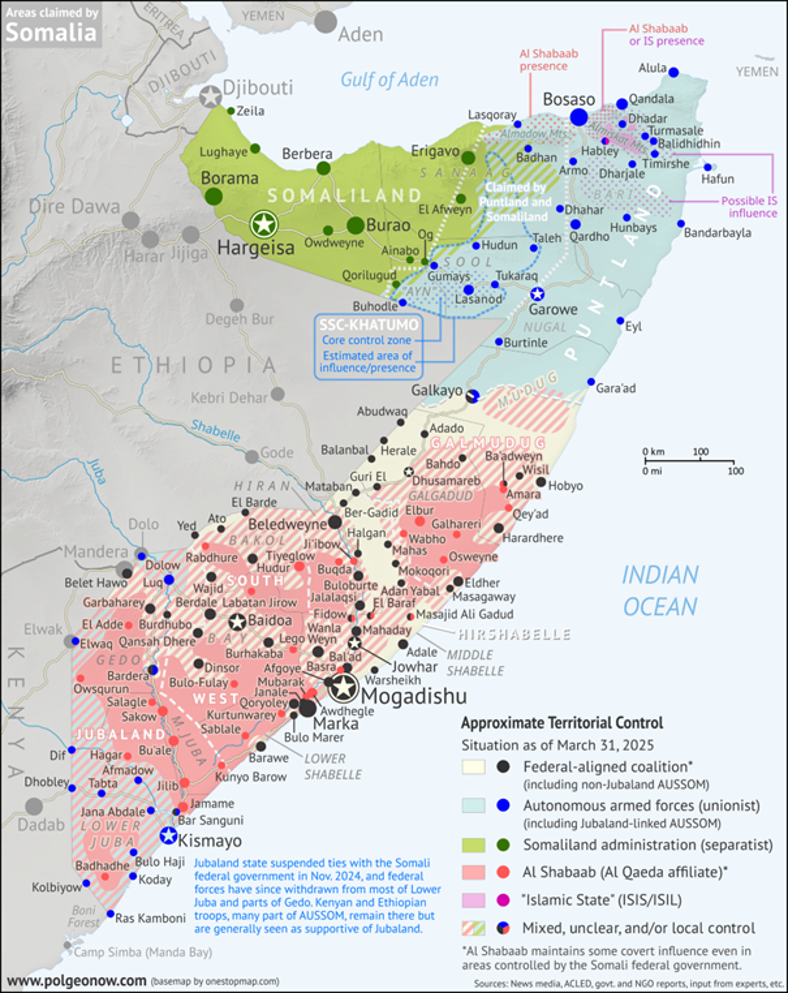
Al-Shabaab has engaged in conflict with the federal government of Somalia since the late 2000s and, despite several counterinsurgency campaigns, it has maintained effective control over territories in southern and central Somalia (Tyson 2025) (see Figure 2). There are other Islamist terrorist groups with a presence in in Somalia – for example, the Islamic State in Somalia Province (ISSP) – but their influence is limited compared to Al-Shabaab and they do not exert equivalent levels of territorial control (Zenn 2023).
Figure 2: Map of Somalia including territories controlled by Al-Shabaabas of 2025
Source : EUAA 2025
Given its wide territorial reach and substantial funds, many donors fear that aid intended for Somali civilians is diverted to the terrorist organisation. As Jackson and Majid (2024: 11) explain: “concerns about aid reaching Al-Shabaab are given much greater attention than corruption and aid diversion in government-held areas”.
While there is – as described below – evidence of diversion, it manifests in different patterns to those outlined in the previous section, which pertained largely to government-held areas, thus making them arguably distinct issues that should not be conflated. Indeed, Lynch (2023) reports that the leaked 2023 UN report did not mention Al-Shabaab as having been involved in the diversion practices described therein.
One crucial difference is that many international aid agencies do not carry out operations in Al-Shabaab controlled territories due to the terrorist organisation’s hostility towards them (Jerving 2019; Kluijver 2025). Papale and Castelli (2025: 12-13) explain several factors are behind this hostility including Al-Shabaab’s fear of intelligence being leaked about their operations. Al-Shabaab has also often sought to deny the existence of humanitarian crises which could delegitimatise their authority in the eyes of locals and their attempts to act as the sole provider of key services. Al-Shabaab has made public announcements that the United Nations and its implementing partners are not welcome in areas under their control (UNSC 2023:9).
For aid actors that can access these area, Kluijver (2025) describes how Al-Shabaab typically forces them to pay fees and tracks their activities by demanding staff CVs and inventory reports. Many aid agencies have withdrawn from the territories due to concerns about such interference and security threats, instead redirecting their funding to support the federal government (Haver and Carter 2016; Kluijver 2025; Jackson and Aynte 2013). A consequence of this is that civilians in Al-Shabaab controlled areas tend to receive “only a fraction” of the support which goes to those in government controlled areas (ALNAP 2022: 114).
Nevertheless, some humanitarian aid agencies are still active in Al-Shabaab territories, although their activities are normally implemented by local partners (UNSC 2023:9). Some of these are given a degree of discretion on how they secure access but in any case most agencies are typically restrained in publicising the extent to which they must engage with Al-Shabaab (Haver & Carter 2016: 52). This may be out of fears that this engagement is illegal – for example, the payment of fees is in violation of counter-terrorism financing laws (Kluijver 2025) – which can mean activities go underreported (Marín and Ali 2021). The United Nations Security Council has adopted a resolution introducing a humanitarian exemption to the wider asset freezing measures applied to Al-Shabaab for “payment of funds, other financial assets or economic resources necessary to ensure the timely delivery of urgently needed humanitarian aid” (UNSC 2023), but many agencies reportedly still face complex legal hurdles (Jackson and Aynte 2013) and substantial due diligence obligations (Jerving 2019), with many reportedly choosing to err on the side of caution and avoid programming in Al-Shabaab controlled territories (ALNAP 2022: 114).
With all these considerations in mind, the remainder of this section documents what evidence is available to link Al-Shabaab to aid diversion.
Seizures
While the evidence base is limited, there are some older reports of Al-Shabaab seizing aid supplies; however, this appears to be rarely done for financial gain, and instead supplies are often destroyed as a gesture against the perceived interference of humanitarian actors (Papale and Castelli 2025: 12-13).
For example, in 2013, Al-Shabaab seized and reportedly burned GB£480,000 in humanitarian supplies which had been financed by the Department for International Development (DfID) (The Guardian 2013). In 2017, Al-Shabaab seized and burned relief food seized from civilians and issued a public warning against accepting “handouts from crusaders and apostates” (ICG 2017: 4).
In parallel, Al-Shabaab has periodically launched and publicised its own relief efforts supplying livestock, food, water and other amenities (ICG 2017; Rono 2017), often with the aim of fostering dependence and winning the support of the local population (Papale and Castelli 2025). While there appears to be little evidence that they seize and redirect supplies from aid agencies to do so, there is some evidence that these relief efforts are funded by compulsory donations and taxes (ICG 2017: 5; Papale and Castelli 2025: 12).
Taxation
The main source of Al-Shabaab’s revenue is illicit taxation on, for example, agriculture, vehicles, commercial goods and livestock (UN Panel of Experts on Somalia 2022). This system is reportedly methodical in nature with fixed prices and receipts being provided (Kluijver 2025). Williams (2023) describes how a registry of citizens’ assets is maintained for the purpose of collecting an annual 2.5% “zakat” tax. Civilians and traders based in Al-Shabaab controlled territories face violent reprisal if they refuse to pay up (Kiley 2018).
Numerous sources suggest that aid agencies active in Al-Shabaab controlled territories must pay registration taxes. Jackson and Aynte’s (2013) research into the humanitarian response to the 2011 drought drew from interviews with former Al-Shabaab officials, aid workers and civilians. It found that Al-Shabaab’s humanitarian coordination office had generally forced aid agencies to pay up to US$10,000 of registration fees, as well as to submit documentation forms and agree to certain conditions for access. But some organisations had managed to circumvent these demands by investing in continuous dialogue with Al-Shabaab officials. In another study, aid organisations working in Al-Shabaab controlled areas reported that the normal taxation rate was 30% of the operational budget, but that this could be negotiated downwards (Haver and Carter 2016). Such forms of extortion may not be unique to Al-Shabaab. Majid and Harmer (2016: 14) highlight reports that other local authorities across southern Somalia (often in coordination with the federal government) also request registration fees and impose other access conditions on NGOs.
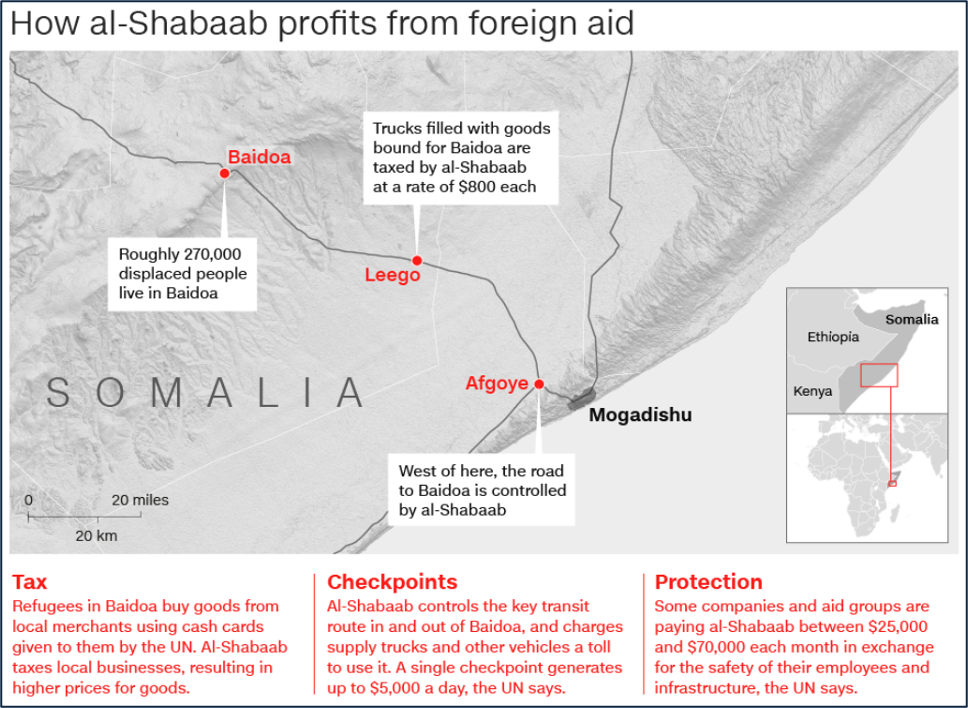
Another tax, “checkpoint taxation”, occurs where fees are extracted from vehicles and cargos passing through checkpoints overseen by Al-Shabaab (Bahadur 2022: 1-2). A report by the UN Panel of Experts on Somalia (2022) did not single out diversion of aid as the main source of funding for Al-Shabaab, but flagged that checkpoints can also affect convoys delivering aid to or transiting their controlled territories. Majid and Harmer (2016: 15) note that that local transporters as well as agency staff passing through such checkpoints typically reported complying with these charges. A 2018 CNN investigation found that agencies’ funds were diverted in the form of taxes paid by local partners and checkpoint fees as well as through protection payments to ensure the safe passage of staff and assets (see Figure 3).
Figure 3: 2018 CNN investigation into the channels Al-Shabaab uses to profit from foreign aid
Source: Kiley 2018
Most of the sources attesting to aid agencies paying taxes to Al-Shabaab come from the 2010s and there is less evidence from more recent years. This, again, may be linked to a “chilling effect” which terrorist financing laws have, making agencies fearful to openly discuss their payments (Counter Extremism Project 2024: 14). Nevertheless, experts interviewed for this Helpdesk Answer indicated that, as of 2026, many humanitarian agencies do continue to pay taxes to the group, describing it as an “open secret”.
Ransom payments
Another means by which funds can be diverted to Al-Shabaab is when the group kidnaps employees of aid agencies and implementing partners, and demands ransoms for their safe return (Counter Extremism Project 2024: 13). While it is difficult to ascertain the scale of this threat as agencies generally do not disclose if they pay ransoms, there have been several incidents. According to Reid (2018), there were at least 16 abductions targeting local and international aid workers between January 2016 and August 2018. They cited one example where Al-Shabaab demanded US$200,000 in ransom from an aid agency to return seven victims; this ransom was presumably paid, but there is no evidence confirming this.
Corruption of authorities
The aforementioned threats tend to be underpinned by extortionary tactics such as intimidation and violence (Williams 2023) rather than the private gain of any actor. While it is conceivable that corruption of entrusted authorities in Somalia could facilitate the diversion of aid into Al-Shabaab’s hands (as a hypothetical example, sympathetic officials or gatekeepers might embezzle aid funds and channel them to the terrorist group for a reward), the research for this Helpdesk Answer uncovered no such reports. This is not to say Al-Shabaab does not benefit from corruption as a tactic in a wider sense; studies indicate that political officials and clan elders, as well as law enforcement and the defence forces, have all supported the group, including with providing intelligence, in return for favours (GI-TOC 2025; Williams 2023; Mealin Seid 2025).
Drivers of corruption and diversion of aid
This section gives a non-exhaustive overview of various drivers of corruption in relation to humanitarian assistance and the diversion of aid that experts on Somalia have highlighted; whether or not these come to the fore in practice may be contingent on contextual factors, such as the operating models adopted by aid agencies as well as the varying patterns found in local political economies.
Remote programming
Due to security concerns, many international aid agencies have very little field presence in Somalia and rely on remote forms of programming (IAHE 2025: 90), which both undermines oversight efforts and engenders its own corruption risks. Instead, many international staff work from neighbouring countries such as Kenya, and when in Somalia, they restrict their presence for security reasons to the “green zone” around Mogadishu airport. Other agencies do have staff based beyond the zone who oversee the direct delivery of aid to beneficiaries, but they often rely heavily on security services; furthermore, their presence may be contingent upon the success of military campaigns against Al-Shabaab (IAHE 2025: 93). A 2025 inter-agency humanitarian evaluation of Somalia concluded that “the lack of international field presence has inhibited efforts to reduce aid diversion and strengthen accountability to affected people” (IAHE 2025).
Harmer and Majid (2016) explain that while there are few empirical studies demonstrating that direct delivery is inherently less prone to corruption, many studies do indicate that remote programming models based on contracting local partners can be susceptible to corruption. Remote programming in the Somali context is often marked by lengthy subcontracting chains, where UN agencies subcontract to international NGOs who go onto to subcontract to local NGOs and private contractors (Devine 2021). The European Commission (2025: 27) conceded that while it carried out assessments of the NGOs it partnered with for aid delivery to Somalia, it did not do the same for these NGOs’ local implementing partners as a condition for giving them grants, which carried a risk the latter would fail to uphold expected standards (European Commission 2025: 27).
Remote programming also entails considerable challenges for monitoring. Majid and Harmer (2016:11-12) describe how many agencies rely on “third-party monitoring organisations” (TPMs) to monitor programme deliverables and provide assessments of which local stakeholders are reliable partners. These processes can themselves be vulnerable to corruption, however. For example, in their study of Puntland, Sofe (2020: 114) documented reports of third parties contracted to carry out audits and evaluations of projects receiving bribes tofabricate results.
Market dominance
Majid and Harmer (2016:11-12) outline how many private contractors and NGOs have long-established relationships which can reduce competition and lead to overvalued contracts. Similarly, Norman (2023) describes how private security companies in Mogadishu operate within a generally unregulated market and may seek to inflate profits by exaggerating the security risk level. Some of these companies have also expanded to other sectors such as hospitality where they collude to win contracts (Norman 2023). Indeed, the sway security firms hold in Somalia is not to be underestimated. Levine et al. (2025: 25) describe how a WFP pilot intervention to improve beneficiary targeting was obstructed by security personnel “who threatened to stop the exercise if they or their relatives were not included in the registration”.
Crisis response
When humanitarian crises emerge, aid is often delivered as a rapid response, entailing short timelines and high absorption pressures for agencies. These patterns are often pronounced in Somalia. As an illustration, the WFP’s budget for Somalia operations increased from US$270 million in 2021 to US$1.27 billion in 2022, before decreasing again to US$292 million in 2023 (IAHE 2025: 7).
Jackson and Majid (2024: 1) describe how crisis response conditions can foster diversion vulnerabilities, for example, if expansion takes places too hastily and inexperienced staff are hired for implementation, or if there are unrealistic expectations to spend funds. It can also lead to safeguards not being adequately prioritised. According to interviewees, the UN risk management unit in Somalia faced significant staff capacity gaps during the scale-up in response to the 2022 famine, creating oversight challenges (IAHE 2025: 89). In one study, various Somali stakeholders interviewed expressed their view that they were not adequately consulted – short timelines reduced their potential role as external holders of accountability (Seferis et al. 2024: 30).
Coordination and transparency gaps
Coordination gaps in the aid sector can lead to a fractured information landscape, making it difficult to detect diversion and corruption. The aid system in Somalia is characterised by extensive subcontracting: a large portion of funds typically go through UN agencies which subsequently subcontract many deliverables to other international and national NGOs (Jackson and Majid 2024: 2) that in turn may rely on the services of private contractors working on the ground (Majid and Harmer 2016:11-12), complicating the oversight of delivery chains.
Additionally, when humanitarian organisations fail to share data with each other, it can lead to missed early warnings and create duplication in programme coverage (Somalia Humanitarian Country Team 2025: 5). In managing their response to the 2022 crisis, most aid agencies in Somalia used their own, separate systems of registering beneficiaries and did not share data which each other, which reportedly made it harder to detect ghost beneficiaries and diversion (Humanitarian Outcomes 2023:33). Other sources cite reportedly poor collaboration between aid agencies and the federal and local governments, meaning that the latter are often kept in the dark about key decisions (Tindall 2024: 11)
This links to another repeatedly cited issue: transparency gaps that hinder external accountability. Respondents to a study from Seferis et al. (2024: 4) said that the design of social assistance programmes was opaque and closed, making it difficult for external actors to hold aid agencies to account. Furthermore, it has been argued that UN agencies’ decision to withhold the publication of key reports and audits makes it challenging for external stakeholders to gauge the extent of issues and lend their expertise towards crafting solutions (Counter Extremism Project 2024). Devine (2021) reports that donors were dissatisfied with the office for the coordination of humanitarian affairs for a lack of proactive communication and information sharing in their response to diversion reports in the early 2010s.
Delivery models
Delivery models for humanitarian aid are often distinguished between the provision of in-kind support[7] and cash and voucher schemes (Jenkins 2024). As Jenkins (2024) explains, there is little evidence available that tests if one delivery model carries less corruption risks than another; rather, each can give rise to specific corruption risks. Furthermore, the often entrenched nature of corruption in fragile settings can mean that switching delivery models does not displace but merely transforms the risk.
In recent years in Somalia, aid agencies have increasingly turned away from in-kind assistance to more cash and voucher based assistance, often paid using mobile money or through electronic coupons (Seferis et al. 2024: 12). This is justified by the idea that cash transfers to recipients are more direct and go through fewer intermediaries, thus reducing the opportunities for diversion that the distribution of food and other supplies create (Harmer and Majid 2016:22; Counter Extremism Project 2024:10). Nevertheless, these cash based models carry their own vulnerabilities and indeed funds can be diverted more quickly in comparison to in-kind assistance which requires efforts to capture, store and resell (Counter Extremism Project 2024:10).
With voucher schemes, beneficiaries are given vouchers they can redeem with authorised local retailers in exchange for basic goods (Counter Extremism Project 2024:15). This system is reportedly susceptible to various forms of corruption such as the biased selection of which retailers receive authorisation (with some retailers even being owned by staff of local implementing organisations) and cartel behaviour leading to the inflation of prices (Counter Extremism Project 2024:15). There are also reports of traders buying vouchers for much less than their face value (Levine et al. 2025: 36).
Underreporting
If acts of corruption and diversion are not reported, it means offences often go undetected and are therefore less likely to be challenged or deterred. Many Somali beneficiaries are reportedly reluctant to report the diversion of aid because perpetrators threaten them with reprisals such as eviction and the cessation of support. Against such existential threats, they unsurprisingly prioritise their day-to-day survival over reporting (Humanitarian Action 2024).
In other cases, underreporting can be explained when feedback mechanisms such as hotlines are not working or are inaccessible, as well as the fact that complaints are often not promptly addressed with follow-up actions, which over time engenders a lack of trust in these mechanisms (Majid and Thomas 2023; Lynch 2023; Seferis et al. 2024: 4).
Another consideration is that drawing attention to diversion will lead to aid cuts, a fear common to beneficiaries and agency staff alike (Jackson and Majid 2025: 24). Indeed, the decisions of several key donors to suspend aid following high-profile media exposures indicate such fears may be well grounded. Jackson and Majid (2025: 24) outline other reasons why agency staff may be disincentivised from reporting issues, including the perception that it could impede their career advancement and concerns of infringing on counterterror restrictions when operating in Al-Shabaab controlled territories. In other cases staff may simply believe that “some degree of corruption and diversion is the cost of doing business”.
Entrenched patronage
Some of the corruption and aid diversion risks are underpinned by entrenched forms of patronage existing in Somalia (Chêne 2012), which are often but not exclusively centred around clan identities. Further, this patronage system occupies a functional role within Somali life, making it resistant to any attempt to change it.
There are four main overarching clan groups in Somalia, each of which has multiple subgroups (Minority Rights Group n.d.). Members of the same clans offer each other reciprocal forms of support (Minority Rights Group n.d.; Mealin Seid 2025: 10); Levine et al. (2025: 27) explain that in Somali society more widely, the allocation of resources often takes place within clans. One study found that interference in beneficiary targeting may be legitimised by clan actors as part of their community’s sharing culture and presented as a way to invest in a safety net for members who may not be in need now, but could conceivably be in the future (ALNAP 2022: 106). This influences the allocation of aid supplies but also other valued resources such as jobs; Jackson and Majid (2024: 12) note that some powerful clans have disproportionately benefited from employment in the aid sector.
Different clans occupy varying levels of power across localities (Levine et al. 2025: 27), which influences the emergence of patronage networks. For example, Majid et al. (2025b) describe how the Reer Hassan clan are dominant actors in Luuq and benefit from gatekeeping practices in the management of IDP camps located there. Similarly, Majid and Thomas (2023) explain how the networks linked to the Hawiye clan own and control IDP camps in Mogadishu and occupy key positions of power in local authority structures, which contributes to the exclusion of IDPs who are members of the Digil and Mirifle clans as well as other minority groups. In some cases, gatekeepers may also serve as clan elders (Harmer and Majid 2016:21) which can create expectations that beneficiaries reciprocate their asks.
Levine et al. (2025: 27) found that many humanitarian workers do not discuss clan dynamics openly, viewing this as a sensitive topic. Seferis et al. (2024:4) in contrast concluded that many aid organisations are paying more attention to such dynamics, but that progress was difficult because “aid has become deeply embedded in exploitative political economies”.
Social norms
A driver strongly entwined with patronage networks are the social norms underpinning much of the corruption in Somalia, which have become strongly embedded in the fabric of social life not just because of local customs but also because of decades of weak state authority and a reliance on aid economies (Humanitarian Outcomes 2023).
Mealin Seid (2025: 8-9) authored a study examining “the interplay between weak state institutions and entrenched social norms in perpetuating corruption in Somalia”. They find that state fragility – marked, among other things, by a lack of judicial and legislative checks on the executive and the extensive privatisation of basic services such as healthcare, education and water supplies – have given rise to a “localised social contract” where people’s loyalty is stronger to local identities such as clans than the state. Under this localised social contract, certain corrupt acts become widespread and normalised, including but not limited to the aid sector (Mealin Seid 2025). This can make corrupt behaviour resistant to change unless addressed by programming that directly engages with these social norms, which Hailey and Majid (2024) say is often lacking in the Somali context.
Mitigating corruption and diversion of aid
This section explores a mixture of actual policy responses undertaken in response to corruption and diversion in Somalia and recommendations made by experts. Crucially, the literature highlights that none of these mitigation measures constitute silver bullets and that they can even trigger unintended consequences.
Furthermore, in terms of measuring effectiveness, observers are often divided on the success of policy responses. Devine (2021) describes how a new accountability framework was introduced after several donors withdrew from the SHF due to allegations of aid diversion during the humanitarian response to the 2011 drought. This included the adoption of a diverse range of monitoring tools (including audits, spot checks, capacity assessments, etc.) which led to the detection of a greater number of irregularities and red flags in the mid-to-late 2010s which, according to Devine (2021), demonstrated the framework was functioning well. However, for Lynch (2023), the persistence of corruption and diversion practices as highlighted by the leaked 2023 report indicate the framework reforms have ultimately failed to embed effective safeguards. These diverging appraisals suggest that it is possible for policy responses to prove effective in the short term, but results may not be sustained in the long term as political will wanes or corruption manifests in new forms requiring adapted responses in turn, evidenced by newly arising reports of corruption scandals. Experts consulted for this Helpdesk Answer noted that there is a lack of audits of agencies’ anti-corruption programming covering a wide timespan in Somalia, which could shed light on these effectiveness of measures over time.
Following the leaked 2023 report, a new UN-wide response42b08c7b2fb2 was developed by the humanitarian coordinator and the HCT primarily under the rubric of the post-distribution aid diversion’ (PDAD) plan based on ten priority actions. Various humanitarian agencies and entities were appointed as leads of workstreams for implementing these actions (IAHE 2025: 27). The plan has not been made available in the public domain, but some of the implementing agencies have publicised details and updates of their workd320658bfbf2 and other sources have outlined what the priority actions are (see Table 1). Implementation of most of these priority actions only commenced in 2023, meaning it is too early to definitively measure their effectiveness in preventing corruption and diversion, and there are few available studies attesting to their results. Nevertheless, IAHE (2025:88-89) found that some levels of progress had been reported by lead agencies on all of their respective priority actions.
Table 1: List of PDAD priority actions and lead agencies
|
# |
Priority action |
Lead agency |
|
1 |
Commission light research on the sub-national political economy of aid diversion |
IOM |
|
2 |
Share best practices and experiences in shifting from community based to vulnerability based targeting |
WFP |
|
3 |
Develop a common beneficiary registration system, including for biometric data |
IOM |
|
4 |
Establish data sharing agreements to help operationalise the common registration system |
Bureau for Humanitarian Assistance (BHA) & European Civil Protection and Humanitarian Aid Operations (ECHO) |
|
5 |
Identify and document barriers to the inclusion of minority and marginalised people |
NGO consortium |
|
6 |
Complete accountability to affected populations (AAP) mapping and produce monthly consolidated report on AAP |
Community engagement and accountability (CEA) task force |
|
7 |
Establish inclusive hiring mechanisms; conduct a diversity, equity and inclusion audit of staffing practices |
NGO Consortium |
|
8 |
Strengthen IDP awareness of assistance and rights |
UNHCR |
|
9 |
Establish a monitoring and reporting system on aid diversion |
Risk management unit (RMU) |
|
10 |
Increase physical field presence |
Access working group |
Source: IAHE 2025: 88-89
It must also be recognised that the PDAD reforms have seen their share of criticism. Some commentors argue that the PDAD plan prioritises technical reforms which, while important, failed to address more systemic issues, such as the entrenched interests, social norms, power dynamics and politics at play in the Somali aid economy (Hailey and Majid 2024; Levine et al. 2025: 7). Humanitarian Outcomes (2023: 20) found that the PDAD reforms did amount to “a shift away from a purely technological and risk control response”, but that international agencies still did not fully acknowledge their own role in driving diversion.
Others argue that the focus on the diversion of aid after the point of distribution is too narrow and fails to encompass the wider range of corruption risks inherent in the humanitarian delivery chain in Somalia. For example, Levine et al. (2025: 10) hold that the term “post-distribution aid diversion” is something of a misnomer because the “ability to influence the distribution of the benefits of aid begins long before distribution”.
Additionally, some have argued the PDAD reforms essentially constitute a reactive response to the 2023 leaked report rather than a proactive attempt to deliver sustainable reform. For this reason, reforms appear not to address wider risks occurring beyond the diversion of aid intended for IDPs covered in the leaked 2023 report, such as embezzlement and procurement corruption, as well as the overlap between diversion and terrorist financing risks. Hailey and Majid (2024) call on humanitarian actors in Somalia to better anticipate future crises such as drought and linked displacement and ensure that their anti-corruption reforms are “shock-responsive” and sustained beyond rapid responses. Similarly, Bryld (2023) argues that more ambitious reforms are needed to break from the modus operandi where successive diversion scandals in Somalia trigger intensified scrutiny and donor withdrawals but not lasting change.
The remainder of this section breaks down in greater detail different aspects of the policy response, both the so-called technical fixes as well as calls for more systemic reforms. This is an inexhaustive list and does not attempt to delve into each of the ten priority areas, but rather focuses on the measures that are featured to a greater extent in sources available in the public domain.
Beneficiary targeting and registration
Priority Actions 2 to 5 of the PDAD action plan broadly aspire to improve beneficiary targeting and registration, including through enhanced data collection and sharing. The HCT has adopted a common position to transition from its prior community based forms of beneficiary targeting and selection to vulnerability based forms97813492c1b7that are intended to be less susceptible to interference and more inclusive of minorities (Somalia Humanitarian Country Team 2025: 3). For example, under vulnerability based targeting, the registration of pregnant or lactating women could be made automatic and not conditional on gatekeepers’ selection (Seferis et al. 2024: 25).
The WFP trialled two vulnerability based pilot methodologies for identifying households to receive cash and voucher transfers, one of which resulted in the detection of suspected ghost households being listed on a previously maintained register. The pilots were evaluated by the Humanitarian Policy Group at ODI Global which, while cautioning further studies were needed, highlighted positive aspects such as the methodologies’ reliance on objective criteria statistically associated with food security, as well as WFP’s attempts to develop a deeper understanding of local power dynamics and make greater efforts to include women and members of minority groups in the targeting committees (Levine et al. 2025: 7-8).
However, the evaluation also warned about potential unintended consequences of vulnerability based methodologies, especially in undermining social cohesion. Camp and community leaders who had previously been responsible for targeting under the community based methodology reported feeling excluded under the new system and even humiliated after ghost households were removed from the register. Similarly, community members reported a loss in trust in these leaders after the volume of incoming aid flows was reduced (Levine et al. 2025: 30).
In the framework of the PDAD, the HCT adopted a common approach to harmonise beneficiary registration through the use of a “single registration form” that would have a common minimum standard02ee09e1dedb and would be operable across different registration platforms used by UN agencies and NGOs, thus facilitating better data sharing (Somalia Humanitarian Country Team 2025: 3-5). However, progress to develop this joint beneficiary registration system has reportedly stalled, with UN agencies continuing to pursue their own approaches in isolation from each other (IAHE 2025: 13), even though there are reportedly little substantial differences between them (Levine et al. 2025: 19). The Humanitarian Policy Group evaluation recommended greater harmonisation across UN led registration reforms which should also be joined up with wider state led initiatives, such as the establishment of a planned national ID system and comprehensive national population registration in Somalia (Levine et al. 2025: 13).
The PDAD action plan also includes a commitment to make better use of biometric data. Such data, based on unique identity factors such as fingerprints and iris scans, can streamline beneficiary verification and make it less vulnerable to manipulation (Jenkins 2024:31). Nevertheless, many humanitarian organisations in Somalia reportedly lack the capacity to collect such data (IAHE 2025: 91), creating a risk of coverage gaps, as well as potential monopolies for the few organisations holding such capacity (Levine et al. 2025: 11). The HCT has stated that the integration of biometrics will be accompanied by efforts to enhance biometric registration capabilities to prevent the exclusion of NGOs and local partners (Somalia Humanitarian Country Team 2025: 3-4).
Follow-up to reports of corruption
In terms of follow-up to reports of diversion and corruption, many experts interviewed for one study said that were uncertain about the effectiveness of feedback mechanisms in escalating cases of diversion and corruption (Humanitarian Action 2025). Similarly, key informants interviewed for a study by Seferis et al. (2024:4) found that, despite significant investments in feedback and redress mechanisms, there was a “continuing struggle to use the data being collected and act based on feedback being received” which they attributed to coordination issues across aid agencies and the inconsistent involvement of government actors. In the IAHE (2025: 11) report, 65% of their respondents who had used a feedback mechanism reported not receiving any response.
Jackson and Majid (2024: 4) stress the need for independent and dissuasive accountability mechanisms with the possibility of disciplinary consequences, which should be as applicable to staff from international agencies as they are to local actors. Similarly, the Counter Extremism Project (2024: 2) calls on UN and international aid agencies to dedicate more resources to detecting “insider threats”.
Under the PDAD action plan, the risk management unit – an entity attached to the office of the humanitarian coordinator – is responsible for developing a joint fraud incident management system for IDP camps, including referral pathways for reported cases (UNSC 2023). The IAHE (2025:90) report noted some progress in strengthening the unit’s capacities through additional funding and staffing which has supported enhanced information sharing and analysis of incidents of aid diversion. However, there appears to little information in the public domain about the number of reported cases of diversion and corruption filed, who these reports concern, and what follow up is undertaken; for example, if cases are referred only for internal UN investigations or if Somalia criminal justice bodies also become involved.
Monitoring
Priority action 9 also touches on improved monitoring, and other UN sources allude to plans to: increase the number of third-party field monitors; improve their key performance indicators; expand the coverage of markets that are monitored; and introduce independent spot checks on vendors and partners (UNSC 2023).
According to Cliffe et al. (2023: 63), third-party monitoring (TPM) “is typically conducted by NGOs or private firms with the expertise and local knowledge to verify claims made by local project partners”. TPM organisations are relied on extensively in Somalia (Jackson and Majid 2022:22) for a wide range of services, including to assess local partners’ capacities, to monitor aid distribution in real time, and to carry out inspections of assets, as well as financial checks (European Commission 2023).
However, Jackson and Majid (2024) flag certain risks associated with TPM organisations in Somalia, arguing that the sector is often made up of inexperienced firms which are rarely subject to quality assurance, making it difficult to verify the information they provide (Jackson and Majid 2024: 22). Their independence may be threatened when they come under pressure to positively report results, while they may themselves initiate collusive relationships with the objects of their monitoring (Jackson and Majid 2024). These risks appear to be increasingly recognised by donors. A study commissioned by the European Commission (2025: 47) found that European donors agreed “that TPM could be used to complement their own monitoring capacity but should not replace it” (European Commission 2025: 47). This is not to understate the importance of independent monitors. The IAHE (2025: 90-91) praised the role of the independent investigative firm consulted for the leaked 2023 UN report in uncovering aid diversion practices and called for the continued use of such firms to monitor aid diversion practices.
Further, the commitment made in priority action 10 to increase physical field presence speaks to a recognition that remote programming challenges may in part be addressed through the relocation of staff to Somali territory. The UN Country Team in Somalia has committed to undertake an assessment to identify opportunities for increasing physical field presence (UN Country Team in Somalia 2024b); however, as of the time of writing, it is unclear from information available in the public domain to what extent the agencies have implemented any significant restructuring.
Diversity audits
Staff biases and backgrounds can influence power politics in humanitarian programming and therefore shape how corruption and diversion manifest (Levine et al. 2025:41). Under the PDAD action plan, priority action 7 calls for organisations to carry out diversity audits of their staff. On this basis, the Somalia NGO consortium launched an initiative encouraging aid actors to analyse potential clan affiliations of their staff members (IAHE 2025: 63). Such an audit could identify if some groups were underrepresented in staffing arrangements, but equally if there was any overrepresentation of dominant clans which could create risks that the organisation’s neutrality was compromised and subject to interference in beneficiary selection (IAHE 2025: 63). Nevertheless, the IAHE (2025: 63) reports that this initiative was met by pushback from staff associations and the leadership of several agencies. According to experts consulted for this Helpdesk Answer, this may have been because they feared diversity audits would expose skewed composition of their staffing along clan lines.
Despite this, a study by Seferis et al. (2024:21) documents how a select few aid organisations have carried out such clan mapping and adapted hiring processes on the basis of the results which, according to key informants, has reduced their exposure to risks of clan bias. However, they note that while aid organisations may aim to hire people from outside of the region of intervention to reduce the risk of diversion, this approach entails trade-offs; for example, they may be unable to speak local dialects and not be able to communicate with the community (Seferis et al. 2024:21).
Multi-stakeholder approaches
The multi-faceted nature of corruption and diversion in the aid sector in Somalia speaks to the need for inter-agency, strategic and collective approaches (Harmer and Majid 2016: 38; Humanitarian Outcomes 2023: 21).
The PDAD action plan is overseen by a task force composed of donor agencies, UN agencies and NGOs, which has been deemed an effective approach (IAHE 2025: 13). Furthermore, Somalia government institutions are engaged at a higher, strategic level – with the establishment of a joint task force and collective strategy between the UN and the federal government and development of a collective strategy to mitigate aid diversion (UNSC 2023) – and in implementation, such as the SODMA and UNICEF’s launch of a joint initiative to deliver capacity-building for aid diversion (Abdullahi 2025).
Nevertheless, there have been demands for the federal government to assume more of a leading role in efforts to address corruption and diversion in the humanitarian sector (Hailey and Majid 2024) and for donors to shift from a response based approach to long-term investment in credible domestic institution-building in Somalia (Jackson and Majid 2024: 4). Harmer and Majid (2016: 31) describe how donors have prioritised investing in accountability mechanisms within aid agency operations instead of cooperating with the Somali government to develop and apply anti-corruption laws in the humanitarian sector. Barter et al. (2024) argue that “international humanitarian actors must transition from supplanting to supporting the state and Somalia’s robust civil society – or risk drifting further towards inertia and neglect”.
There are Somali anti-corruption and integrity institutions which have been praised by international stakeholders as driving progress domestically. The World Bank has highlighted the work of the financial governance committee in improving competitive procurement processes and reducing leakages in Somalia (World Bank Group 2023), while the IMF cites the auditor general’s office’s key role in supporting transparency and accountability in the country. It is unclear if they have been assigned key responsibilities under the PDAD reforms.
Other challenges with the multi-stakeholder approach have been reported. The IAHE (2025: 92) found that dividing the PDAD action plan into different workstreams strengthened ownership of many actions, but also created silos between them. Despite the establishment of a consortium made up of select NGOs, many other local NGOs reportedly felt excluded from the process (IAHE 2025: 13). As it is confidential, some partners enlisted to implement related reforms have not even been able to read the PDAD report (IAHE 2025: 90).
Responsibility sharing and culture of openness
Many experts emphasise that an effective and impactful response to diversion and corruption in Somalia requires donors and aid agencies to share responsibility for the issues. Majid et al. (2023) argue that many donors and international aid agencies do not want to acknowledge the systemic nature of corruption in Somalia and their role in contributing to it, instead electing to scapegoat local actors, meaning that the mitigation measures endorsed will fall short of addressing issues holistically.
Concerning the response to the 2023 leaked UN report, one study opined that the extent of the focus on PDAD and gatekeepers was misplaced, and meant that the reforms “fail[ed] to look hard enough at aid organisations’ own practices” and how these play into the wider political economy of aid in Somalia (Humanitarian Outcomes 2023: 20). In contrast, Steets and Sagmeister (2025) take a more positive view of the PDAD reforms, arguing that aid agencies have signalled increased political will to share responsibility over diversion. The IAHE study (2025: 90) meanwhile positively cites their proactive information sharing about alleged diversion with donors.
This links closely with the discourse around a zero-tolerance approach towards corruption, which has been pushed in Somalia and other aid recipient countries by donor governments to “signal the rigorous approach they are taking to diversion of taxpayer money” (Harmer and Majid 2016: 36). A zero-tolerance approach implies that an organisation must make maximum efforts to prevent and respond to corruption in all its forms (Shipley 2024) but does not mean by the same measure that corruption can realistically be eradicated or prevented entirely. With respect to Somalia, Devine (2021) has argued that the challenges of remote programming mean that risks can be managed or transferred but not completely eliminated. Further, a zero-tolerance approach can mean that reports of corruption are treated with disproportionate gravity and thus discourage transparent discussion between aid agencies and donors around risks (Harmer and Majid 2016: 36).
Hailey and Majid (2024) describe how aid agencies have often transferred risks down the implementation chain in an attempt to essentially absolve themselves of the responsibility of making difficult decisions about trade-offs, ones which local partners must then shoulder. They argue that instead of taking a rigid zero-tolerance approach, donors and aid agencies should at higher levels of decision-making be more open and directly engage with these trade-offs between mitigating corruption risks and meeting the pressing humanitarian needs Somalia has (Hailey and Majid 2024). One prominent example of such a trade-off often discussed in the Somali context is whether to try to minimise the influence of gatekeepers or instead to regularise their role and use them as an asset for distributing aid (see Box 2).
Box 2: Regularising the role of gatekeepers
While PDAD reforms appear to be premised on a reduced role of gatekeepers, other experts argue that, given the authority they hold in local contexts, gatekeepers should rather be engaged and integrated into efforts to address corruption and diversion from a pragmatic point of view. For Hailey and Majid (2024), completely removing the role of gatekeepers from programming entails a clear trade-off, including losing out on their unrivalled role in acting as an intermediary to deliver humanitarian assistance to beneficiaries.
A study by Humanitarian Outcomes (2023: 37) argues that the gatekeeper system has proven resilient to multiple efforts to change it, and there have been positive results in engaging gatekeepers so they act as facilitators of humanitarian services without succumbing to corruption and diversion. Similarly, Majid and Thomas (2024: 10) highlight progress made under the TANA accountability project, the aim of which was to “influence the gatekeepers gradually through small interventions that, over time, will improve IDP protection”. The project included several such interventions, including training and certification of IDP camp managers, as well as enhancing the transparency of fee and taxes imposed by gatekeepers (Majid and Thomas 2024: 10).
Others argue that clearer organisational policies on the engagement of gatekeepers can give aid staff more direction but also make it more transparent to donors (Counter Extremism Project 2024: 2). The IAHE (2025: 18) recommended that UN agencies consider – in partnership with the federal government – developing policies towards the regularisation of gatekeepers and private landowners.
In general, Levine et al. (2025: 43) speak about the need for a greater culture of openness which can foster continuous adaptation and learning around solutions used by humanitarian stakeholders to address diversion risks. Hailey and Majid (2024) positively cite the Golaha platform hosted by the Centre for Humanitarian Change for facilitating open discussions on the challenges and trade-offs in humanitarian reform, especially around corruption and diversion.
- For a more general overview drawing from a wider set of countries, see Jenkins, M. 2024. Corruption in Humanitarian Assistance in Conflict Settings.
- PDAD has been defined by the UN as “actions where, after humanitarian assistance is received by the affected people, all or part of the aid is taken, stolen or damaged by a third party” (UN Country Team in Somalia 2024b: 28).
- For a recent, broader overview of wider corruption and anti-corruption in Somalia covering multiple sectors, see Maslen. 2026. Somalia: Corruption and Anti-Corruption. Furthermore, for an overview of recent political economy developments in Somalia, see Majid and Abdirahman. 2024. Mid-term, Corruption and International Engagement – xaa iigu jira? (what’s in it for me?).
- Sexual corruption has been defined as “the abuse of entrusted power to demand or obtain sex or acts of a sexual nature” (Barnes and Bergin 2025: 37).
- An overview of clan dynamics in Somalia is provided in the later section on drivers of corruption and aid diversion.
- An investigation into embezzlement from the same programme was reportedly launched by the attorney general (Horn Observer 2020), although the review of publicly available sources carried out for this Helpdesk Answer did not locate information as to its outcome.
- For example, Somalia Humanitarian Country Team. 2025. Common Policy Position on: Enhancing Efficiency of Humanitarian Aid through Effective Targeting, Registration Systems and Data Sharing ; International Organisation for Migration (IOM). 2024. Somalia: PDAD Activity 8_Communication and Community Engagement.
- While the PDAD action plan is the most prominent response of its kind (and is focused on in this Helpdesk Answer), it has not precluded other actors from their own initiatives. For example, SomRep – a consortium of 8 NGOs – has jointly developed measures such as the adoption of a community complaints feedback and response mechanism (SomRep 2023).
- For more details on the five typologies used for beneficiary selection under the common position, see the technical annexes to Somalia Humanitarian Country Team, 2025.
- According to the HCT, “[t]he minimum standard consists of identity registration indicators and minimum vulnerability criteria needed for selection for first-line integrated response and through coordinated referrals” (Somalia Humanitarian Country Team 2025: 3-4).