Query
Which anti-corruption interventions have demonstrated effectiveness and under which conditions have they succeeded? Which approaches show limited to no impact? How strong is the underlying evidence?
Introduction
Anti-corruption has been described as an “evolving field of policy and practice that seeks to reduce the incidence and harm of corruption in all its manifestations” (Trivunovic 2025). Practitioners and scholars have promoted a variety of interventions which they assert reduce corruption. However, experts – especially at earlier periods in the development of the field (Johnsøn et al. 2012) – have noted that significant evidence gaps exist regarding the effectiveness of anti-corruption interventions. One study found that despite significant investments in anti-corruption in the private sector, almost no business had invested in approaches to measure the effectiveness of their interventions (Transparency International UK 2021).
The existence of such gaps is unsurprising given corruption’s characteristics as a societal phenomenon. Wathne (2022) summarises key challenges with measuring the effectiveness of anti-corruption interventions:
- the difficulty of accurately measuring corruption and therefore changes in corruption
- stakeholders’ potential reluctance to openly discuss corruption
- the difficulty of proving causation
- the typical long time taken to achieve an impact
- the likelihood of unintended consequences
Scholars have also highlighted the complex and context sensitive nature of anti-corruption, meaning an intervention which works in one setting may not in another (Scharbatke-Church and Chigas 2016).
In spite of these challenges, more and more studies attempt to empirically test the effectiveness of interventions, often employing innovative methodologies. In their review of academic literature on public sector corruption, published between 2001 and 2020, Ceschel et al. (2022) observed a gradually increased focus in the field on prevention of corruption as opposed to studies focusing on its determinants or consequences.Shipley (2024) too found that many organisations implementing anti-corruption interventions have started to regularly commission and publish reports evaluating their interventions, although there are widespread issues with methodological quality.
Several previous systematic literature reviews have been undertaken to document the available evidence on anti-corruption intervention effectiveness.453f2c373a33 This Helpdesk Answer follows in this line of studies, attempting to fill a gap by providing an overview of recent literature, spanning 2021 to 2025. Being time bound in this sense prevents the review from providing a fully comprehensive picture. Nevertheless, it provides insights into the kinds of interventions prioritised for study in the recent past and where recent evidentiary gaps lie.
The Helpdesk Answer is structured as follows:
- In the remainder of this section, a description is provided of the approach to identifying literature and how interventions were categorised; the section also shares observations on the strengths and limitations of the different kinds of evidence produced.
- An overview of high-level findings of the review is provided.
- The literature identified is collected in a matrix, which categorises each publication according to the kind of anti-corruption intervention tested and documents high-level main findings and select observations on the strength of evidence.
Literature review approach
Identification of literature
The literature included in this review is limited to studies published from January 2021 through to December 2025.72741d403aef The review is not exhaustive in nature; instead, two main selection criteria were applied:
- Credibility of publisher: for academic literature, studies published in journals of record and with multiple citations were prioritised. In the case of grey literature, studies published by prominent organisations in the field were prioritised.
- Alignment with topic: publications were prioritised where the main, or one of the main, research questions is to empirically test the effectiveness of one or more anti-corruption interventions.
The first round of searching for literature was conducted using keywords (and different combinations thereof) on the Google and Google Scholar search engines (up to ten pages). Microsoft Copilot was also used to locate sources. The searches included combining keywords such as “corruption” and “anti-corruption” with words such as “effect” and other synonyms to connote effectiveness e.g. “reduce”, “deter”, “change”, “curb” and “decrease”. After the identification of initial anti-corruption interventions, new keywords were applied in a subsequent round of searching e.g. “social accountability”, “discretion”. Additionally, upon locating relevant literature, some snowballing was conducted by scanning the reference lists and identifying further relevant literature.
Categorisation of anti-corruption interventions
The categories of anti-corruption interventions used in this Helpdesk Answer were inductively developed. They were derived from identifying the interventions that were the subjects of the identified literature and then grouping these interventions in a way that retained their distinction from one another, but which would not be overly granular and unnecessarily prevent them from being compared.
These categories are described below to help orientate the reader. Since these definitions were interpreted flexibly for the purposes of the review, they should not be treated as fixed definitions.
Access to justice: a well-functioning justice system (and an independent judiciary) ensures that anti-corruption provisions in law are appropriated fulfilled (Kukutschka 2024). The relationship between justice and corruption is two-fold: corruption is both a threat to the justice system and results in fewer corruption cases being prosecuted.
Audits:for the purposes of anti-corruption, audit scan be understood as formal investigations of an organisation’s or individual’s accounts or other internal processes. They can be conducted by an appointed unit within the audited organisation itself (internal audit) or be conducted by an outside independent entity (external audit) (UNODC n.d.).
Budget transparency: according to the OECD (2025), budget transparency refers to the “disclosure of fiscal information in a timely and systematic manner”. For the purpose of this literature review, this category includes transparency measures at both the macro and micro budgetary levels and overlaps closely with the concept of public financial management.
Codes of conduct: according to Transparency International, a code of conduct is a “statement of principles and values that establishes a set of expectations and standards for how an organisation, government body, company, affiliated group or individual will behave, including minimal levels of compliance and disciplinary actions for the organisation, its staff and volunteers”. In practice, codes of conduct often (but not always) incorporate explicit anti-corruption provisions (Jenkins 2015).
External conditionality: can be understood as when international partners condition their provision of financial support to recipient countries upon the latter’s implementation of domestic anti-corruption reforms(Martin Richter 2025).
Human resources management (HRM): according to Ceschel et al. (2022), an HRM system “integrates practices of pay and reward, recruitment, selection, training and development, career progression and related HRM practices”.
Institutions (independence and quality): for the purposes of this Helpdesk Answer, this category focuses on the assessments of the independence and/or quality of state bodies with leading anti-corruption functions, such as specialised anti-corruption agencies, but also the judiciary and supreme audit institutions.
Integrity values: Jenkins (2022) explains that integrity led anti-corruption interventions constitutes a wide range of measures. In contrast to exemplary punitive measures, such interventions aim to establish positive examples and encourage desirable behaviour in response to corruption. For the purposes of this Helpdesk Answer, a focus is put on measures that aim to inculcate integrity and ethical values.
Limiting discretion: this can be understood as policy measures aiming to reduce certain decision-making powers public officials hold and to introduce predictable, consistent rules in their place. Many studies focus specifically on procurement and the extent of discretion officers have in selecting bidders (for example, Szucs 2024).
Media exposure: when media outlets report on corruption (specifically on incidents but also on general prevalence) it can attract public attention to issues and lead to consequences, including political reform and investigations (Schauseil 2019). In the case of political corruption, media exposure may lead voters to use elections as way of holding corrupt political figures accountable.
Messaging: in anti-corruption awareness raising campaigns, messages about the prevalence of corruption or the control of corruption may be disseminated to the public or targeted stakeholders. Many studies distinguish between messages based on descriptive norms – perceptions about what others typically do – and those based on injunctive norms – perceptions of what is approved or disapproved by others(Ishikawa 2024).
Open contracting data: this refers to the “publication of information related to the planning, procurement, and implementation of public contracts” (OCP n.d.)
Political finance reform:Transparency International has defined political finance as “ways in which political parties, candidates, non-contestants and other parties to political processes raise and spend money for regular activities and election campaigns, and how that financing is regulated” (Transparency International 2024).
Sanctions: for the purposes of this Helpdesk Answer, sanctions refers to any punitive measure handed down to an individual or firm guilty of corruption. This includes criminal and non-criminal punishments (for example, fines, imprisonment and the confiscation of the proceeds of corruption) (Chêne 2015).4aa067b80021
Social accountability: has been defined as an “approach toward building accountability that relies on civic engagement, i.e., in which it is ordinary citizens and/or civil society organizations that participate directly or indirectly in exacting accountability” (Malena et al. 2004). For the purposes of this answer, the social accountability category overlaps with a number of related concepts such as civic monitoring and citizen reporting.
Staff rotation: under this measure, public officials are rotated at set intervals, mostly across geographic locations but also occasionally across functions (Bergin 2023).
Technology: information and communication technology (ICT) is deployed for anti-corruption in a wide variety of ways, often overlapping with the other categories here, such as technology backed whistleblowing platforms (Kossow and Dykes 2018). For the purposes of this Helpdesk Answer, the focus is primarily on e-government – defined as the “use of ICTs to more effectively and efficiently deliver government services to citizens and businesses” (UNDESA n.d.) – although some other ICT solutions are included, such as mobile money.
Whistleblowing: according to Transparency International, whistleblowing “discloses information about corruption or other wrongdoing being committed in or by an organisation to individuals or entities believed to be able to effect action – the organisation itself, the relevant authorities, or the public” (Transparency International n.d. A).
The authors of this Helpdesk Answer also conducted searches based on their own knowledge of the various anti-corruption interventions commonly deployed in the field, but these yielded no identifiable literature aligning with the criteria described above published during the period. In this sense, notable gaps appear to exist for:
- anti-money laundering (of the proceeds of corruption)
- beneficial ownership
- business integrity/environmental, social, and governance (ESG) compliance
- asset registration/declaration frameworks
- participation in multilateral instruments and initiatives
- risk assessment/due diligence
Categorisation of studies and observations on strength of evidence
The literature review further categorises studies based on their type and makes observations on the strength of the underlying evidence.
Anti-corruption is a topic of study in multiple social science disciplines. The diversity and sophistication of study types and methodologies employed have developed considerably since anti-corruption was first studied. In this literature review, studies are clustered into different study types (or in the case of mixed methods research, more than one study type). However, as with the interventions, this is a pragmatic grouping, and readers are invited to consult each relevant individual study to learn more about the approach and methodology relied on. The main overarching categories9a3979f79b1c identified are:
Experimental: “seeks to determine the causal relationship between an independent variable and a dependent variable, relying on random assignment processes used to create the treatment and control groups” (Petrosino et al. 2021). Experiments are often further distinguished between “field” (those taking place in real-life settings) and “laboratory” (an artificial, controlled environment). In the anti-corruption field, experiments are often conducted by involving participants in behavioural games simulating corruption situations. A survey experiment is a subcategory where the randomly assigned treatment is administered within the context of a survey (Huber and Graham 2025).
Observational: the independent variable and dependent variable are observed and analysed, but the investigator does not manipulate the variables and typically does not rely on control groups or randomly assigning subjects (Cochran 2015). Observational studies are often considered more suited for finding correlations than causation.
Quasi-experimental: the relationship between an independent variable and dependent variable are tested by manipulating the variables but typically there is no random assignment (Capili and Anastasi 2025). Quasi-experimental studies are often used to test causation where a randomised experiment is not feasible (Capili and Anastasi 2025).
Literature review: can broadly be described as a more or less systematic way of collecting and synthesising previous research (Snyder 2019). The level of ambition of these reviews can range from semi-systematic to more systematic forms such as meta-analysis, which is a quantitative method for aggregating impacts from empirical studies.
Case studies: according to Salmons (2021), this can entail the study of one or more “cases that could be described as instances, examples, or settings where the problem or phenomenon can be examined”. Case study approaches often rely on a single case, but may also involve a comparison between multiple cases.
Project evaluations: according to Shipley’s (2024) overview, most evaluations of anti-corruption interventions have no formal design. Where an approach is explicitly adopted, it is most commonly a qualitative case-based design. The evaluations featured in this literature review were also largely based on qualitative data collection with project stakeholders.
Mixed methods: a publication relying on more than one of the above mentioned approaches.
Other: a publication relying on a methodological approach not covered by any of the above mentioned categories.
It is difficult to attest to the strength of evidence based solely on study type. For instance, it is generally agreed that certain study types typically yield more generalisable findings than others; for example, the findings of single case studies are often held as being less generalisable compared to statistical analyses (Kennedy 1979).
Nevertheless, some kind of evidentiary limitations exist for each study type. For example, findings from randomised experiments in laboratories are often viewed as having strong internal validity (i.e. regarding the causal relationship tested for the specific sample) but external validity (i.e. the generalisability of the findings to other contexts) may not be guaranteed (Petrosino et al. 2021). Conversely, while observational studies are considered to provide findings with weaker internal validity, if implemented with a sophisticated design, they may yield findings with stronger external validity (Hess 2025). Quasi-experimental studies often seek to achieve a balance between these types in terms of internal and external validity (Capili and Anastasi 2025).
Furthermore, the distinction between causality and correlation is a critical one for measuring the effectiveness of anti-corruption interventions. Many observational studies demonstrate correlations between one of the categories and a change in estimated levels of corruption, rather than testing and proving causality for a specific intervention as quasi-experimental and randomised experiments attempt to; while correlations are arguably useful for identifying directions for macro-level change (e.g. Many observational studies demonstrate correlations between one of the categories and a change in estimated levels of corruption, rather than testing and proving causality for a specific intervention as quasi-experimental studies and randomised experiments generally attempt to; while correlations are arguably useful for identifying directions for macro-level change (e.g. more fiscal transparency is associated with less corruption), they are less useful for asserting which kind of interventions (and which combinations of them) could actually bring about that change.
Lastly, the strength of evidence is not only determined by the type of study but also the type and rigour of the analytical method (e.g. multivariate regression analysisdb24b8f631ed) and nature of data relied on (e.g. panel, cross-sectional, longitudinal8c447d70e29c).Given the sheer complexity of many, especially statistical, models that have been adopted across disciplines to study anti-corruption interventions, this Helpdesk Answer does not attempt to assess the validity of each individual study (e.g. the selection of control variables, robustness checks) as this would require a detailed examination of each study by an econometrist or other relevant expert.
Nevertheless, authors often (but not always) explicitly acknowledge the evidentiary limitations of their own studies. Where this is the case, select observations are included in the matrix below.
Overview of findings
Table 1 provides a high-level summary of the identified literature, highlighting the number of publications and then dividing them into one of four categories:
- finding significant effects: where the study largely finds the intervention to be significantly effective in reducing corruption
- finding significant effects but under limited conditions: where the study points to effectiveness in reducing corruption but under limited conditions, for example, if the intervention is effective against one form of corruption but not another or is effective in one setting but not another
- finding insignificant effects: where the study finds the intervention to have generally insignificant results in terms of reducing corruption effectiveness
- finding counterproductive effects: where the study finds the intervention to have backfire effects and led to an increase in corruption
As highlighted in each entry of the matrix, studies normally produce granular results with important contextual nuances. Therefore, this classification is necessarily imprecise and serves solely for purposes of aggregation.
Table 1: high-level summary of literature review
|
Type of anti-corruption intervention |
# of identified publications |
# finding significant effects |
# finding significant effects but under limited conditions |
# finding insignificant effects |
# finding counterpro-ductive effects |
|
Access to justice |
2 |
2 |
0 |
0 |
0 |
|
Audits |
3 |
3 |
0 |
0 |
0 |
|
Budget transparency |
6 |
4 |
2 |
0 |
0 |
|
Codes of conduct |
2 |
2 |
0 |
0 |
0 |
|
External conditionality |
1 |
0 |
1 |
0 |
0 |
|
Human resources management (HRM) |
4 |
0 |
4 |
0 |
0 |
|
Institutions (independence and quality) |
4 |
2 |
1 |
1 |
0 |
|
Integrity and ethics |
4 |
3 |
1 |
0 |
0 |
|
Limiting discretion |
2 |
1 |
1 |
0 |
0 |
|
Media exposure |
3 |
1 |
2 |
0 |
0 |
|
Messaging |
6 |
1 |
3 |
0 |
2 |
|
Open contracting data |
2 |
0 |
1 |
0 |
1 |
|
Political finance reform |
3 |
1 |
2 |
0 |
0 |
|
Sanctions |
4 |
1 |
2 |
1 |
0 |
|
Social accountability |
8 |
3 |
5 |
0 |
0 |
|
Staff rotation |
1 |
0 |
1 |
0 |
0 |
|
Technology |
12 |
7 |
4 |
1 |
0 |
|
Whistleblowing |
1 |
0 |
1 |
0 |
0 |
|
Total |
55 |
20 |
29 |
3 |
3 |
These results are also expressed on a grid diagram (see Figure 1). The “average findings on effectiveness” were calculated by giving publications classified as having findings of significant effects a score of 2, those with findings of significant effects but under limited conditions a score of 1, and those with findings of insignificant effects a score of 0, those with counterproductive effects a score of -1, and then taking the average for each intervention.
Figure 1: summary of literature review displayed in grid
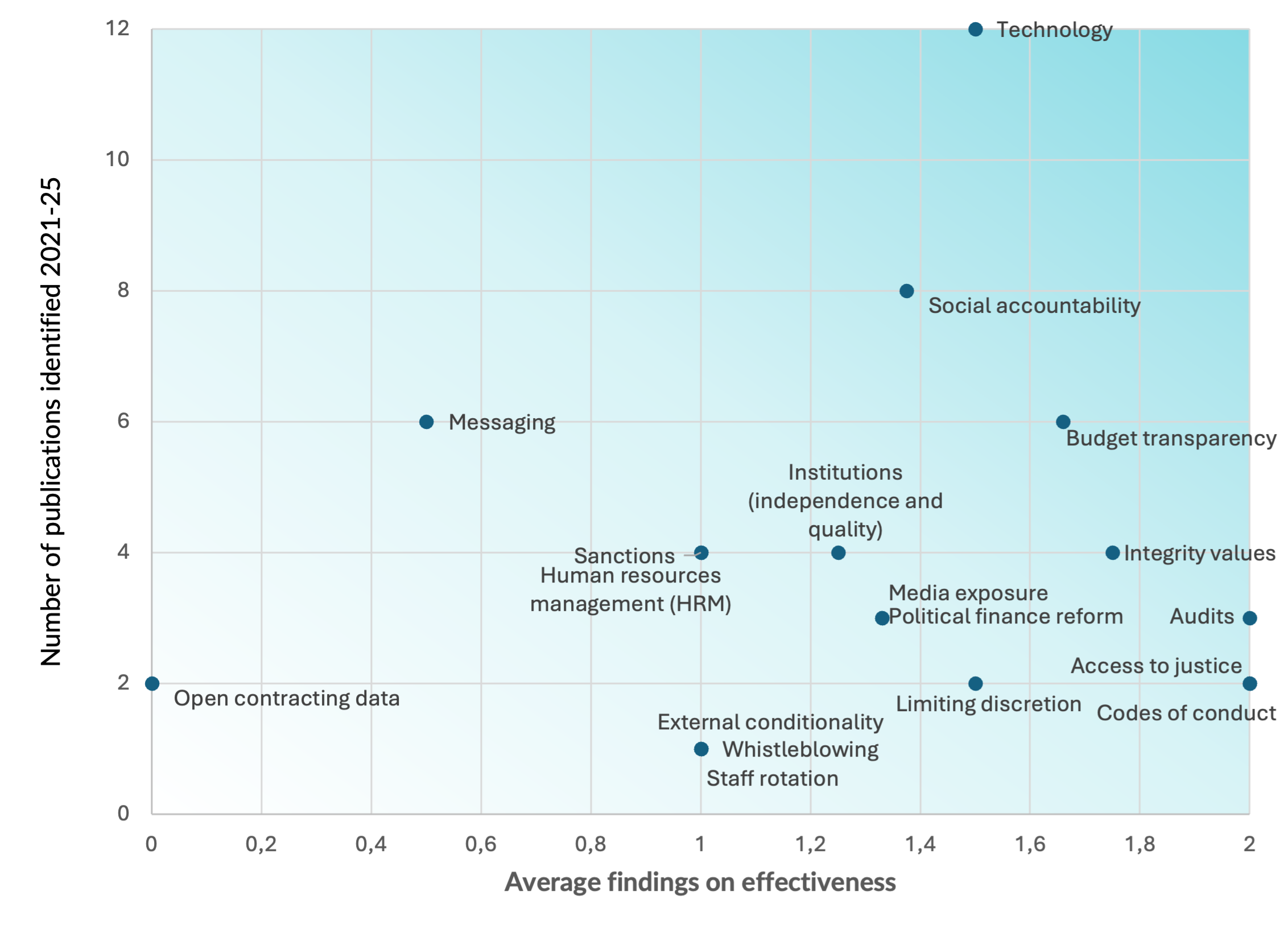
The X axis ranges from 0, indicating insignificant effectiveness, to 2 indicating significant effectiveness.
Some findings from the grid include:
Technology, social accountability and budget transparency are anti-corruption interventions which are generally found to be effective and supported by a number of publications.
Significant effects are also found for audits, improved access to justice, codes of conduct and interventions based on integrity and ethical values, but with fewer publications backing them up.
Media exposure, political finance reforms, whistleblowing protection, staff rotation, external conditionality, sanctions, human resources management and institutions appear to be effective subject to the existence of specific conditions, although the limited number of publications signals that further studies are warranted. The same is also the case for sanctions, human resources management and institutions.
While a fairly high number of publications are dedicated to anti-corruption messaging, the findings paint a more mixed picture. This is also the case for open contracting data where effectiveness was found to be insignificant, although this is based on very few studies.
Overall, the effectiveness of anti-corruption interventions continues to be understudied relative to investments in such interventions, particularly when it comes to project evaluations and grey literature.
On the whole, the number of studies on the effectiveness of anti-corruption interventions on reducing corruption in the last five years is limited, with only 55 in total found during this review.443a24221900 There could be a number of different reasons for this. Corruption is inherently difficult to measure. It encompasses a broad spectrum of offences and is, by nature, a concealed activity, which makes capturing it with confidence and accuracy particularly challenging (UNDP 2022:11). As a result, attributing reductions in corruption to any single anti-corruption intervention, across any sector or form, is a complex undertaking. Measuring the impact of such interventions through project evaluations also demands considerable time and resources, which many donor funded projects may not have. Nevertheless, academic literature continues to deploy innovative methods and provide evidence to support what may or may not be effective in the field, which can help policymakers and development practitioners to invest in interventions that work in practice.
A review of the literature from 2021 to 2025
Study type: An attempt has been made to categorise the publications into different kinds of studies. Further details about the research methods employed and data relied on are included in brackets.
Effectiveness findings: In addition to the main findings on the effectiveness, this column highlights any important contextual conditions identified by the authors; for example, if the findings are valid or only pertain to a particular type of corruption as opposed to others. In several cases, especially in studies which have a multi-thematic focus, other main findings which do not pertain to corruption or anti-corruption are not included in the summary.
Evidence observations: In order to manage scope, in many cases, this column only highlights selected observations on evidence made by the author(s). As mentioned above, the priority focus is whether or not the research method applied has implications for the generalisability of findings.
|
Type of anti-corruption intervention |
Study (citation and link) |
Type of study |
Findings on effectiveness |
Observations of evidence |
|
Access to justice |
Hansen, A. and Robert, P. 2022. Mid-term Review of IMPACT - ‘Improving Accountability through Fighting Corruption and Increased Access to Justice’. IMPACT programme. |
Project evaluation |
Significant effects The project found that facilitating access to justice through legal aid projects showed encouraging signs of increasing identification of high-level corruption and other crimes as a result of improved investigation and prosecution capacity. It also helped to strengthen the rule of law and legitimacy of the government more broadly. |
The evaluators noted that to fully assess the impact, this would need to re-evaluated in the longer term.
|
|
Pedersen, K. and Johannsen, L. 2023. When Corruption Hits the Judiciary: a Global Perspective on Access to Justice and Corruption.
|
Quasi-experimental |
Significant effects The study found that there is a two-way negative relationship between perceived levels of access to justice and perceived levels of corruption. The authors conclude that reforms improving access to justice could be an effective measure to curb corruption. |
The authors recognised that statistical limitations means their findings may be inconclusive in proving causality. |
|
|
Audits |
Fonseca, T.D.N. and Izumi, M.Y. 2025. Audit Risk and Wealth Accumulation: When Politicians Give up on Corruption. Journal of Politics in Latin America. |
Experimental (ordinary least squares – OLS – regression; survey data) |
Significant effects Mayors who were informed of having a high probability of being audited accumulated less wealth (46% decrease) compared to mayors with lower chances of facing an audit, suggesting that audit risk awareness demotivates politicians from corruption. |
The study relies on self-reported wealth data and acknowledges the mayors may have withheld information. |
|
Bobonis, G.J., Gertler, P.J., Gonzalez-Navarro, M. and Nichter, S. 2025. Does Combating Corruption Reduce Clientelism? The Economic Journal. |
Experimental (regression analysis; field survey data) |
Significant effects The study found that randomised audits effectively reduced politicians’ provision of electoral campaign handouts, with a 51% decrease in the 2012 electoral year. Audits also decreased citizens’ demands for private goods (21% decrease) and reduced such requests fulfilled by politicians (44% decrease). |
The authors distinguish between corruption and clientelism and note their study does not empirically test a link between both. They also note more empirical research would be needed to explore whether the findings hold beyond Brazil, from where the data is sourced. |
|
|
Keefer, P. and Roseth, B. 2024. Transparency and Grand Corruption: Lessons from the Colombia School Meals Program. Journal of Comparative Economics. |
Experimental (field informal audits and survey data) |
Significant effects The study finds that informal audits, in addition to mobilisation of parents as monitors, were effective in reducing wholesalers shirking their contractual responsibilities to provide meals to schools. |
The experiment was implemented in 208 schools in 60 municipalities. The authors acknowledge the possible presence of bias deriving from mixed response rates to the surveys. The study conceptualises shirking on contractual responsibilities as a form of grand corruption (e.g. political ties), but does not account for the possible occurrence of shirking without the involvement of such corruption. |
|
|
Budget transparency |
Chen, C. and Ganapati, S. 2023. Do Transparency Mechanisms Reduce Government Corruption? A Meta-Analysis. International Review of Administrative Sciences. |
Literature review (meta-analysis of empirical studies) |
Significant effects Transparency has an overall impact, although a small effect in reducing corruption; fiscal transparency and e-transparency were found to play the strongest roles in reducing corruption, while legal transparency, political transparency and governance of natural resources were less significant. |
The study finds that transparency mainly reduces perception of corruption (through CPI scoring) rather than objective measures. The authors also rely on a small sample size of literature (56 publications). |
|
Parra, D., Muñoz-Herrera, M. and Palacio, L.A. 2021. The Limits of Transparency in Reducing Corruption. Journal of Behavioral and Experimental Economics. |
Experimental (laboratory game) |
Significant effects under limited conditions The study found that the more transparency that existed regarding the amount of budget resources in the game, the less likely embezzlement attempts became. However, no significant effect on bribery was found. |
The authors treat their findings with caution, noting that actors in the game may misrepresent their actions for strategic reasons. |
|
|
Montes, G.C. and Luna, P.H. 2021. Fiscal Transparency, Legal System and Perception of the Control on Corruption: Empirical Evidence from Panel Data. Empirical Economics.
|
Observational (panel data) |
Significant effects The study finds that more transparent fiscal practices lead to a decrease in perceived levels of corruption. This effect becomes more significant in countries where rule of law is stronger.
|
The study relies on two perception based indices for corruption (the Control of Corruption Perception Indicator from the World Bank WGI data base and the Corruption Perceptions Index) and the Open Budget Index to measure fiscal transparency. The authors do not recognise any limitations. |
|
|
Bisogno, M. and Cuadrado-Ballesteros, B. 2022. Budget Transparency and Governance Quality: A Cross-Country Analysis. |
Quasi experimental (Regression analysis; econometric data) |
Significant effects The study found that increased levels of budget transparency (at the central government level) were positively associated with control of corruption. |
The study relies on the Open Budget Index and the Worldwide Governance Indicators. The authors acknowledge the robustness of findings would have been strengthened by testing alternative indicators of budget transparency and governance. |
|
|
Upadhaya, B., Soobaroyen, T., Ntim, C., Adhikari, P., Jayasinghe, K., Zalata, A. and Haque, F. 2024. To What Extent Do Public Financial Management Systems Support Fiscal Transparency and Public Accountability? |
Mixed method (observational study based on econometric analysis and case study based on qualitative field research) |
Significant effects under limited conditions The econometric analysis found a strong association between the quality of public financial management (PFM) systems and perceived levels of corruption in developing countries. However, qualitative interviews with local informants highlighted the limitations of PFM systems in controlling corruption. |
The authors acknowledge a small sample size and number of observations relied on for the econometric analysis. |
|
|
Lehtinen, J., Locatelli, G., Sainati, T., Artto, K. and Evans, B. 2022. The Grand Challenge: Effective Anti-Corruption Measures in Projects. International Journal of Project Management. |
Literature review |
Significant effects The study found that project-level transparency was the most decisive mechanism in determining the effectiveness of anti-corruption measures (categorised as compliance, managerial, probing, reactive and regulatory) in construction projects. |
The review identified a sample of 42 articles for inclusion but recognised that the quality of empirical evidence varied across these. |
|
|
Codes of conduct |
Le, N.T., Vu, L.T. and Nguyen, T.V. 2021. The Use of Internal Control Systems and Codes of Conduct As Anti-Corruption Practices: Evidence from Vietnamese Firms. Baltic Journal of Management.
|
Observational (cross-sectional analysis; survey data) |
Significant effects The study statistically analysed survey data from Vietnamese firms and found that the use of codes of conduct appears to reduce bribe payments. |
The authors acknowledge limitations in the dataset, including a low number of firms participating in the survey and that responses may be influenced by social desirability biases. Furthermore, they recognise that relying on cross-sectional data does not allow them to confirm causal relationships. |
|
Meyer-Sahling, J.H. and Mikkelsen, K.S. 2022. Codes of Ethics, Disciplinary Codes, and the Effectiveness of Anti-Corruption Frameworks: Evidence from a Survey of Civil Servants in Poland. Review of Public Personnel Administration. |
Quasi experimental (OLS regression; survey data) |
Significant effects The study finds that the combination of disciplinary codes and codes of ethics reduce the perceived levels of kickbacks in public administration, but that neither achieves this in isolation.
|
The authors note their study relies on a limited sample from a survey of civil servants in Poland and they cannot assume that the findings apply in other settings. They also note their study is based on the perception of kickbacks, which is not indicative of the actual behaviour of civil servants. |
|
|
External conditionality |
Martin, J.P. and Hajnal, Á. 2025. Trials and Errors: Limitations of Anti-Corruption and Rule-of-Law Policies in the Context of Systemic Corruption. The Case of Hungary. Public Integrity. |
Case study (systemic policy evaluation) |
Significant effects under limited conditions The research assessed 27 anti-corruption and rule-of-law measures prescribed by the European Union (EU) for Hungary and found that while the conditions had some positive, incremental anti-corruption impact, they failed to address systemic corruption. |
The authors recognise that their findings are based on a single case, meaning generalisation is limited. They also acknowledge the analysis covers a short timeframe and measures may take longer to be implemented. |
|
Human resources management |
Demirgüç-Kunt, A., Lokshin, M. and Kolchin, V. 2021. Effects of Public Sector Wages on Corruption: Wage Inequality Matters. World Bank Policy Research Working Paper 9643. |
Quasi experimental (OLS and fixed effects regression; longitudinal panel and micro-level data) |
Significant effects under limited conditions The study identifies two main effects: i) in countries with low public sector wage inequality, increasing the wages of public officials may help reduce corruption; ii) in countries where public sector wages are highly unequal, raising the wages of government employees may increase corruption. |
The authors do not acknowledge any limitations but instead argue their findings “are robust to a wide range of empirical model specifications, estimation methods, and distributional assumptions”. |
|
Heggedal, T.R., Helland, L. and Morton, R. 2022. Can Paying Politicians Well Reduce Corruption? The Effects of Wages and Uncertainty on Electoral Competition. |
Experimental (regression analysis; laboratory data) |
Significant effects under limited conditions The study finds that higher wages for politicians leads to reduced rent-taking. However, this relationship is subject to significant variation if elections are characterised by voting behaviour along popularity or ideological lines. |
The authors acknowledge they do not explore alternative explanations for their findings such as alternative theories of social, psychological or moral motivations. |
|
|
Cooper, C.A. 2022. Encouraging Bureaucrats to Report Corruption: Human Resource Management and Whistleblowing. Games and Economic Behavior. |
Quasi-experimental (survey data) |
Significant effects under limited conditions This study finds bureaucrats’ belief that merit based recruitment and opportunities for promotion within their organisation is positively associated with their likelihood to report corruption. Conversely, this relationship was not affected by bureaucrats’ belief “in the permanency of their job, satisfaction with remuneration, turnover intention or organisational commitment”. |
The study relies exclusively on data from the 2018 Australian public service employee census (APSEC), which the authors acknowledge may entail a common-source bias and that further research could investigate other countries with different administrative traditions. The study does not test if human resources management reforms lead to a lower propensity to engage in corruption, but only to report it. |
|
|
Nieto‐Morales, F. and Ríos, V. 2022. Human Resource Management As a Tool to Control Corruption: Evidence from Mexican Municipal Governments. Public Administration.
|
Quasi experimental (multilevel regression; census data and microdata) |
Significant effects under limited conditions The study finds that certain HRM policies (merit based recruitment, performance and departmental evaluations and more equal remuneration structures) led to a reduction in the misappropriation of local government funds. The study found no significant effects of other policies (employment protection and the probability of employee dismissal). |
The study relies on a dataset of US$5.22 million audited in 545 local Mexican governments over 3 years as well as census data of local governments on their HRM policies. The authors acknowledge the reliance solely on Mexican data may have implications for the generalisability of the findings as Mexico has higher estimates of corruption but also significant subnational variation. |
|
|
Institutions (independence and quality) |
Nonki Tadida, E.Z. 2023. Public Auditing: What Impact Does the Quality of the Institutional Framework Have on the Level of Corruption? International Review of Administrative Sciences. |
Quasi experimental (multivariate regression; cross-sectional data) |
Significant effects under limited conditions The study found a positive relationship between supreme audit institutions (SAIs) with a high-quality institutional framework and lower perceived levels of corruption, although the effect was weak. |
The study relies on the World Bank’s Control of Corruption Index and the indicators from the International Budget Partnership (IBP) database to measure the quality of SAIs’ institutional frameworks, although it notes that this database does not touch any important aspects such as SAI’s cooperation with the judiciary. |
|
Campbell, J.W. and Danar, O.R. 2025. Institutional Independence, Credible Commitment, and Anti-corruption Reform Failure in Developing Contexts: Three Illustrative Examples from Indonesia. Public Integrity. |
Case study (multiple cases; comparative) |
Insignificant effects The study finds that elite capture of anti-corruption reforms and the weakening of the independence of anti-corruption institutions undermines those reforms. |
The study relies on three recent and linked cases from Indonesia, meaning findings may not be generalisable. |
|
|
Saha, S. and Sen, K. 2023. Do Economic and Political Crises Lead to Corruption? The Role of Institutions. Economic Modelling. |
Quasi-experimental (regression analysis; panel data) |
Significant effects The study found that institutions in countries with strong rule-of-law levels are an effective control on corruption during political and economic crises. |
The study relies on V-DEM data to measure the quality of institutions, political and economic crisis and control of corruption, which is based on expert judgements. |
|
|
Taylor, I.W., Ullah, M.A., Koul, S. and Ulloa, M.S. 2022. Evaluating the Impact of Institutional Improvement on Control of Corruption—A System Dynamics Approach. Systems.
|
Mixed methods (systems dynamics model and case studies) |
Significant effects The study found that improving institutional quality can lead to greater control of corruption. |
The study derives a model based on World Bank data on control of corruption and institutional quality indicators. The model was only applied to 13 institutions in three countries (Pakistan, India and Canada); the authors argue that more representative time-series data may be needed. |
|
|
Integrity and ethics |
Corrado, G., Corrado, L. and Marazzi, F. 2025. Transparency Reduces Bribery by Shaping Beliefs in a Public Goods Experiment with Corruption Opportunities. Nature. |
Experimental (random-effect tobit regressions; public goods game) |
Significant effects The study found find that when information about corruption is transparently communicated, individuals are less inclined to act corruptly, aligning their personal actions with the collective interest. |
Generalisability of its results due to it being a laboratory experiment. The “bureaucrat” that they are dealing with is also computerised, which removed the additional complexities of social norms, meaning that it does not necessarily capture all the nuances of real social interactions. |
|
Williams, S. 2024. Leveraging Behavioral Insights to Mitigate Public Procurement Corruption in Nigeria. Africa Growth Initiative at Brookings. |
Literature review (case studies) |
Significant effects under limited conditions Nudges work when there is sustained research, advocacy, action and refinement. Post-intervention evaluations are also important, and positive or “friendly” nudges have a better effect. However, there are contextual nuances that are important to consider in the design of nudges. |
This is a case study review and the actual tests were carried out by different bodies, with different methodologies. |
|
|
Tanner, C., Linder, S. and Sohn, M. 2022. Does Moral Commitment Predict Resistance to Corruption? Experimental Evidence from a Bribery Game. PLoS ONE.
|
Experimental (multivariate regression; survey data) |
Significant effects The study found that people who treat compromises to integrity as unacceptable were less willing to accept bribes. Furthermore, the higher a person scored on the honesty-humility trait,1 the less likely they were to give a bribe. These findings hold across key demographic variables such as age and gender as well as personal traits such as risk tolerance and dispositional greed. |
The authors recognise certain limitations, including the relatively small sample size (76) and that the experiment was conducted with student participants rather than practitioners, meaning it was unclear if the findings would hold in real-life settings. |
|
|
Meyer-Sahling, J.H. 2022. Civil Service Reform and Anti-Corruption: Can Ethics Training Reduce Corruption in the Civil Service? |
Experimental (survey data) |
Significant effects The research project preliminarily2 found that civil servants’ participation in an ethical training had a positive effect on their willingness to decline offered gifts, including observed changes in behaviour in the short-term. |
The survey is based on ethical leadership training of 1,404 police officers in a district of Bangladesh. |
|
|
Limiting discretions |
Decarolis, F., Fisman, R., Pinotti, P. and Vannutelli, S. 2025. Rules, Discretion, and Corruption in Procurement: Evidence from Italian Government Contracting. NBER Working Paper No. 28209. |
Quasi-experimental (regression analysis; panel data) |
Significant effects under limited conditions The study finds that greater discretion leads to higher opportunities for theft/corruption, but a central monitor manages this trade-off by limiting discretion. Discretion is not necessarily a risk when there is high enough competition between bidders. |
The study relies on a database of 200,000 procurement auctions in Italy between 2000 and 2016. The authors do not note any limitations in their study. |
|
Szucs, F. 2024. Discretion and Favoritism in Public Procurement. Journal of the European Economic Association. |
Quasi-experimental (structural model; panel data) |
Significant effects The study found that when procurement officers had discretion to select contractors, it led to increased prices, the selection of more unproductive contractors and benefited firms with connections to the governing political party in Hungary. The findings suggest that raising the threshold for discretionary procurement decisions could reduce political favouritism. |
The author does not acknowledge limitations in the method applied. The method includes testing and ruling out alternative mechanisms. |
|
|
Media exposure |
de Figueiredo, M.F., Hidalgo, F.D. and Kasahara, Y. 2023. When Do Voters Punish Corrupt Politicians? Experimental Evidence from a Field and Survey Experiment. British Journal of Political Science. |
Experimental (simple linear regression; field and survey data) |
Significant effects under limited conditions Informing voters of candidates’ record reduced turnout by 1.9 percentage points and increased the opponent’s vote by 2.6 percentage points, meaning that challenger’s supporters are more willing to punish their candidate for corruption; however, this is not seen with the incumbent. |
The experiment was conducted during a real-life election, but the results only reflect a small region and a mayoral election. |
|
Schechter, L. and Vasudevan, S. 2023. Persuading Voters to Punish Corrupt Vote-Buying Candidates: Experimental Evidence from a Large-Scale Radio Campaign in India. Journal of Development Economics. |
Experimental (OLS regression; survey data) |
Significant effects The study found that a radio campaign emphasising that electing corrupt vote-buying politicians has a significant social cost led to a decrease in voting for parties that engaged in vote buying.
|
The findings relied on official electoral data and were crosschecked by a voter survey. The authors acknowledge one limitation in that they relied on journalist interviews to identify which parties engaged in the most vote buying. |
|
|
Van Klaveren, C., Murshed, S.M. and Papyrakis, E. 2024. Media Credibility and Voter Penalization of Corrupt Politicians in Latin America. Latin American Politics and Society. |
Experimental (survey data) |
Significant effects under limited conditions The study finds that when voters’ likelihood to penalise corrupt politicians is not significantly affected by whether the corruption allegation was made on social media or in the written press, but that likelihood decreased significantly where the allegation was posted anonymously on social media. |
The authors acknowledge certain external validity challenges with their methodology; for example, the experiment did not control for the affiliation respondents may have to certain political parties. |
|
|
Messaging |
Erlich, A. and Gans‐Morse, J. 2025. Can Norm‐Based Information Campaigns Reduce Corruption? American Journal of Political Science. |
Experimental (OLS regression; survey and laboratory data) |
Significant effects under limited conditions Injunctive norm-based information campaigns have small, temporary effects but these are unlikely to inspire large-scale transformations in behaviour. Descriptive norm-based campaigns provide more lasting effects for subjects who already find such messaging credible. |
The authors do not note any methodological limitations in their study, but note their findings are not commensurate with other studies finding the existence of a “backlash effect”. |
|
Köbis, N.C., Troost, M., Brandt, C.O. and Soraperra, I. 2022. Social Norms of Corruption in the Field: Social Nudges on Posters Can Help to Reduce Bribery. Behavioural Public Policy. |
Experimental (probit and binary regression analyses; lab-in-the-field data) |
Significant effects The study found that descriptive norms messages on posters lead people to perceive bribery to be less common and that they engage in bribery less frequently. |
The authors acknowledge certain limitations in their design, such as the fact the experiment was held over a relatively short timeframe in a single location. |
|
|
Cheeseman, N. and Peiffer, C. 2022. The Curse of Good Intentions: Why Anticorruption Messaging Can Encourage Bribery. American Political Science Review. |
Experimental (logistic regressions; field survey data) |
Counterproductive effects The anti-corruption messages were found to either have no effect or made the participants more likely to pay a bribe. This suggests that there are collective action problems which are self-reinforcing. |
This study used data conducted in Lagos, Nigeria, meaning there are limitations in the diversity of participants. The game was a simulation on a tablet, and the “messaging” is not reflective of a real-life situation. |
|
|
Claus, C., Köhler, E.A. and Krieger, T. 2022. Can Moral Reminders Curb Corruption? Evidence from An Online Classroom Experiment. CESifo Working Paper No. 9670. |
Experimental (logistic regression; data from online classroom experiment) |
Significant effects under limited conditions They find that a deontological moral reminder (stating that corruption in the context of the COVID-19 pandemic is immoral) is more effective than consequentialist treatment (that corruption would be at the expense of taxpayers). |
The study had a large sample size (1,050 participants). The authors acknowledge that the findings may not be generalisable beyond the local context of the experiment (German universities during COVID-19 pandemic). |
|
|
Incio, J. and Seifert, M. 2024. How the Perception of Corruption Shapes the Willingness to Bribe: Evidence from An Online Experiment. International Journal of Public Opinion Research. |
Experimental (regression analysis; survey data) |
Counterproductive effects The study found that exposure to both injunction and descriptive norm-based messages on corruption increased the overall probability of engaging in bribery, signalling a potential backfire effect of messaging. The results varied depending on the public service exchanged for the bribe (for example, with higher probability for health services), as well as gender and age. |
The study had a relatively high sample of participants (2,584). The authors acknowledge the context in which the experiment was implemented (Peru in the aftermath of the COVID-19 pandemic) could have had a bearing on some of the results. |
|
|
Stahl, C. 2022. Behavioural Insights and Anti-Corruption a Practitioner-Tailored Review of the Latest Evidence (2016–2022). Basel Institute on Governance. |
Literature review |
Significant effects under limited conditions Corruption messaging should be framed as a general issue that everyone can understand, using normative language. However emphasising overly negative impacts of corruption is not as effective; instead, focusing on integrity and ethics is more effective. |
The studies reviewed did not all flesh out a theory of change to help spell out and test the expected pathways to elicit change in the desired outcomes. |
|
|
Open contracting data |
Duguay, R., Rauter, T. and Samuels, D. 2023. The impact of Open Data on Public Procurement. Journal of Accounting Research.
|
Quasi-experimental (OLS regression; cross-sectional data) |
Significant effects under limited conditions After the introduction of an EU open data initiative, procurement officials were more likely to award contracts through competitive bidding. |
The authors do not note any methodological limitations in their study. |
|
Martinez, T.M. and Whitley, E.A. 2023. Open Data As An Anticorruption Tool? Using Distributed Cognition to Understand Breakdowns in the Creation of Transparency Data. Data & Policy. |
Case study |
Counterproductive effects The study finds that instead of reducing corruption, open contracting data can introduce new opportunities for control if individuals and institutions succeed in manipulating data flows. |
The study relies on a single case – focusing on the open data efforts undertaken by a Brazilian procurement agency – meaning the generalisability of findings is limited. |
|
|
Political finance reform |
Hummel, C., Gerring, J. and Burt, T. 2021. Do Political Finance Reforms Reduce Corruption? British Journal of Political Science. |
Quasi experimental (regression analysis; cross-sectional data) |
Significant effects The study finds political finance subsidies are negatively associated with estimated levels of political corruption. The authors attribute this to the reduced importance of private money in politics and an increase in sanctions for corrupt behaviour. |
The study relies on V-DEM data to measure political corruption which it recognises may be limited due to being based on expert perceptions. The study provides for some robustness checks by testing alternative dependent variables (such as Transparency International and World Bank data), finding similar results. |
|
Lipcean, S. and Casal Bértoa, F. 2024. Do Political Finance Reforms Really Reduce Corruption? A Replication Study. Research and Politics.
|
Quasi experimental (fixed effects regression; cross-sectional data) |
Significant effects under limited conditions This replication study of Hummel et al. (2021) did not lead to significantly different findings, but found regional contexts substantially affect the negative relationship between political finance subsidies and political corruption, and that methodological challenges cast doubt on the reliability of their results. |
The focus of this paper was on testing a previous study; the authors do not note any limitations in their study. |
|
|
Crepaz, M. and Arikan, G. 2024. The Effects of Transparency Regulation on Political Trust and Perceived Corruption: Evidence from a Survey Experiment. Regulation & Governance. |
Experimental (multivariate regressions; survey data) |
Significant effects under limited conditions Transparency in political donations improves trust in political parties, while asset declaration for conflict-of-interest prevention reduces perceptions of corruption toward MPs. However, transparency in lobbying is found to have no impact on attitudes toward business interest groups. |
While there was a generally large sample (1,373 participants from Ireland), the authors note their findings may not be replicable across other contexts. Furthermore, they note the one-off experiment approach cannot capture any long-term, lagged effects. |
|
|
Sanctions |
Bahník, Š. and Vranka, M.A. 2022. Experimental Test of the Effects of Punishment Probability and Size on the Decision to Take a Bribe. Journal of Behavioral and Experimental Economics. |
Experimental (mixed-effect linear regression; laboratory data) |
Significant effects under limited conditions The authors did not observe any clear negative effects of small-level punishment; however, they did find that the effectiveness of punishment depends on people’s emotionality and their honest-humility personality traits. Therefore, the threat of punishment can reduce bribery, but the kind of personality should also be considered when designing deterrence policies. |
The authors do not note any limitations of the study. |
|
Freedberg, S.P., Kehoe, K. and Armendariz, A. 2022. As US-Style Corporate Leniency Deals for Bribery and Corruption Go Global, Repeat Offenders Are on the Rise. International Consortium of Investigative Journalists – ICIJ. |
Literature review (of legal cases) |
Insignificant effects ICIJ identified 34 cases of companies that entered into corporate deferred and non-prosecution agreements for bribery or fraud, and then were subject to subsequent similar allegations, suggesting the settlement did not have a deterrent effect on these “repeat offenders”. |
The analysis does not explain how many cases were considered, therefore making it difficult to assess if 34 cases of repeat offenders represents a small or large portion of these. |
|
|
Mugellini, G., Della Bella, S., Colagrossi, M., Isenring, G.L. and Killias, M. 2021. Public Sector Reforms and Their Impact on the Level of Corruption: A Systematic Review. Campbell Systematic Reviews. |
Literature review (meta-analysis) |
Significant effects The study finds that monetary sanctions or the risk of an audit are more effective in reducing administrative forms of corruption than interventions focused on organisational, cultural and educational interventions. They found this effect was stronger for countering embezzlement and misappropriation than bribery.
|
The meta-analysis identified a relatively low number (29) of studies for inclusion, predominately laboratory experiments. The authors acknowledge such methods may be less able to identify longer term effects, which may be more relevant for organisational and cultural interventions. |
|
|
Axbard, S. 2025. Convicting Corrupt Officials: Evidence from Randomly Assigned Cases. Review of Economic Studies. |
Quasi-experimental (multivariate analysis) |
Significant effects under limited conditions The study finds a strong deterrent effect of convictions of corrupt officials among bureaucrats, estimating a reduced likelihood of embezzlement by roughly 50%. Convictions did not have a significant deterrent effect on politicians where they led to lower electoral accountability (where convicting political opponents of the incumbent leads to a reduction in political competition) but could have a deterrent effect where term-limited politicians were convicted (thus having no implications for political competition). |
The study relies on a relatively large dataset of 1,073 corruption cases against 1,968 defendants at the municipality/city level in Indonesia from 1979 to 2015. The author performs several additional empirical tests to explore whether alternative explanations for the findings exist.
|
|
|
Social accountability |
Angelucci, C. and Russo, A. 2022. Petty Corruption and Citizen Reports. International Economic Review.
|
Other (game theoretical model testing) |
Significant effects under limited conditions The authors find that a simple self-reporting scheme helps reduce bribery and extortion but must include a level of trust in the government, meaning that the government must commit to not punish self-reporting entrepreneurs. Without communication from the government, paying officials more when they deny permits deters bribery but encourages extortion. However, with communication, they introduce a self-reporting scheme, which is considered only worthwhile when extra wage and administrative costs are smaller than the social damage avoided. |
The authors do not note any limitations in their study. |
|
Kamei, K., Putterman, L., Tabero, K. and Tyran, J.R. 2024. Civic Engagement As a Constraint on Corruption. CESifo Working Paper. |
Experimental (generalised least squares – GLS – regression; laboratory game) |
Significant effects The study finds that civic engagement is effective in constraining corruption. These effects are stronger when citizens encourage each other to provide civic engagement through social approval. |
The authors argue their findings are robust to framing and that the laboratory experiment results mirror self-reported engagement in the field. |
|
|
Zarychta, A., Benedum, M.E., Sanchez, E. and Andersson, K.P. 2024. Decentralization and Corruption in Public Service Delivery: Local Institutional Arrangements that Can Help Reduce Governance Risks. Journal of Public Administration Research and Theory. |
Quasi-experimental (logistic regressions; survey data) |
Significant effects under limited conditions External supervision and civil society engagement serve to attenuate the higher levels of corruption reported under decentralisation reform, while public participation does not lower corruption. |
The study focuses only on the health sector in Honduras and the data (from health workers) was from 2016-2017; the authors recognise future studies could examine trends over time. |
|
|
Schnell, S. 2023. To know is to Act? Revisiting the Impact of Government Transparency on Corruption. Public Administration and Development. |
Literature review |
Significant effects under limited conditions The study finds that citizens effectively detect and report corruption, even in contexts where corruption is widespread, but only where they treat it as a salient issue and they have some expectation that corruption will be sanctioned.
|
The study reviewed a total of 114 publications (although not all of these focused on social accountability). |
|
|
Vieira, J.B. 2023. How Social Accountability Fosters Public Integrity: the Role of Public Policy Councils in Curbing Corruption. Revista de Sociologia e Política. |
Quasi-experimental (regression analysis and propensity score matching)
|
Significant effects The study found that active and operational public policy councils3 were associated with a significant reduction in the occurrence of corruption cases in Brazilian municipalities. |
The study relies on a sample of 1,223 randomly selected Brazilian municipalities from years 2006 to 2015. The author acknowledges further studies could be needed to unpack what makes public policy councils effective by, for example, including the role of civil society dynamics. |
|
|
Waheduzzaman, W. and Khandaker, S. 2022. E‐Participation for Combating Corruption, Increasing Voice and Accountability, and Developing Government Effectiveness: A Cross‐Country Data Analysis. Australian Journal of Public Administration.
|
Quasi-experimental (OLS regression; panel data) |
Significant effects The study found e-participation levels were negatively associated with perceived corruption levels. E-participation levels were also negatively associated with government effectiveness but had an insignificant relationship with voice and accountability, as both are measured under the Worldwide Governance Indicators. |
The authors acknowledge their study considers all nations as a single variable, and more research would be needed to disaggregate effects for developed, developing and least-developed nations. |
|
|
Pring, C. et al. 2022. End-of-Project Evaluation of Transparency International’s Integrity Pacts EU Project. |
Project evaluation |
Significant effects under limited conditions The evaluation found several examples of integrity pacts4 leading to reduced corruption in monitored procurements. |
The project involved the monitoring of 18 procurement projects, meaning a relatively small sample. Additionally, the conclusion that corruption had been reduced appears to be primarily based on key stakeholders’ interviews with no specific evidence at hand. |
|
|
Larsson, F. and Grimes, M. 2023. Societal Accountability and Grand Corruption: How Institutions Shape Citizens’ Efforts to Shape Institutions. Political Studies. |
Quasi-experimental (OLS regression; panel data) |
Significant effects under limited conditions The study finds that civil society strength is associated with lower levels of procurement corruption in regions where there are comparatively less favourable accountability conditions. However, the effect is marginal in regions where there are stronger transparency and meritocracy conditions. |
The study relies on single-bid data from 173 EU regions as an indicator of procurement corruption. The authors acknowledge their findings cannot speak to the mechanisms explaining the relationship between civil society strength and control of corruption. |
|
|
Staff rotation |
Fišar, M., Krčál, O., Staněk, R., & Špalek, J. 2021. Committed to Reciprocate on a Bribe or Blow the Whistle: The Effects of Periodical Staff-Rotation in Public Administration. Public Performance & Management Review. |
Experimental (laboratory data) |
Significant effects under limited conditions The study finds that rotation of staff in public administration reduces the rate of bribe acceptance and inefficient decisions caused by bribery. However, rotation did not influence the rate of firms offering bribes. |
The authors recognise that by using a laboratory experiment method, they face external validity concerns; for example, the behaviour of the students who took part in the experiment may differ from public officials or firm managers in the real-life settings that were mimicked. |
|
Technology |
Androniceanu, A., Georgescu, I. and Kinnunen, J. 2022. Public Administration Digitalization and Corruption in the EU Member States. A Comparative and Correlative Research Analysis. Transylvanian Review of Administrative Sciences. |
Observational (canonical correlation analysis – CCA – and regression analysis; panel data) |
Significant effects The results show that the level of e-government was found to be the best predictor of control of corruption and government effectiveness, suggesting that digitalised and less corrupt governments also made economies more competitive. They therefore recommend that the digitisation of public administration and services is a strategic objective of EU member states and should become a priority. |
The authors rely on the Corruption Perceptions Index (CPI) for control of corruption, which has methodological limitations.5 |
|
Barasa, L. 2021. Mobile Money Payment: An Antidote to Petty Corruption? African Economic Research Consortium Research Paper 453. |
Quasi experimental (probit regression analysis; panel data) |
Significant effects The study finds that adopting mobile money for financial transactions leads to a 3.1 percentage point reduction in bribe payments in firms in Kenya. They suggest this is because mobile money transactions leave behind a detailed trail of digital records. |
The study relied on a small sample size (104 firms), which is not necessarily representative of the entire population and the authors used propensity score matching to construct a credible comparison group with a small sample size (although their robustness check suggested the results were still stable). |
|
|
Castro, C. and Lopes, I.C. 2023. E-Government As a Tool in Controlling Corruption. International Journal of Public Administration. |
Quasi-experimental (regression analysis; panel data) |
Significant effects The study finds that e-government, accountability, political stability, economic wealth and the internet are all significant determinants of corruption; with e-government being a significant tool in anti-corruption by enhancing transparency and reducing discretional power. |
The study relies heavily on the CPI and the E-Government Development Index (EGDI), therefore methodological limitations apply. |
|
|
Martins, J., Veiga, L. and Fernandes, B. 2021. Does Electronic Government Deter Corruption? Evidence from Across the World. Núcleo de Investigação em Políticas Económicas e Empresariais (NIPE). |
Quasi-experimental (regression analysis; panel and cross-sectional data) |
Significant effects under limited conditions The study finds that e-government deters corruption and that this effect is stronger in countries that that are not classified as high-income and in countries where levels of press freedom are neither extremely low nor high. |
The study relies on longitudinal data for more than 170 countries for the period 2002-2017. The authors find the results are robust to alternative measures of corruption and e-government, as well as other estimation techniques. |
|
|
Puspita, A.C. and Gultom, Y.M. 2024. The Effect of E-Procurement Policy on Corruption in Government Procurement: Evidence from Indonesia. International Journal of Public Administration. |
Quasi-experimental (Difference-in-differences; panel data) |
Significant effects The study found that the use of e-procurement significantly reduced the incidence of procurement corruption in Indonesian provinces with relatively high government procurement expenditure. |
The study relies on a relatively small number of cases (103) all which were investigated by Indonesia’s corruption eradication commission (KPK) from 2005 to 2017, casting doubts on the generalisability of the findings. |
|
|
Setor, T.K., Senyo, P.K. and Addo, A. 2021. Do Digital Payment Transactions Reduce Corruption? Evidence from Developing Countries. Telematics and Informatics. |
Quasi-experimental (fixed effects regression; panel data) |
Significant effects This study finds digital payment transactions reduce the level of corruption in developing countries. |
The study relied on CPI data only from developing countries and acknowledges findings may not be generalised to non-developed countries. |
|
|
Sadik-Zada, E.R., Gatto, A. and Niftiyev, I. 2024. E-Government and Petty Corruption in Public Sector Service Delivery. Technology Analysis & Strategic Management.
|
Quasi-experimental (random tobit and linear regressions; panel data) |
Significant effects The study finds that the adoption of e-government innovations in the delivery of public services has led to the reduction of petty corruption in developing economies. |
The study does not ostensibly recognise limitations. However, it relies on only two datasets - United Nations E-Government Development Index (EGDI) and the CPI – to measure e-government and petty corruption respectively. |
|
|
Jiménez, A., Hanoteau, J. and Barkemeyer, R. 2022. E-Procurement and Firm Corruption to Secure Public Contracts: the Moderating Role of Governance Institutions and Supranational Support. Journal of Business Research. |
Quasi-experimental (tobit regressions; panel data) |
Significant effects under limited conditions The study finds that the adoption of an e-procurement system leads to a reduction in corruption reported by firms. However, this effect only becomes significant in the presence of quality governance institutions and supranational support. |
The study relies on a relatively large dataset (8,373 firms in 72 countries from 2008 to 2019 responding to the World Bank Enterprise Survey). The authors acknowledge certain limitations; for example, their methodology does not control for political ties held by firms. |
|
|
Addo, A. and Avgerou, C. 2021. Information Technology and Government Corruption in Developing Countries: Evidence from Ghana Customs. MIS Quarterly.
|
Case study (single case) |
Insignificant effects The study finds that the potential of IT to reduce petty corruption may not be realised in many developing countries where petty corruption practices are socially embedded and institutionally conditioned. |
While it draws on the experience of IT systems in Ghana customs agencies over 35 years, the authors acknowledge that by using a single case study approach, the outcome of IT anti-corruption interventions could be different in other settings. |
|
|
Kalesnikaite, V., Neshkova, M.I. and Ganapati, S. 2023. Parsing the Impact of E‐Government on Bureaucratic Corruption. Governance.
|
Quasi-experimental (OLS regression; panel data) |
Significant effects under limited conditions The study finds that e-government significantly reduces bureaucratic corruption, but this effect does not hold for services where there is direct contact between citizens and officials (for example, police officers). |
The study relies on AmericasBarometer data for 21 Latin American and Caribbean countries between 2008 and 2018 to measure corruption and scores on the EGDI to measure e-governance. The authors do not recognise limitations in their methodology, but note future studies could rely on data from other regions to test generalisability of the findings. |
|
|
Organization for Security and Co-operation in Europe (OSCE). 2022. Supporting Incremental Changes in the Fight against Corruption. |
Project evaluation |
Significant effects under limited conditions OSCE’s Tunduk digital ecosystem in the Kyrgyz Republic was noted as being the most effective anti-corruption achievement. The system was widely adopted and contributed to monitoring corruption risks in public procurement and other state spending. However, the effects it had on reducing corruption were considered limited by contextual factors such as change of government priorities and staff turnover. |
The claims about reducing corruption are based on key stakeholders’ interviews and there is no specific evidence at hand. |
|
|
UNDP. 2021. End of Project Evaluation of Anti-Corruption for Peaceful and Inclusive Societies (ACPIS) Global Project. |
Project evaluation |
Significant effects The project found that developing an SMS-based system for staff in the public sector to file complaints against possible cases of corruption (Phones Against Corruption) had impressive results, such as:
|
The study did not measure corruption levels but the number of complaints received. |
|
|
Whistleblowing |
Feinstein, S. and Devine, T. 2021. Are Whistleblowing Laws Working? a global study of whistleblower protection litigation. Government Accountability Project and the International Bar Association. |
Other (Legal Comparative study) |
Significant effects under limited conditions The study measures the success of whistleblower protection laws by the number of cases brought under it (rather than the outcome of cases). They find that the majority of countries do not have a high number of cases brought. For example, in many of the countries reviewed, the authors did not find any cases (despite there being whistleblower protection laws in the country). They conclude that these laws do not exist in a vacuum, and public awareness schemes and other initiatives (such as access to legal counsel, gender sensitivity, etc.) is important. |
The authors note that the lack of credible public data in the majority of countries hampered their study’s evaluation of the effectiveness of such laws. |
1 Honesty-humility is one of the six personality dimensions of the HEXACO personality model. In the study, an online questionnaire was used to assess participants’ honesty-humility score.
2 This research project was implemented under the Governance & Integrity Anti-Corruption Evidence (GI ACE) programme, hosted by the Centre for the Study of Corruption (CSC). The results described are preliminary in nature and derived from a publicly available presentation; no final report appears to have been published as of March 2026.
3 In Brazil, policy councils are active in fields such as health, education and social assistance. They are legally and administratively independent from the government, and most of their members come from civil society.
4 An Integrity Pact is both a signed document and approach to public contracting which commits a contracting authority and bidders to comply with best practice and maximum transparency. A third actor, usually a civil society organisation, monitors the process and commitments made. Monitors commit to maximum transparency and all monitoring reports and results are made available to the public on an ongoing basis (TI n.d. B)
5 Common criticisms and methodological concerns of the CPI include: that it does not cover private-sector corruption, transnational corruption or illicit financial flows), its overall concept as an expert-based assessment of corruption (which is seen as non-representative and perpetuating the views of international elites), its focus on perceptions (which do not always correlate with actual experiences of corruption such as reported cases of grand corruption, bribery, etc.), and the index’s inability to capture the impact of policy interventions.
- See Sauve, B., Woodley, J., Jones, N.J. and Akhtari, S. 2023. Methods of preventing corruption: A review and analysis of select approaches. Hanna, R., Bishop, S., Nadel, S., Scheffler, G. and Durlacher, K. 2011. The effectiveness of anti- corruption policy: What has worked, what hasn’t, and what we don’t know: a systematic review.; Johnsøn, J., Taxell, N. and Zaum, D. 2012. Mapping evidence gaps in anti-corruption: assessing the state of the operationally relevant evidence on donors' actions and approaches to reducing corruption; Department for International Development (DfID). 2015. Why corruption matters: understanding causes, effects and how to address them.
- For academic publications, inclusion is based on the date of publication listed by the cited journal. In some cases, earlier version of the publications may have been published too.
- The term sanctions has also been increasingly employed in the anti-corruption field to refer to the targeted measures introduced under state sanction regimes against persons suspected of corruption (Bergin 2024); however, the review for this Helpdesk Answer did not identify any literature which has attempted to measure their efficacy.
- The categorisations used here were inspired in part by the approach taken in Jackson, D. and Salgado Moreno, D. 2016. What works to curb political corruption? A review of the evidence base.
- Panel and longitudinal data are multi-dimensional data that involve measurements over time, whereas cross data observes many subjects at one point in time.
- Multivariate regression is used to measure the degree to which more than one independent variable (predictors) and more than one dependent variable (responses) are linearly related.
- To compare, data from the Global Anti-Corruption Blog bibliography (Stephenson 2022) indicates there was an average of 509 academic publications on corruption each year over the period 2016-2020 (the bibliography was not updated after this period, meaning a direct comparison over the 2021-25 period is not possible).