Query
Please provide an overview of the recent corruption and anti-corruption developments in Somalia.
Background
Somalia (the Federal Republic of Somalia) is in East Africa, on the Horn of Africa. It consists of five federal states: Jubaland, South West, Hirshabelle, Galmbudug and Puntland, while Somaliland unilaterally declared independence from Somalia in 1991, and its independence is still disputed (BTI 2024:9). Somalia currently has one of the lowest levels globally of development in the Human Development Index, and 52% of its population lives below the poverty line (UNDP 2023; Kemkhadze 2024).
Somalia is a fragile state with ongoing conflicts over how authority, funds and power are divided between the central government and federal states. Since the early 1990s, the country has been in a state of civil war, with militant groups fighting for territory against the internationally recognised Federal Government of Somalia (USCRI 2020). Today, large portions of the countryside remain under the control of Al-Shabaab, an Islamist group designated by many states as a terrorist organisation, while other areas are controlled by either clan militias or federal member state militias (BTI 2024:6).
Figure 1: Contested areas of Somalia
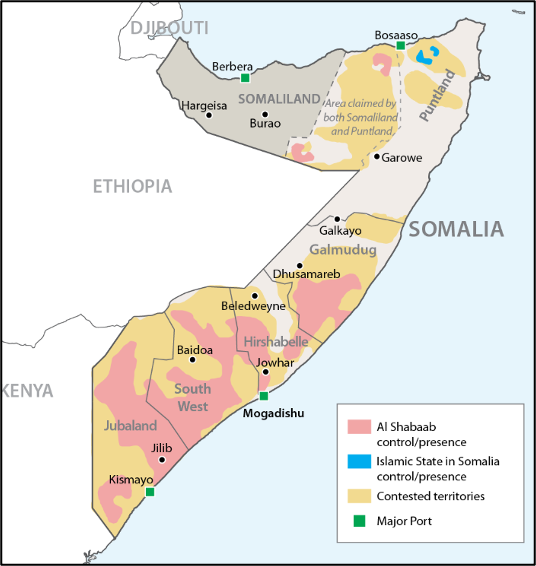
Source: Africa Centre 2025.
The state-building process in Somalia has been slow and hampered by corruption and nepotism, with public institutions and services unable to cater to the needs of the population (BMZ 2022). Human rights are notably not upheld, including civil and political rights as well as the freedom of the press (BMZ 2022). Somalia is also vulnerable to external shocks, such as in 2025 when the northern regions experienced a particularly extended drought due to below-average rainfall, which worsened water scarcity and food insecurity (European Commission 2025).
Due to the ongoing conflict and humanitarian challenges facing the country, approximately 714,000 Somalian refugees live abroad and almost 4 million are internally displaced, with at least 5.98 million people in Somalia in extreme need of humanitarian assistance (USCRI 2020; European Commission 2025). Civilian casualties caused by the armed group Al-Shabaab have been high, with the group responsible for around 65% of all recorded causalities, with state security forces, clan militias and international and regional forces responsible for the remaining 35% (Amnesty International 2024). There have been 648 documented cases of child recruitment in the conflict, and observers of the conflict consider gender-based violence to be widespread (European Commission 2025).
More recently, there have been further risks of destabilisation in the country due to tensions with Somaliland (Al Jazeera 2025). Tensions escalated following a memorandum of understanding agreed between Ethiopia and Somaliland, which saw Somaliland lease land to Ethiopia for a naval facility in return for Ethiopia’s recognition of its statehood (Amnesty International 2024). After a widespread backlash, however, Somalia and Ethiopia restored diplomatic representation in their respective capitals (Ali 2025). As of January 2026, Israel recognises Somaliland as a sovereign state, and the Israeli foreign minister visited the territory, leading to further tensions in the country (Al Jazeera 2026).
Given the complex humanitarian crisis in Somalia, protecting public funds as well as foreign aid (which accounts for approximately two-thirds of the state budget) is crucial to ensuring that the basic needs of the population are met (BTI 2024). However, corruption remains widespread in the country. It consistently ranks among the most corrupt countries globally on international indices. Some of those at the highest level of the central government have been accused of corruption as well as committing human rights abuses (USCRI 2020). As a result, efforts to promote transparency and accountability face significant structural and political challenges. Understanding the nature and impact of corruption is therefore essential for assessing governance failures and identifying pathways toward more effective humanitarian and development interventions.
Extent of corruption
Table 1: Somalia’s ranking and scoring on selected governance indicators
|
Worldwide Governance Indicators* |
Corruption Perceptions Index** |
UNCAC status |
||
|
Control of corruption |
Rule of law |
|||
|
Latest available data (year in brackets) |
12.64/100 (2014) 14.77.100 (2019) 11.70/100 (2024) |
18.61/100 (2014) 17.78/100 (2019) 19.01/100 (2024) |
9/100 (2024 score) 179/180 (2024 rank) |
Accession in 2021 |
* The Worldwide Governance Indicators by the World Bank Group. This is measured on a scale from 0 to 100. Higher values correspond to better governance.
** The Corruption Perceptions Index by Transparency International. This uses the scale of 0 (highly corrupt) to 100 (very clean).
There is limited data on Somalia, meaning scores on many governance indices are unavailable. Somalia is near the bottom of the Corruption Perceptions Index (CPI), ranking 179 out of 180 countries in 2024, with a score of 9/100 (Transparency International 2025). This indicates that it has a high level of perceived political corruption. It scores similarly low in the Worldwide Governance Indicators, with 11.7/100 for control of corruption and 19.01/100 for rule of law in 2024 (World Bank n.d.).
Bertelsmann Stiftung’s Transformation Index (BTI 2024) ranks Somalia 122 out of 137 countries on its governance index. It notes that there is no unified or common political leadership structure in the country and that the development of policies and strategic action plans are largely supported by international donors (BTI 2024). As a result, its anti-corruption policy coordination is very weak, and corruption remains endemic, which accounts for its low governance score (BTI 2024:36-38).
Forms of corruption
The following section gives an overview of four common forms of corruption described by the relevant literature. However, this is a non-exhaustive list and is only representative of the forms commonly included in recent analyses of the issue.
Bribery
Bribery is reported in everyday interactions in Somalia, varying from petty bribery between citizens and public officials in the form of facilitation payments, bribery to secure votes during the electoral process and large scale bribes paid to high-level political officials to secure government contracts and/or favours.
Recent empirical research provides an insight into the prevalence of bribery and facilitation payments in Somalia. This research was conducted by a non-governmental organisation (NGO), Marqaati, based in Mogadishu, between 2022 and 2023 reaching 1,037 individuals across the country (excluding Puntland and Somaliland). The study found that 12% of the respondents admitted to paying a bribe in the last year, with the rate in some areas of Mogadishu as high as 20% of respondents (Marqaati 2023:7). The study also found that 44% of bribes were taken by central government (the Federal Government of Somalia) security forces, while the police force alone was responsible for 33% of all bribes (Marqaati 2023:7).
However, the rate of complaints filed following bribery and extortion within Somalian government institutions remains low (Horn Observer 2023). Research into the reporting of corruption found that 93% of respondents who admitted to paying a bribe to a government institution did not file a complaint (Marqaati 2023). This was due to a lack of avenues to report to as well as the belief that no action would be taken as a result of the complaint made.
The literature identifies the election period as a time when bribery is particularly prevalent. Prices for electoral seats range from US$1,000 to US$20,000, leading some candidates to request bribes to cover the costs (Ahmed, Abdullahi and Hussein 2025). Similarly in 2016, the auditor general reported widespread cases of corruption and voter intimidation during the election (BBC 2016).
In Somalia, corruption significantly increases the cost of business through the price of bribes and the management cost of negotiating with corrupt officials. Businesses have been asked to pay bribes to secure commercial bank loans, with 55.3% reporting that bribes were necessary during the process (Afyare 2024). This is reflected in the World Bank’s Ease of Doing Business Index, where Somalia ranks last out of 190 countries, illustrating the complexity of doing business in the country (World Bank 2020). Bribery is also widespread in the customs administration where bribes are requested when clearing goods through the Mogadishu port (GAN Integrity 2020).
Bribery also affects international financial institutions that fund projects in Somalia. For example, in 2025, the director general of the Ministry of Environment and Climate Change was accused of exploiting his position to coerce organisations into paying bribes to secure their participation in environmental projects (Shabelle Media 2025). The Ministry of Finance is the only government entity that is authorised to engage directly with multilateral financial institutions and the Ministry of Environment and Climate Change had directly violated this mandate (Shabelle Media 2025). Other entities have reported extortion by the ministry, but it is unclear what the current status of this investigation is.
Finally, there have also been reports of censorship and bribery of media outlets by the government. Amnesty International alleged that public officials at the office of the president were reported to have paid monthly bribes to not publish unfavourable stories, often paid directly in cash to directors of media agencies (Amnesty International 2020).
Misuse and misappropriation of public funds
The misuse of public funds in Somalia has been widely documented. It often involves embezzlement and diversion of state funds, central bank resources, as well as aid given by donors in the form of aid, either in the form of cash, food or other resources.b7d6795de69a
The Bertelsmann Transformation Index notes (BTI 2024:38) that very few effective measures have been put into place in Somalia to increase transparency in public financial management and that a culture of impunity for public officials prevails. Sheikh (2023) notes that theft of aid in Somalia is systemic, with an entire ecosystem benefiting from the theft of aid, including refugee camp owners, local authorities, humanitarian workers and members of the security forces who intimidate and sometimes arrest those who refuse to pay. Some steal cash-based assistance by charging rent to displaced persons and requiring them to pay to get on aid beneficiary lists, while others take food delivered by aid (Sheikh 2023).
For example, in 2023, a report by the office of the auditor general, investigated allegations of financial mismanagement in the work permit department of the Ministry of Labor and Social Affairs (MOLSA), the visa extension department of the Immigration and Nationality Agency (IND), the payroll management department of the Ministry of Finance, the personnel management department of the Central Bank of Somalia and the general accounting office (Abdullahi 2023). The responsible institutions were reportedly urged to hold accountable all the officials and employees who were involved in the mismanagement of government funds (Abdullahi 2023). It also found widespread embezzlement within the Somalian government’s central treasury amounting to approximately US$21 million from March 2018 to April 2023 (Abdullahi 2023). Additionally, in 2024, the auditor general released its 2024 annual report identifying systemic weaknesses in the public financial management of 21 federal entities (Goobjoog 2025). The supreme court, Banadir regional court and the court of appeal declined to provide the necessary financial documentation for the audit (Goobjoog 2025).
In 2024, it was also reported that the president had diverted foreign aid to bankroll a contract with a US-based lobbying group valued at approximately US$50,000 per month (Pecquet 2024). The aid funds were intended to be used to help alleviate the humanitarian crisis, however, they went towards lobbying against international recognition of Somaliland’s independence (Pecquet 2024).
More recently, in January 2026, the US halted all assistance to the government of Somalia, alleging that officials had destroyed a UN World Food Programme (WFP) warehouse and seized donor-funded food aid. Authorities denied these allegations, pointing to the expansion work that was underway in the Mogadishu port which had not affected aid storage (BBC 2026).
In addition, there have been accusations that the formal tax system in Somalia has been operating as part of the patronage system. A report by the Somali Public Agenda (SPA) noted that the Benadir regional administration (BRA) used public revenue to primarily serve the internal payroll rather than citizens (Yusuf 2025). The report found that the BRA collected around US$58.5 million in taxes in 2024, but spent 85% of its US$68 million budget on salaries, leaving just 15% for development or services, with no evidence that these funds improved public infrastructure, health or education (Yusuf 2025).
Public procurement
Persistent irregularities in public procurement in Somalia have been noted, indicating that corruption is widespread. For example, a recent report identified many instances of procurement without tendering, ghost assets, unaccounted donor funds and hundreds of public officials working without pay (Goobjoog 2025). The office of the president has split more than US$1.5 million worth of contracts into smaller procurements, a common tactic used to avoid competitive bidding as required in procurement law (Goobjoog 2025). The Ministry of Finance also split contracts worth over US$2.4 million, had no functional procurement committee, left non-tax revenues worth around US$10 million uncollected and left 50 staff unpaid (Goobjoog 2025). The list of authorities who had committed similar malpractices is long and includes a number of others across the judiciary, social services, fisheries and natural resource sectors.
Land corruption
Land corruption is an umbrella term for several forms of corruption that occur in land administration and management, primarily: bribery during the land administration process, the denial of land rights, the exclusion of communities from participating in land deals between private investors and local authorities and land grabs (Transparency International n.d.). Land corruption more broadly is pervasive in Somalia, often facilitated by patronage networks, and severely affects a population where millions are displaced and living in already precarious positions. Land grabs have had a significant impact on Somali citizens, particularly given that many evictions are carried out with little warning, with no due process and little to no compensation (Mowliida 2025).
President Hassan Sheikh Mohamud has allegedly been involved in authorising or facilitating the sale of state-owned land and public assets without following legal and financial procedures (Yusuf 2025). The sales have allegedly been pocketed by individuals with connections to the political elite and have resulted in the forced eviction of thousands of families, resulting in an escalating humanitarian crisis and increasing the number of internally displaced persons (IDPs) around the capital city (Yusuf 2025). Public institutions have also been implicated in land corruption cases, such as in 2023 when six officials from the land tax office faced corruption charges, including theft of public property, falsification of government documents, abuse of power in public office, embezzlement and taking bribes (Somali Digest 2023).
In the capital, Mogadishu, land grabs by the state have been reported, pushing thousands of citizens from their homes (Geesood 2025). These have been driven by the government’s push to reclaim public property, which is enabled by a lack of transparency and accountability surrounding development projects. In 2024, there was public outcry when the government claimed public land used as a cemetery to controversially build a hotel and a public park (Geesood 2025). This was considered sacred land by citizens, despite the government claiming it had never been designated as a burial ground. A member of parliament accused the government of corruption in the sale of this land as the proceeds were not deposited into official accounts nor recorded in budgeting documents (Somalia Digest 2024).
In 2025, it was reported that Somalian security forces had evicted residents from two plots of public land, which led to clashes with other military units, resulting in the deaths of four individuals (Nor 2025). This event came in the wake of accusations of President Mohamud not following proper procedures, including in relation to the sale of public lands that were once military camps, agricultural fields and areas reserved for community development. These issues sparked similar localised violence in Mogadishu (Mowliid 2025; Nor 2025).
In the same year, more forced evictions occurred in the neighbourhood of Kalluunka, where thousands of low-income families were asked to leave their homes to make way for a public park, funded by private businessmen (Geesood 2025). Other state-owned land, including schools, hospitals, public squares and other historic neighbourhoods have reportedly been sold to private developers with links to the president (Somali Stream 2025).
A concern for both informal settlement residents and IDPs in camps is the forced relocation by the Somali national police. Sources report that this land has often been sold to individual entities to pay monetary or political debts (Dawan Africa 2025).
However, informal settlements that are located on government land and that have strong clan affiliations are often provided better protection than the IDP camps (Elmi and Ali 2024:25). One example is the Taleh Hotel grounds, where residents are former militias or related to Somali army personnel, and they enjoy protection from clan elders and security sector actors. Conversely, in informal settlements on private land, tenure security depends on rental payments and landlord-tenant agreements, meaning that only those who can afford it enjoy any security in their arrangements (Elmi and Ali 2024:25).
State capture
State capture is when corruption becomes systemic and the state apparatus no longer operates to serve the interests of the public but rather a specific interest group or interest groups. This form of corruption occurs when decision-makers abuse their positions to shape the rules, appointments, allocation of state funds and rights in ways that serve narrow interest groups, rather than that of the public interest (David-Barrett 2023). According to David-Barrett (2023), there are three pillars of capture in state capture: the formation of constitution/law/policy; the implementation of policy by government bodies/civil service; and accountability institutions such as supreme audit institutions, civil society and the media.
There is evidence of state capture in Somalia as public institutions have been captured to benefit narrow elites. Holding public office is described as “treated as spoils” where rent is extracted systematically (Ali 2024). The military is loyal to dominant clan leaders; citizens view taxation as arbitrary extraction; and court judgements can be overturned easily by political pressure (Ali 2024). While the state capture in Somalia is fragmented across different states and among different dominant clans, there is evidence that each part of the state apparatus is used to further strengthen and fund narrow interest groups rather than citizens.
Drivers of corruption
While this section examines the drivers of corruption in Somalia, the pervasive nature of corruption across all sectors makes it difficult to determine whether these factors independently drive corruption or are themselves shaped by it. Corruption both enables and reinforces these dynamics, making clear distinctions between cause and effect difficult to establish and untangle.
Political instability and conflict
The ongoing political instability and conflict in Somalia have weakened institutions and attempts to strengthen them by eroding state capacity. This leads to power vacuums that have been exploited by corrupt individuals or groups, perpetuating further corruption. The actors involved in the struggle for power in Somalia are primarily the central government, the terrorist group Al-Shabaab and local clan militias (Menkhaus 2018). Furthermore, while the conflict contributes to corruption, it is also funded by corruption, including bribery, embezzlement and the diversion of aid and public funds (Jackson and Majid 2024).
Al-Shabaab operates outside of the political settlements established in the country and seeks to drive out foreign peacekeepers and other external actors, with the aim of establishing an Islamic state (Menkhaus 2018:4). It has been recorded to have exploited existing corrupt structures within the government to gain access to sensitive information, disrupt security operations and erode public trust more broadly (Farah, Ouma and Nyanchago 2025). The group reportedly uses bribery, infiltration, information buying and manipulation of the clan networks to bypass the state authority (Farah, Ouma and Nyanchago 2025).
The central government is widely regarded as highly corrupt, and critics argue that despite its mandate to ensure peace and stability, numerous government factions benefit privately from the state’s continued fragility. Political cartels are reportedly responsible for deliberately perpetuating chronic state weakness and insecurity (Menkhaus 2018:4). These political cartels often view foreign aid as a form of rent that they can benefit from, meaning that the money never reaches its intended beneficiaries. Moreover, a stable and centralised state would mean regulations and taxing of their (often illicit) activities, which are two aspects that these political cartels seek to avoid (Menkhaus 2018:4).
Menkhaus (2018) examines the nature of elite bargains in Somalia, in particular how the government of Somalia is held together by deals between powerful elites, where rival political cartels control and divert finances to and through the rentier state. This results in the de factodivision of the country into regional states, and each clan enjoys its own rent in the form of seaport customs and other opportunities (Menkhaus 2018:3). When there is violence in the country it tends to be split along clan lines (which will be elaborated on further in the following subsection) and is related to political power struggles.
Addan (2025) collected data from political, clan and religious leaders and found that a number of these different actors have contributed to the country’s fragmentation. In the absence of a strong central government, prolonged conflict, social tension, clan fragmentation and international interventions have led to a failed state (Adan 2025). Importantly, the clan-based social structure has led to political and economic exclusion and has intensified inter-communal tensions (Addan 2025).
The ownership of resources (particularly natural resources) by a small elite also intensifies economic inequalities, meaning that a more equitable distribution of resources is necessary for the country’s development (Addan 2025). Additionally, the federal government still depends on the presence of foreign peacekeeping forces and international aid (Elmi and Ali 2024). However, international financial assistance remains an important source of income of elite patronage and political rivalry (Elmi and Ali 2024).
Clan-based patronage systems
Clans in Somalia were originally based on claims of direct lineage from a common ancestry and were historically fluid systems, but in contemporary times they have become important markets of territorial and military formations (Wahiu and Abebe 2025). Today, access to resources and political authority is often organised along clan lines rather than through meritocracy or other state mechanisms. Further complicating the matter, a large part of the civil unrest in Somalia is caused from its colonial legacy, where arbitrary borders were drawn that ignored these clan dynamics, which were later exacerbated by post-independence political clashes (Adan 2025).
Clans and sub-clans in Somalia exist within a caste-based system, where there are clans that provide social support and protection (Adan 2025:502). While this provides certain benefits to members of the clan, it also results in a source of conflict. For example, clans compete for domestic resources such as land, water points and grazing areas (Adan 2025:502). While there is no strong central government, there is a lack of effective mechanisms to resolve clan disputes, instead, clan leaders and other elders have dispute resolution mechanisms called Xeer (customary law) (Adan 2025:502).
This system of “elite bargain” is partially formalised into the political structures and agreements in the country, although much of it is understood as the informal “rules of the game” (Menkhaus 2018). There is an understanding that the elites of each clan enjoy a monopoly on resources in the region where that clan-family are dominant. Moreover, if businesses wish to operate in another region, they must be able to forge relationships with businesspeople from the local clan (Menkhaus 2018). Menkhaus (2018:4) also notes that most clans share a commitment to maintaining weak central authority, however, this is not consistent among all clans. This has resulted in a highly fragile state where foreign aid and other sovereign rents serve the elite of the clans.
As previously noted, clan leaders often seek to limit the reach of formal local governance frameworks while simultaneously manipulating formal institutions to their advantage (Wahiu and Abebe 2025). For example, district councils are often based on clan representation and are formed through informal pacts among the clan leaders (Wahiu and Abebe 2025). Customary and sharia law also continue to provide the basis for governance and resolution of disputes in many instances. However, according to Wahiu and Abebe (2025), the central government is reluctant to recognise the clan identities in a formalised manner, presenting a discord between all these different ongoing aspects of governance in the country.
Each federal state has varying levels of governing capacities and tends to be associated with one dominant clan (Menkhaus 2018:23). Local council representatives are chosen through informal clan-based agreements which are outside the local government law, and disagreements over representation are resolved through informal negotiation (Wahiu and Abebe 2025). The hiring of unqualified staff due to nepotism also leads to the inefficiency of local institutions, which is particularly prevalent in the public services and political sector (Afyare 2024). Favouritism in appointments, where clan affiliated individuals are chosen over those based on meritocracy, slows down the civil service and undermines an independent judiciary (Walhad 2025).
Weak internal controls in the public sector
After the collapse of the republic in 1991, Somalia’s public sector reportedly saw widespread loss of institutional capacity and general poor management of its public finances (Ali 2023). Today, while the federal administration has introduced some internal audit and control mechanisms, there is still limited official information regarding their effectiveness and capacity (BTI 2024). Similarly, Bincof (2020:70) refers to public sector reforms as a “work in progress”.
The public service has been politicised in Somalia, which increases the risks of administrative failure and favouritism in its recruitment processes (Bincof 2020:73). Government portfolios are manufactured and dismantled without any parliamentary legislation or evidentiary basis and instead form part of power struggles (Hassan 2025). For example, the creation of the position second deputy prime minister was held by a former minister of commerce and parliamentarian who admitted that his participation in government was intended to secure jobs and services for his immediate family (Hassan 2025).
The evidence suggests that inadequate internal controls increase the risk of crime and corruption in the public sector. Financial crimes were found to be committed by public officials in the office of auditor general, office of accounting general, office of attorney general, the financial reporting centre and the central bank of Somalia, primarily due to irregular audit and control; with 122 respondents (76.25% of those surveyed) agreeing that public officials commit financial crimes due to this lack of oversight and internal controls (Kulmie 2023:27). This research finds that the opportunity element is particularly pertinent in the Somalian public sector and negatively impacts public resource allocation and wealth distribution in the country more broadly (Kulmie 2023:31).
Anti-corruption institutional framework
The anti-corruption law (2019) is the primary legislation on the prevention, investigation and prosecution of corruption cases in Somalia. It also established the Independent Anti-Corruption Commission (IACC) (Transparency Somalia Initiative n.d.) only for a presidential decree in 2022 to disband the IACC, stating that the institution did not follow the correct legal procedure stipulated in the provisional constitution (2012) (Transparency Somalia Initiative n.d.).
Prior to this, the provisional constitution (2012) had criminalised several forms of corruption, including abuse of office, embezzlement and bribery. There are no laws in Somalia to protect whistleblowers (PPLAAF 2025). Transparency Somalia Initiative (n.d.) also contends that there is a significant implementation gap in the country, resulting in low conviction rates and a culture of impunity among high-level officials.
The national anti-corruption strategy (2020-2023) is a government policy that outlines the goals for anti-corruption enforcement and is centrally coordinated by the national integrity coordination unit which sits within the Ministry of Justice (Ministry of Justice and Judiciary Affairs n.d.:9). The strategy aims to review the current status of corruption and anti-corruption in Somalia; make legal, technical and institutional changes; and provide a means for coordination of the government’s anti-corruption efforts (Ministry of Justice and Judiciary Affairs n.d.:12).
The office of the auditor general is responsible for conducting audits of government accounts and promoting transparency and accountability of public funds, which is enshrined in article 114 of the constitution (Warsame 2025). However, it reportedly faces challenges to its independence, primarily through its lack of budgetary autonomy from the executive branch (Warsame 2025). Similarly, the public procurement agency, which is responsible for overseeing public procurement processes, faces political interference and independence challenges as well as nepotism and inadequate training for staff (Warsame 2025). Finally, the constitution grants independence to the judiciary, and its authority is vested in courts; however, the formal court system remains weak and secular courts only operate in larger cities (BTI 2024:8).
The World Bank’s 2023 financial governance report on Somalia noted that there were significant improvements in the country’s financial governance compared to that of 2013, noting that tax revenues had increased in the period as well as public expenditure management systems and procedures (World Bank 2023). The capacity of the office of the auditor general had also been improved during that period. Nonetheless, the report highlights that corruption has reduced the ability of the government to implement major infrastructure projects and continues to infiltrate the public procurement process (World Bank 2023).
The constitution guarantees freedom of speech and the independence of the media (Warsame 2025); however, the reality in practice is quite different. Amnesty International describes Somalia as a dangerous environment for the media, where violent attacks, threats, harassment and intimidation of media workers are common (Amnesty International 2020). There has been an ongoing crackdown on the right to freedom of expression and media freedom, which is happening with impunity as authorities reportedly regularly fail to investigate or prosecute perpetrators of attacks on journalists (Amnesty International 2020). The National Intelligence and Security Agency (NISA) has reportedly tracked down dissenting journalists, leading some to flee the country (Amnesty International 2020).
In large parts of Somalia, there are few to no vertical accountability mechanisms available to citizens and civil society in Somalia. In areas that are controlled by Al-Shabaab, NGOs were forced to close down as they were perceived as spying for western powers (BTI 2024:35).
Indeed, many Somalis who were intellectuals or qualified professionals fled abroad due to insecurity and conflict and today only contribute to the economy through remittances (Walhad 2025). However, the overseas elite have failed to contribute to changes within the country as many participate in international summits and peace talks that lack legitimacy on the ground in Somalia (Walhad 2025). Their backgrounds are generally disconnected from local realities and, upon return to Somalia, they are often absorbed into the same systems of corruption and patronage.
Nonetheless, educating Somalian citizens about their rights and responsibilities to better understand how they can actively participate in holding their leaders accountable is important in fostering social accountability in Somalia and therefore reducing corruption. This should be done in conjunction with establishing strong oversight bodies that are independent from the executive, including an anti-corruption agency and an ombuds service, as well as opening civic space for civil society organisations (CSOs) (Assair 2024).
Donor funded anti-corruption initiatives in Somalia
There are a number of donor led initiatives in Somalia, focusing on both longer term development of the country as well as humanitarian aid. In terms of anti-corruption, the majority of donor funded initiatives focus on governance more broadly and public financial management, rather than on corruption issues specifically. This section provides an overview of several of the largest anti-corruption related initiatives that are either ongoing or recently completed in the country.
Somalia’s national transformation plan 2025-2029 emphasises the need to reduce levels of corruption and to strengthen its governance structure (Federal Republic of Somalia 2025:5). It recognises the importance of international funding and expertise in fulfilling its objectives, listing international organisations and development partners as key collaborators. However, the plan also notes the importance of reducing its reliance on donor funding through increasing domestic revenue in the medium term of fiscal planning (Federal Republic of Somalia 2025:101).
Somalia is a recipient of the World Bank and International Monetary Fund’s (IMF) heavily indebted poor countries (HIPC) initiative, allowing its debt to be reduced from US$5.2 billion at the end of 2018 to US$557 million once it reaches the HIPC completion point, which has since been achieved (World Bank 2020). The African Development Bank is also funding a public sector project which focuses on enhancing the financial and fiscal ecosystem at the subnational level in Jubaland and in the southwest from 2025, contributing US$1.35 million (GTAI 2025).
The Somalia Joint Fund was established in 2014 to accelerate UN contributions to the country, focusing on inclusive politics, rule of law and local governance, among other issues (UN MPTF n.d.). The top contributors to the fund are Sweden, Norway, Switzerland, the European Union and Denmark (UN MPTF n.d.). For example, one project which was funded by the Somalia Joint Fund, started in 2024 and focused on increasing capacity and coordination across governance structures in the national and local governments and social accountability structures, particularly with respect to public financial management and urban planning (United Nations Somalia 2024). The project report notes that it applies a rights-based lens, recognising local governments as the frontline duty bearers that are responsive to citizens as rights holders (United Nations Somalia 2024:8). Notably, it highlights the need for contextual analysis to understand the political, social, security, economic and cultural differences to ensure that local governance structures are successful (United Nations Somalia 2024:9).
The Transformational Governance Project is a key governance initiative funded by Sweden and coordinated by the UNDP and office of the prime minister. It aims to enhance capacity, review and develop regulatory frameworks for business environments and processes, and will run from July 2025 to December 2026 (UNDP n.d.). USAID also funded, as of 2023, the USAID People Centred Governance programme that aims to enhance the visibility, effectiveness and functionality of district councils (USAID 2023). However, a 2025 evaluation report of this wider programme found several issues, such as a lack of implementation of the portfolio management system to record progress towards results, limited staff resources, a lack of effective internal controls and a lack of discretionary post-award financial oversight to detect fiduciary risks (Office of Audits, Inspections and Evaluations 2025).
Switzerland also funds governance related projects in Somalia, including “strengthening state institutions for better service delivery” (2023 to 2025) and “consolidating community recovery, peace-building and local governance” (2023 to 2026) (FDFA n.d.). A similar project, focusing on governance and service delivery has been funded by the World Bank which focused on fiscal federalism, natural resource revenue management, public procurement and expenditure management by the World Bank (World Bank 2023). This project also reviewed and advised on government contracts above US$5 million in value and all concession contracts (World Bank 2023).
A recent review of the European Union’s development assistance programmes in Mogadishu describes how they focus on not only building physical infrastructure but also more broadly on good governance and community engagement (Adan and Mohamoud 2025). For example, one programme encouraged local governance structures to take part in project planning and execution to ensure that infrastructural developments align with community needs (EU Delegation to Somalia cited in Adan and Mohamoud 2025:34). The authors note that this participatory approach has been crucial for the long-term sustainability of projects in Somalia. The EU has also mandated that all EU funded projects in the country are subject to external audits and public disclosure of reports, which has resulted in fewer corruption risks associated with their projects (Adan and Mohamoud 2025:36).
However, not all of the literature is positive on the impact of donor funded initiatives in Somalia. Some argue that widespread aid has created a “dependency syndrome” and also served to undermine the central government, with most humanitarian financing in the country bypassing the government and instead coming directly from UN agencies and international NGOs (Worley 2024).
- See Aid diversion and corruption in Somalia (2026) for more information