Query
Please provide a summary of corruption and anti-corruption in the Pacific region (Fiji, Kiribati, Marshall Islands, Federated States of Micronesia, Nauru, Palau, Papua New Guinea, Samoa, Solomon Islands, Tonga, Tuvalu and Vanuatu). Please focus on political corruption and bribery cases involving politically exposed persons (PEPs), where possible.
Caveat
This Helpdesk Answer examines corruption cases and trends involving politically exposed persons (PEPs) through desk-based research. However, accurately quantifying the extent of the problem in each of these jurisdictions is difficult using this research method due to limited data availability and a lack of systematic measurement of the problem. Therefore, these cases should be taken as emblematic, rather than systematic representations of the level of corruption involving PEPs in these jurisdictions.
Background
Regional trends
The Pacific region encompasses a vast area of the Pacific Ocean and includes numerous distinct and varied island countries scattered throughout the ocean. The culture of each country varies, and several hundred distinct languages are spoken in the region. Generally, Pacific island countries consist of developing economics where agriculture, fishing and services are the largest economic sectors, with mining prevalent in some (Foster 2025b). Safeguarding public funds from corruption therefore is a critical issue to prevent these countries from being trapped in a low-growth cycle.
Figure 1: Cultural areas of the Pacific islands
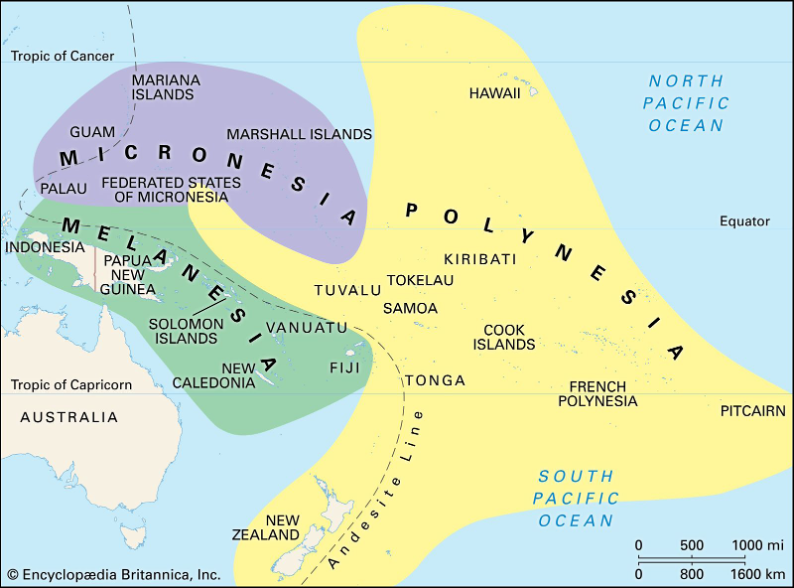
Source: Foster 2025b.
Pacific island countries also tend to be young democracies which were largely under Europeanc0df7eee2a56 and US colonial control between the sixteenth and nineteenth centuries, from which many only gained independence in the twentieth century. Colonialisation of the Pacific differed widely between islands, with countries such as Micronesia being more fully colonised, while Papua New Guinea, due to its mountainous terrain, was not fully controlled until the mid-twentieth century (and even today has low state penetration) (Barcham 2007:10-12). Various waves of human settlement in the region, and rule by successive colonial powers, meant that many of these countries have overlapping legislative structures, often combined with customary systems (Barcham 2007). This, together with the weak penetration of the state in some Pacific island states, meant that governance structures of some countries were historically weak or non-existent (Barcham 2007).
Today, Pacific island countries face a variety of external risks due to their location. They tend to be reliant on natural resources, have relatively small populations, a remoteness from major global markets and are vulnerable to external shocks (Kukutschka 2021). The Pacific region is among the most vulnerable to the impacts of climate change, despite contributing less than 0.03% of the world’s total greenhouse gases (Pacific Community n.d.). Indeed, a 2-degree Celsius rise in global temperatures could increase the region’s risks to runoff and flood hazards, and approximately 70-90% of tropical reefs could disappear (Pacific Community n.d.). Currently, the likelihood is 80% that the global temperature will exceed an increase of 1.5 degrees in the next five years (WMO 2024), meaning that the impacts of climate change could be imminent for the region.
Figure 2: Characteristics of Pacific island countries’ economies
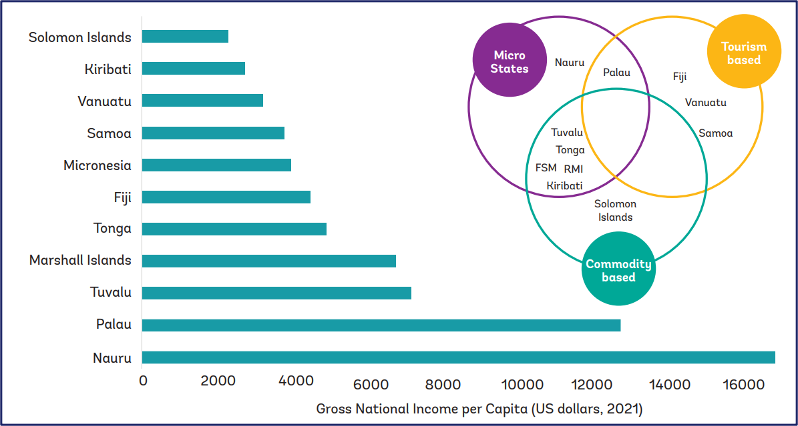
Source: World Bank 2023.
Figure 2 above illustrates some of the similarities and differences in the economies of Pacific island countries today. The gross national income per capita of countries can vary widely, from approximately US$2,200 in the Solomon Islands to approximately US$23,000 in Nauru. Figure 2 also reflects how much of the Pacific region relies heavily on export revenues from primary goods and tourism.
Pacific island countries tend to generate low revenue relative to their gross domestic product (GDP) (Panth et al. 2022). In terms of tax revenues, the World Bank (2023:42) notes that Pacific island countries would benefit from improving their efficiency in tax collection and eliminating numerous tax exemptions. The report provides the examples of Tonga, which received 30% less in tax revenues in the first half of 2020 due to VAT exemptions and Samoa where tax exemptions resulted in foregone tax revenue amounting to 2.9% of gross domestic product (GDP). Moreover, tax exemptions in the region are not always transparent and the true costs of them are often hidden to the wider public (World Bank 2023:42). While this is separate from corruption, these opaque structures can be exploited by corrupt individuals when hiding or storing their ill-gotten gains.
The Pacific region has been described as an “arena of geostrategic competition” due to its critical shipping lanes, oceans with maritime resources, strategic location connecting the US to other countries, as well as the fact that its countries collectively make up a significant bloc in UN General Assembly votes (CSIS 2025a). China has also increased its engagement with Pacific island countries recently, such as through the China-Solomon Islands security agreement in 2022 and its Belt and Road Initiative (CSIS 2025b; Hawksley 2025). Australia has also signed a number of agreements with various island states, including the Australia-Fiji Vuvale Partnership (2019), Australia-Tuvalu Falepili Union treaty (2023), the Nauru-Australia treaty (2024) and the Pacific Australia Labour Mobility (PALM) scheme, which allows eligible Australian businesses to hire from 9 Pacific islands (PALM n.d.). Australia is the largest development partner for Pacific island countries (CSIS 2025a). External grants remain important sources of revenue for the Pacific region, with grants being about 25% of GDP in Tuvalu and Kiribati, and about 10% GDP in Nauru, Palau and Tonga (World Bank 2023:30).
Over the past two decades, Pacific governments have made steady commitments to transparency and accountability. Other than Papua New Guinea which has ratified the United Nations Convention against Corruption (UNCAC), all jurisdictions covered in this Helpdesk Answer have acceded to the UNCAC (UN Treaty Collection 2025).
Despite these gains, corruption remains entrenched in key sectors, shifting from petty bribery to include more complex forms of transnational corruption in bribery and corruption schemes. Corruption in law enforcement and public services is also an issue throughout the Pacific region (Nguyen and Hopkins 2022:12).
For example, on average, 61% of people surveyed in the 2021 Global Corruption Barometer (GCB) in the Pacific region reported that they think government corruption is a big problem (see Figure 3 below) and nearly a third of respondents reported paying a bribe to access public services in the previous 12 months (Kukutschka 2021).
Figure 3: Percentage of people who think corruption in government is a significant problem in the Pacific region
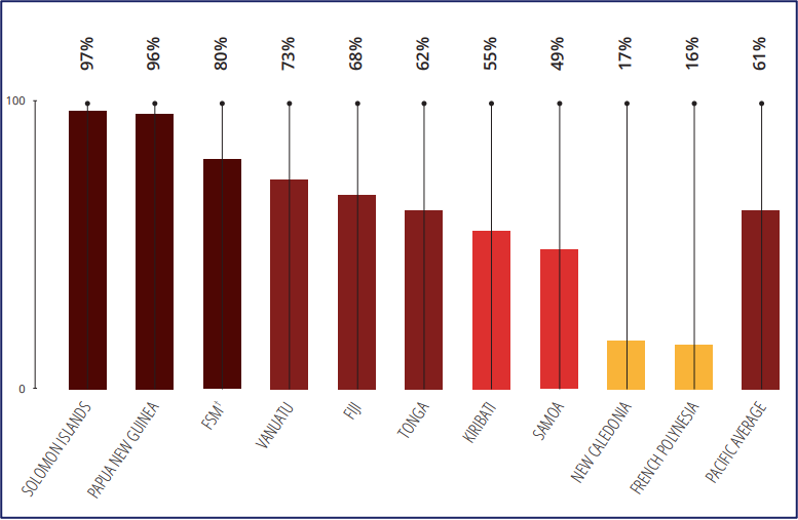
Source: Kukutschka 2021:9.
Money laundering remains a problem in the Pacific region more broadly and has, in recent years, shifted from being primarily national in its operation to having a transnational dimension (Nguyen and Hopkins 2022). Many Pacific region countries are attractive transit economies and destinations for laundered money, particularly given that several countries in the region are considered to be tax havens where companies can be incorporated to hide and launder money (Nguyen and Hopkins 2022).
There are a number of regional initiatives that have been founded to address corruption and money laundering in the region. The Regional Anti-Corruption Platform for the Pacific, coordinated by the UNODC, brings together anti-corruption practitioners from the region and facilitates their sharing of experiences in order to achieve the implementation of the UNCAC (UNODC n.d.).
The Teieniwa Vision was developed by the group in 2020 as a Pacific-led regional roadmap to unite Pacific islands against corruption, and has been signed and adopted by states. This statement calls on all Pacific states to unite against corruption through adequately resourcing national efforts and to implement anti-corruption reforms throughout their parliaments, public services, private sectors and wider communities (Pacific Unity Against Corruption 2020). It also acknowledges that corruption disproportionately affects vulnerable populations, particularly women, people with disabilities, the youth and the elderly. The Teieniwa Vision was built on the Boe Declaration on Regional Security of 2018.
Other regional initiatives include the Association of Pacific Island FIUs (APIFIU), which was established on 21 July 2011 and is an association of financial intelligence unit (FIUs) of the Pacific island countries (Fiji FIU n.d.). Its aim is to act as a common and regional voice on countering money laundering and terrorism financing as well as providing a forum for the sharing and exchange of information, ideas and experiences (Fiji FIU n.d.).
Sectors at risk of corruption in the region
The Pacific region is a region abundant in natural resources, particularly in minerals, timber and fish. Corruption in the natural resources sector in the region often implicates high-level domestic officials such as in the environmental agency and is often driven by foreign firms as well transnational organised criminal groups (Kukutschka 2021). The abundance of fisheries makes the vulnerable to illegal, unreported and unregulated fishing by private operators, which can be facilitated by domestic actors’ corrupt deals and opaque licensing (Dinnen and Walton 2016).
The Guardian’s Pacific Project uncovered high levels of resource extraction from the Pacific to neighbouring markets such as China and Australia, citing in particular the logging, extractives, fishing, minerals and deep-sea mining sectors. While not exclusively the case, its analysis suggests that corruption of domestic officials (for example, to obtain licences and concessions) may be behind some of this extraction, and it finds several instances of discrepancies between the estimated losses of natural resources and the figures reported by industry actors (Nicholas et al. 2021).
Such revenue losses can have significant socio-economic ramifications given the Pacific region’s reliance on natural resources, which can also lead to environmental degradation (UNODC and UNDP 2020). Survey evidence indicates that locals share the perception that natural resource sectors are particularly at risk. For example, 47% of respondents to Transparency International’s Global Corruption Barometer (GCB) implemented by Transparency International in the Pacific in 2021e685b99bb054 said there was little control and oversight of the individuals and companies extracting natural resources (Kukutschka 2021).
Coverage of public services such as education and health are inadequate in some Pacific island countries, and this is exacerbated when corruption drains financial resources (UNODC and UNDP 2020). On average, a third of GCB respondents across all countries who accessed public services had paid a bribe in the previous year, while nearly half used personal connections when dealing with public services; nevertheless only 13% of them reported the corrupt act to the authorities (Kukutschka 2021). Varying bribery rates were identified by sector, with the highest rate recorded for government offices issuing documents, indicating issues with bureaucratic corruption (see Figure 4).
Figure 4: Responses to Pacific Global Corruption Barometer question on bribery rate by service
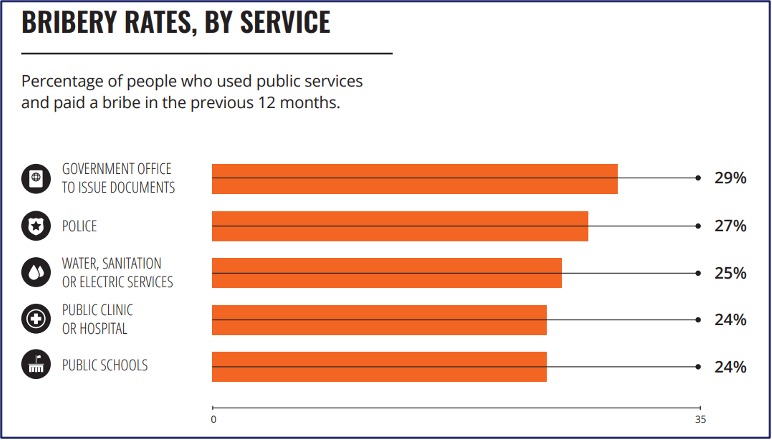
Source: Kukutschka 2021: 26.
While a significant portion of respondents viewed most or all public servants as involved in corruption, even higher scores were accorded to political actors (see Figure 5).
Figure 5: Responses to Pacific Global Corruption Barometer on perceived corruption by institution
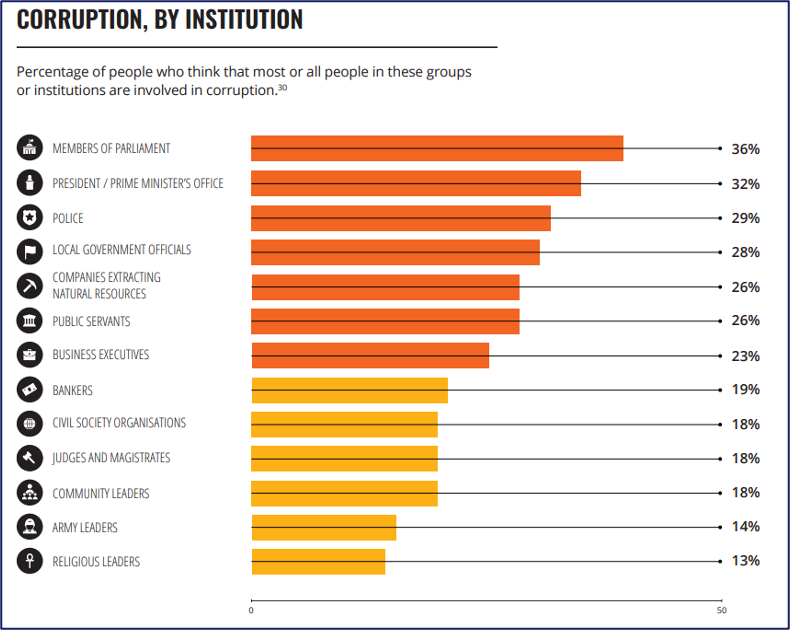
Source: Kukutschka 2021: 25.
Development interventions in the Pacific may also be vulnerable to corruption. For example, audits reportedly uncovered irregularities and corruption allegations concerning the Australian Department of Foreign Affairs and Trade’s (DFAT) Pacific Covid-19 Fiscal Budget Support (FBS) package to 12 Pacific island countries between 2020 and 2023 (Rovoi 2025a). In recent years, road, ports and telecommunications infrastructure development has rapidly accelerated in the region, largely in response to increased investment from foreign governments seeking to wield geopolitical influence (Keen 2023).
Keen (2023) warns that local authorities’ capacities to manage and provide oversight over large infrastructure contracts might be weak. Similarly, Martin et al. (2023) find that in small island developing states, such as many of the Pacific Islands, there are often gaps in procedures for managing tenders of large construction projects, creating bid rigging risks. An analysis of large infrastructure projects across seven Pacific island countries and Timor-Leste found that many lacked the required documentation, which enhanced the risk that tender processes are vulnerable to abuse (Transparency International Australia 2024).
In terms of the financial and banking sector, some Pacific jurisdictions serve as offshore financial centres, often for tax evasion purposes (Van Fossen 2013; Adamczyk 2024). As of October 2025, six of the eleven listed by the European Union as non-cooperative jurisdictions for tax purposes are from the region87b6df9f2a73 (European Council 2025). However, these centres also present transnational money laundering risks, including for laundering proceeds of corruption (Nguyen and Hopkins 2023). Nguyen and Hopkins (2023) found that even for Pacific island countries where the financial sector was underdeveloped, money laundering risks existed and were often linked to high levels of internal corruption.
Indeed, the overlap between corruption and the threat of transnational organised crime is an area that has recently received increased attention. The vulnerability of Pacific law enforcement and oversight agencies to bribes and other forms of corruption initiated by organised criminal groups has been documented for some years (Dinnen and Walton 2016). However, this threat has intensified as transnational criminal syndicates, especially from Latin America, have started using the Pacific as a transit region to Asian markets for trafficking narcotics (Sousa-Santos 2025; Coyne 2025; Williams and Knodell 2025). This has been compounded by inherent challenges in managing the maritime border (UNODC 2024: iv) and what some authors are calling “Narco corruption” where both customs officials and political actors are reportedly captured by organised criminal groups to secure their interests (Sousa-Santos 2025). Furthermore, organised crime groups are increasingly pursuing legitimate business activities in parallel with illicit ones in an attempt to mask and launder the proceeds of their crimes (UNODC 2024: 29).
The following sections look more closely at corruption, with a particular focus on corruption cases involving politically exposed persons (PEPs), in 12 selected Pacific island countries: Fiji, Kiribati, Marshall Islands, Micronesia, Nauru, Palau, Papua New Guinea, Samoa, Solomon Islands, Tonga, Tuvalu and Vanuatu. It should be noted that, given the variations in population sizes in each of these countries, some of them have less literature and evidence than others. In these cases, it is difficult to provide a clear overview of corruption in the country, due to the limitations of desk-based research.
Fiji
Table 1: Fiji’s ranking and scoring on selected governance indicators
|
Worldwide Governance Indicators* |
Corruption Perceptions Index** |
Global Corruption Barometer |
Secrecy Index*** |
UNCAC status |
||
|
Control of corruption |
Rule of law |
|||||
|
Latest available data (year in brackets) |
54.89 (2014) 61.67 (2019) 59.24 (2024) |
49.54 (2014) 58.05 (2019) 62.23 (2024) |
55/100 (2024 score) 50/188 (2024 rank) |
5% of public service users paid a bribe in the previous 12 months (2021) |
77/100 (2025) |
Accession in 2008 |
* The Worldwide Governance Indicators by the World Bank Group. This is measured on a scale from 0 to 100. Higher values correspond to better governance.
** The Corruption Perceptions Index by Transparency International. This uses the scale of 0 (highly corrupt) to 100 (very clean).
*** Tax Justice Network’s Financial Secrecy Index. This Helpdesk Answer only uses the secrecy score, which evaluates the level of financial secrecy that a country’s laws provide for, rather than the overall score that includes the global scale weight. A higher score indicates that the jurisdiction allows for room for financial secrecy.
Background
Fiji is a parliamentary republic in the South Pacific Ocean that is an archipelago of around 300 islands over around 1,000,000 square miles (Macdonald 2025). As of 2025, the population is approximately 900,900 (McDonald 2025). Its 2025 Human Development Index value is 0.73 (out of 1.0), meaning it has a high level of human development (UNDP 2025:275).
Fiji’s has moderate estimated levels of public sector corruption according to the CPI (see Table 1), although 68% of those surveyed in Fiji in the 2021 GCB believe that corruption is a big problem in the government (Kukutschka 2021:47). Indeed, Fiji has experienced several corruption scandals involving high-level politicians in recent years.
A recent Organized Crime and Corruption Reporting Project (OCCRP) investigation found that Fijian police had briefed the former Fijian prime minister and his police commissioner about a Chinese businessman’s suspected criminal ties, but despite this, the prime minister and police commissioner continued to have a public relationship with him (OCCRP 2024). One of the Chinese businessman’s purported top associates is a convicted illegal-narcotics manufacturer, who is also close friends and business partners with a top minister in the Fijian government (OCCRP 2024). In 2024, the same former prime minister was sentenced to a year in prison for obstructing a police investigation into corruption and university fraud (Mao 2024).
Another former deputy prime minister and finance minister were investigated by the Fiji Independent Commission Against Corruption (FICAC) for the failure to declare company directorships (Rovoi 2025b). However, in April 2025, FICAC controversially declared that it would not prosecute them (Rovoi 2025b).
Other recent cases involving lower-level public officials include the former national fire authority board chairman being charged for corruption, two police officers found guilty of bribery and abuse of office, three further Fijian police charged for their alleged involvement in the tampering of narcotics evidence held at a police station, and multiple other police officers currently facing corruption charges (Nataro 2025).
In contrast, only 5% of respondents in Fiji’s GCB survey reported paying a bribe for public services in the previous 12 months (Kukutschka 2022:47). This suggests that bribery may be concentrated in specific sectors, such as higher levels of government or the police, rather than in the routine public services accessed by citizens.
Money laundering is also a particular concern in Fiji. As seen in Table 1 above, Fiji’s secrecy score is fairly high at 77/100, indicating that financial secrecy is facilitated by its legislative framework (TJN 2025). Areas of concern that the Tax Justice Network notes is its lack of information on the beneficial ownership of companies, secrecy in its real estate ownership, a lack of transparency of company accounts, among others (TJN 2025). Other evidence suggests that its vulnerability to money laundering is also due to its strategic location (occupying a central position between Vanuatu and Tonga), porous borders and that fact that its economy is still largely cash based (Nguyen and Hopkins 2022:16).
Fiji also has certain areas designated as tax free regions, which include multi-year corporate tax holiday and import duty exemptions on raw materials, machinery and equipment for initial setup (Nguyen and Hopkins 2022:17). Fiji is currently listed on the EU list of non-cooperative tax jurisdictions as of 2025 and has had significant cases arising including VAT fraud, tax evasion and money laundering, involving millions of dollars (European Council 2025; Vula 2025).
Despite these risks, Fiji’s most recent mutual evaluation report (APG 2021a) noted that the Fijian government’s national anti-money laundering (AML) council (which drives its national AML efforts) has been successful in its national risk assessment, adopting legislation to enhance compliance, and in its review of the non-profit organisations sector. Other positive steps noted by the report are that the government had also recently launched an online company registry (although beneficial ownership information is not always mandatory).
Institutional framework
Fiji’s main anti-corruption law is the Prevention of Bribery Act (2007) and certain provisions of the Crimes Act (2009) (UNODC 2024a). The Crimes Act (2009) also criminalises bribery involving public officials and carries significant penalties (UNODC 2024a).
The Fiji Independent Commission Against Corruption (FICAC) is the main anti-corruption authority in the country. Other relevant anti-corruption authorities include the office of the auditor general, the Fiji financial intelligence unit, the office of the attorney general, the office of the director of public prosecutions, the Fiji police force, the Fijian elections office and the Fiji revenue and customs service. Fiji has also established a national anti-money-laundering council. (UNODC 2024a).
The review of the implementation of UNCAC articles 5-14 and 51-59 in Fiji, stated that it had not yet developed a dedicated anti-corruption strategy and instead relies on its existing legislative and regulatory framework (UNODC 2024a). Authorities had explained during this review process that the FICAC was in the process of drafting and proposing a national anti-corruption policy (UNODC 2024a).
FICAC has reportedly received a significant rise in corruption complaints over the last two years, with 681 recorded in 2024, up from 318 in 2023, which it has attributed to its intensified outreach and public awareness programmes (Prasad 2025). However, conviction rates have generally slowed, which is reportedly due to overloaded courts. FICAC also runs education and awareness sessions with the Fiji public and recorded a total of 293 education sessions between 2017 and 2018, conducted with the public sector, private sector, schools and various communities (UNODC 2024a:24).
There is a public company register in Fiji, however, the UNODC notes several areas of concern with this, such as there being no measures to avoid the misuse of procedures regulating companies, such as subsidies or licences and no restrictions on former public officials taking positions in the private sector (UNODC 2024a:9). The Political Parties Act (2013) contains provisions on the disclosure of account and funding sources by political parties, however, the Registrar of Political Parties that oversees compliance with political finance regulations has been noted to lack political independence and neutrality (Lal 2021:26).
Kiribati
Table 2: Kiribati’s ranking and scoring on selected governance indicators
|
Worldwide Governance Indicators |
Corruption Perceptions Index |
Global Corruption Barometer |
Secrecy Index |
UNCAC status |
||
|
Control of corruption |
Rule of law |
|||||
|
Latest available data (year in brackets) |
53.56 (2014) 54.95 (2019) 55.44 (2024) |
62.54 (2014) 67.01 (2019) 70.49 (2024) |
Not available |
64% of public service users paid a bribe in the previous 12 months (2021) |
Not available |
Accession in 2013 |
Background
Kiribati is situated in the central Pacific Ocean and consists of 33 islands, of which only 20 are inhabited, and are scattered across 1,800 miles (Foster 2025a). As of 2025, the population is approximately 128,800 (Foster 2025a). It is a parliamentary democracy with the head of state being the president and the house of assembly as the legislative institution (UNODC 2024). It has a human development index value of 0.64 (out of 1.0), meaning that it is a medium human-development country (UNDP 2025:276).
The evidence suggests that Kiribati experiences moderate corruption risks, and Freedom House reports that there is “virtually no large-scale corruption in Kiribati”, although petty corruption and nepotism in the appointments of public officials remain a problem (Freedom House 2023a). Generally, there is little analysis on the overall scale of corruption in the country, potentially due to its small population size. Nonetheless, 64% of people surveyed in Kiribati for the 2021 GCB reported having paid a bribe for public services in the previous 12 months, and 31% have experienced sexual corruption26629e6b18b6 or know someone who has (Kukutschka 2021:50). Around US$628 million is held in Australian bank accounts that belong to Kiribatian residents, which presents red flags for potential money laundering and tax evasion (Khadem 2022).
Freedom House reports that Kiribati holds regular elections, and transfers of power are peaceful (Freedom House 2023a). The US Department of State also reported that national elections are reported to be fair and free of abuses and irregularities (US DoS 2023). There are reportedly no constraints on a free and independent media, although the country’s market does not support a large and diverse media sector (Freedom House 2023).
In Craney and Tanielu’s political economy analysis of Kiribati (2024:11), they highlight that judicial independence has been a source of recent tension between the Kiribatian government and bilateral and multilateral partners. Since gaining independence from colonial rule, Kiribati has employed judges from Australia and New Zealand in particular, which has been a common practice in many Pacific Island countries. However, this has led to criticism that this means Kiribati is not fully independent and that this creates the conditions for foreign governments to get involved in local legal matters (Craney and Tanielu 2024:11). While this is not evidence of corruption, effective judicial independence is essential for a country’s anti-corruption efforts as it ensures that the corrupt can be efficiently investigated and prosecuted without interference.
Institutional framework
The Kiribati development plan (2020-2023) contains commitments related to accountability and transparency while the Kiribati Vision (2016-2036) contains a pillar on good governance, which highlights the government’s commitment to counter corruption through strengthening its domestic policies, legislative frameworks and strategic partnerships (UNODC 2024a).
The implementation of anti-corruption policies in Kiribati is decentralised. The Public Service Integrity and Corruption Control Unit (PSICCU) under the Public Service Office is responsible for promoting the principles of the UNCAC and to curb and prevent corruption and economic crime (Public Service Office n.d.). The national anti-corruption committee (NACC) together with the leadership commission (LC) were established within the Public Service Office to coordinate national efforts (UNODC 2024).
The LC was established in 2016 (alongside the Leaders Code of Conduct Act) and holds the power to investigate and prosecute parliamentarians, public officials and staff of state-owned enterprises and business owners (Craney and Tanielu 2024:9). Anonymous complaints concerning corruption can be submitted directly to the PSICCU or the LC; however, there is no legislation on the protection of whistleblowers (UNDOC 2024a).
Kiribati has been involved in regional anti-corruption initiatives, such as hosting the regional forum on anti-corruption in 2020 (News Source 2020). This conference aimed to align anti-corruption work in the Pacific region with the Sustainable Development Goals and to serve as a knowledge-sharing forum (News Source 2020). Significantly, the Teieniwa Vision on Anti-Corruption was adopted in the year that Kiribati chaired the meeting (Craney and Tanielu 2024:8).
However, Freedom House (2023) notes that there is a lack of comprehensive regulations on public asset disclosure for officials, access to government information and other transparency measures. Additionally, civil society is not particularly active in Kiribati, and accountability mechanisms outside of formal structures are overseen by customary leaders who, at times, also deal with issues of corruption, leading to a hybrid governance model in the country (Craney and Tanielu 2024:3).
The UNODC (2024) also recommends that Kiribati establish a separate financial intelligence unit (FIU), separate from the police service, as well as an agency in charge of seized and confiscated assets. Moreover, beneficial ownership transparency remains an issue in the country as well as the scrutiny of accounts maintained by or on behalf of politically exposed persons (PEPs) (UNODC 2024a).
Marshall Islands
Table 3: The Marshall Islands’ ranking and scoring on selected governance indicators
|
Worldwide Governance Indicators |
Corruption Perceptions Index |
Global Corruption Barometer |
Secrecy Index |
UNCAC status |
||
|
Control of corruption |
Rule of law |
|||||
|
Latest available data (year in brackets) |
45.54 (2014) 54.95 (2019) 55.76 (2024) |
68.36 (2014) 71.56 (2019) 71.35 (2024) |
Not available |
Not available |
65/100 |
Accession in 2011 |
Background
The Marshall Islands is situated in the central Pacific Ocean and consists of more than 1,200 islands (Kiste 2025). As of 2025, the population is approximately 38,900 (Kiste 2025). It has a human development index value of 0.73 (out of 1.0), putting it in the high human-development category (UNDP 2025:275). Freedom House assesses that the Marshall Islands is a stable democracy with regular and competitive elections, an independent judiciary and a free press (Freedom House n.d.).
However, its report does note that many issues in the country stem from persistent corruption and human trafficking. The Marshall Islands generally has seen continuing reports of political corruption and the management of its high-risk offshore financial activities. Fraudulent activity, including embezzlement and using public office for personal gain, is also reportedly widespread in the government which has led to a high number of investigations by the auditor general (RNZ 2019). Government procurement and transfers are also considered to be vulnerable to corruption, and personal relationships tend to play a role in government decisions (APG 2024a:20).
For example, in 2023, the US banned the former president of the Marshall Islands and a senator from entering the US due to “involvement in significant corruption” (OCCRP 2023). This was due to them accepting bribes in the form of services and cash in exchange for their legislative support of a bill to create a semi-autonomous region (known as the Rongelap Atoll Special Administrative Region – RASAR) in the Marshall Islands (OCCRP 2023). The main advocates for this project were Chinese born nationals who were convicted in New York for conspiracy to bribe Marshall Islands officials to support the scheme (OCCRP 2023). The two individuals were extradited to the US and pled guilty to conspiring to violate the Foreign Corruption Practices Act (FCPA) (US Attorney’s Office 2022).
The Marshall Islands also has a relatively large offshore corporate sector, as well as a new sector of decentralised autonomous organisations,9a23e4f16def both of which present transnational money laundering risks (APG 2024a:7). The former president of the Gambia diverted millions from the country’s pension fund while in office, and used a Marshall Islands based company, Gallia Holdings, to buy ferries for approximately US$6.8 million (Sharife and Anderson 2019). Notably, in the period assessed by the Financial Action Task Force (FATF), the criminal investigations division (part of the police department) had not undertaken any money laundering investigations involving offshore entities despite these prevalent risks (APG 2024a:9). This is reflected in its financial secrecy score (see Table 3) which is fairly high at 65/100.
Institutional framework
The Marshall Islands does not have an overarching anti-corruption policy or strategy, and good governance has only been referred to as one of its goals in its wider strategic plan for development (UNODC 2022a:2). There is no single anti-corruption agency. A number of bodies have functions related to the prevention of corruption, including the government ethics board, the ethics commission, the office of the attorney general, the office of the auditor general, the banking commission, DFIU, PSC, the department of public safety and the transnational crime unit (UNODC 2022a:3). Each of these bodies has jurisdiction and operational independence to carry out its mandates and has adequate resources and training (UNODC 2022a:3).
The Marshall Islands’ 2024 FATF mutual evaluation report (APG 2024a:5) found that authorities understand key money laundering risks, but the detailed risks from the offshore corporate sector (from non-resident domestic entities) are not yet fully assessed and understood. Moreover, the Trust Company of the Marshall Islands (TCMI) does not proactively share its indicators for these risks with other agencies to ensure that they are widely understood. Its FIU was found to still be developing its capacity, but further support is needed and does not demonstrate experience of developing financial intelligence for investigations, particularly those associated with offshore entities (APG 2024).
Similarly, the UNCAC implementation review mechanism in the Marshall Islands found that the formation of offshore companies and trusts is most susceptible to money laundering risks (UNODC 2022a:8). It recommends that, while trust and company service providers are now subject to customer due diligence, registration of trusts under the Trust Act of 1994 has been low to negligible (UNODC 2022a:8).
Federated States of Micronesia (FSM)
Table 4: Micronesia’s ranking and scoring on selected governance indicators
|
Worldwide Governance Indicators |
Corruption Perceptions Index |
Global Corruption Barometer |
Secrecy Index |
UNCAC status |
||
|
Control of corruption |
Rule of law |
|||||
|
Latest available data (year in brackets) |
65.12 (214) 63.63 (2019) 62.19 (2024) |
59.55 (2014) 60.78 (2019) 73.78 (2024) |
Not available |
61% of public service users paid a bribe in the previous 12 months (2021) |
Not available |
Accession in 2012 |
Background
Micronesia (officially the Federated States of Micronesia) is a country in the western Pacific Ocean, comprising of 600 islands and is divided into the states Yap, Chuuk, Pohnpei and Kosrae (Foster 2025a). As of 2025, its population is approximately 105,000 (Foster 2025a). Its human development index value is 0.62 (out 0f 1.0), placing it in the medium human-development category (UNDP 2025:276). Micronesia is a relatively stable democracy that holds regular elections, where the judiciary is independent and civil liberties are generally respected, according to Freedom House (2023).
Corruption is medium level in Micronesia, although it does have ongoing issues around public financial management and money laundering. In the 2021 GCB, 61% of people surveyed in Micronesia reported having paid a bribe in the previous 12 months and 46% of people have experienced sexual corruption or know someone who has (Kukutschka 2021:49). US authorities have also complained about the misuse of public resources in terms of overseeing aid funds (Freedom House 2023).Both Freedom House (2023) and the US Department of State (2022) note that there is a problem of impunity for corrupt officials in the country.
There are also reports that foreign investments in the country from the US and China have been met with pushback in recent years as citizens have been concerned about how this funding may impinge on the country’s political, economic and cultural independence (Freedom House 2023). In 2023, the outgoing president of Micronesia stated that China was engaging in “political warfare” in the Pacific and accused the state of bribing elected officials in Micronesia with smartphones, alcohol and envelopes of cash and making direct threats against his personal safety and surveilling him (Doherty and Lyons 2023). He stated that this was due to China’s foreign policy on Taiwan (Al Jazeera 2023). Officials from China have denied these accusations (Al Jazeera 2023).
Additionally, in 2019, a Micronesian government official was sentenced to 18 months in prison for their participation in a money laundering scheme which involved bribes made to secure engineering and project management contracts from the government, in violation of the FCPA (US DoJ 2019). The convicted official admitted that, between 2006 and 2016, a Hawaii based engineering and consulting company paid bribes to Micronesian officials to obtain these contracts valued at almost US$8 million (US DoJ 2019).
Two Micronesian nationals were found guilty of conspiracy to commit money laundering and of a conflict of interest, one of which was the former secretary of transport, communication s and infrastructure, who had set up an unlawful international shipping registry in the country’s name (IB 2023). This was unlawful in Micronesia, where closed registries are only permitted where vessels can be registered by qualified citizens, citizen corporations and/or persons with national government investment permits and with their place of business within the country (IB 2023).
Institutional framework
There is no single anti-corruption agency in Micronesia, and the responsible anti-corruption bodies include the department of justice, the national public auditor and the chief justice. Relevant state bodies are the office of the attorney general, the state public auditor and the division of public safety and state police (UNODC 2020). In 2021, the government also enhanced its transnational crime unit with additional personnel, which included a cybersecurity specialist (US DoS 2022). The UNCAC implementation review mechanism suggests that, due to their being a multitude of different responsible bodies, coordination is a problem (UNODC 2020)
There are also no political parties in Micronesia, meaning that campaign contributions to political parties is not an issue and there is no legislation or measures of limiting political party contributions (UNODC 2020). While there are special rules on avoiding conflicts of interest and corrupt practices by high-level officials, the UNODC (2020) noted that there was limited training on this. Moreover, there is no freedom of information legislation and national authorities do not consistently make public information on corruption investigations (UNODC 2020:5).
Nauru
Table 5: Nauru’s ranking and scoring on selected governance indicators
|
Worldwide Governance Indicators |
Corruption Perceptions Index |
Global Corruption Barometer |
Secrecy Index |
UNCAC status |
||
|
Control of corruption |
Rule of law |
|||||
|
Latest available data (year in brackets) |
42.95 (2014) 56.92 (2019) 58.08 (2024) |
71.79 (2014) 60.64 (2019) 61.30 (2024) |
Not available |
Not available |
53/100 |
Accession in 2012 |
Background
Nauru is an island country in the southwestern Pacific Ocean and consists of one coral island (Kiste 2025). Its population as of 2025 is 12,300 (Kiste 2025). Its value on the Human Development Index is 0.70 (out of 1.0), placing it in the high human-development category (UNDP 2025:275). There is little data or evidence on the level of corruption in Nauru, which is likely due to its small population size.
The available evidence suggests that Nauru is predominantly at risk of money laundering and money flows associated with its offshore processing arrangements with Australia. National authorities reported that corruption is the second largest source of illicit funds in the country (after cash smuggling) (APG 2024:6). During its FATF mutual evaluation report visit, stakeholders reported that public integrity and corruption are concerns in the country, particularly in relation to elections and public procurement (APG 2024:18). Nonetheless, the mutual evaluation report found that Nauru was a low-risk jurisdiction for money laundering overall, and it assessed that the country has a robust legislative framework to counter it (APG 2024b).
Nauru hosts Australia’s controversial offshore asylum processing centre, which has received criticism from human rights groups (HRLC 2025). A whistleblower recently reported on how millions in taxpayer funds were being funnelled through secretive and over-inflated contracts, including contracts for non-existent services to enrich private companies and corrupt Nauruan public officials (ASRC 2025; TI Australia 2025). The whistleblowers also claimed that public contract money was being used to insure luxury assets (TI Australia 2025).
Institutional framework
There is no single anti-corruption body or strategy in Nauru, and the review of its UNCAC implementation noted that there is no system of periodic review and evaluation of existing anti-corruption legislation. The government agencies that have an anti-corruption mandate include the department of justice and border control, the office of the director of public prosecutions, the Nauru police force, the judiciary, the Nauru FIU, the public audit office, the public service appeals board, the department of the chief secretary and the department of finance (UNODC 2021:2).
The beneficial ownership act was enacted in 2017, and information on the creation of companies and trusts and beneficial ownership details are maintained in a registry at the department of justice and border control (APG 2024b). The Asia/Pacific Group on Money Laundering (APG) noted capacity issues within the Nauru police force, which is the enforcement agency that investigates money laundering and predicate crimes (APG 2024b).
Nauru does not have a political party system and there are no guidelines or rules that govern the funding of candidatures for elected public office; however, bribery and misappropriation are criminalised under the Public Service Regulations Act 2016 (UNODC 2021:3).
Palau
Table 6: Palau’s ranking and scoring on selected governance indicators
|
Worldwide Governance Indicators |
Corruption Perceptions Index |
Global Corruption Barometer |
Secrecy Index |
UNCAC status |
||
|
Control of corruption |
Rule of law |
|||||
|
Latest available data (year in brackets) |
42.95 (2014) 56.92 (2019) 58.08 (2024) |
79.02 (2014) 76.92 (2019) 77.12 (2024) |
Not available |
Not available |
Not available |
Accession in 2009 |
Background
Palau consists of around 340 coral and volcanic islands situated in the western Pacific Ocean (Shuster 2025). Its population in 2025 is approximately 17,600 (Shuster 2025). Its value on the Human Development Index is 0.79 (out of 1.o), placing it in the high human-development category (UNDP 2025:275). There is little data or evidence on the level of corruption in Palau, which is likely due to its small population size.
Palau has some moderate corruption risks, although the majority of the evidence suggests that its primary risks originate from vulnerabilities in financial oversight, its tax haven status, organised criminal groups and its digital residency programme (GIATOC 2025).
In 2023, the office of the special prosecutor conducted an online survey of employees from the private and public sector and 86.7% of respondents said they had witnessed some form of corruption (US DoS 2023). There were cases of the house of delegates speaker being charged with misconduct in public office for leasing land without a licence and the public land authority chairman for leasing land to a Chinese national without proper approvals and receiving a direct payment (US DoS 2023).
Palau’s FATF mutual evaluation report (APG 2018) notes that there are two high-risk predicate offences in the jurisdiction: illicit trafficking in narcotics and trafficking in human beings. Banks and money lenders are also identified as high-risk institutions, and corruption risks are not given enough focus in the jurisdiction. The report assesses that law enforcement agencies there have limited understanding and use of financial intelligence and lack the resources to act on it (APG 2018:4). Palau is also primarily a cash-based economy, which poses threats in terms of money laundering (APG 2018). As of 2025, Palau is listed on the EU’s list of non-cooperative jurisdictions for tax purposes (European Commission 2025).
Tourism from China has reportedly been used to influence Palau’s foreign policy. Between 2015 and 2017, Chinese tourists made up around half of its visitors but, in 2017, Beijing reportedly ordered tour operators to stop selling packages to Palau as part of a broader campaign to prevent Palau from recognising Taiwan (Yuan 2025).
Palau also has ties to organised criminal groups with links to the Chinese Communist Party that operate illegal online gambling operations as well as other projects in the country (Carreon, Belford and Young 2022). These projects have been aided at times by the local Palauan elite, some of whom have even partnered in the ventures, including two former presidents (Carreon, Belford and Young 2022).
Institutional framework
Palau does not have a specific anti-corruption policy, but the relevant legislative framework is the constitution, the penal code (which criminalises bribery), the national public service system act, the code of ethics act, the open government act, the Palau law on business and business regulation, the public auditor act, the special prosecutors act, the money laundering and proceeds of crime act, the financial institutions act and the mutual assistance in criminal matters act (UNODC 2022b:3). In 2023, after the UN review, the government announced that it was developing its first national anti-corruption strategy, which is being developed in consultation with government, businesses, civil society and media (Island Times 2023).
The responsible institutions include the office of the attorney general, the office of the special prosecutor, the office of the public auditor, the ethics commission, the office of the ombudsman, the bureau of public safety, the bureau of the public service system, the financial intelligence unit and the financial institutions commission (UNODC 2022b:3). Whistleblowers can report to the office of the special prosecutor, which accepts anonymous complaints and enforces witness protection laws (OSP n.d.).
Papua New Guinea
Table 7: Papua New Guinea’s ranking and scoring on selected governance indicators
|
Worldwide Governance Indicators |
Corruption Perceptions Index |
Global Corruption Barometer |
Secrecy Index |
UNCAC status |
||
|
Control of corruption |
Rule of law |
|||||
|
Latest available data (year in brackets) |
28.13 (2014) 27.87 (2019) 31.72 (2024) |
46.92 (2014) 44.67 (2019) 47.13 (2024) |
31/100 (2024 score) 127/180 (2024 rank) |
54% of public service users paid a bribe in the previous 12 months (2021) |
Not available |
Ratification in 2007 |
Background
Papua New Guinea comprises the eastern half of New Guinea, which is the world’s second largest island (Standish 2025). Its population as of 2025 is approximately 14,293,000 (Standish 2025). The world’s third largest intact tropical rainforest is situated in the country (Booth 2023). It is also one of the most culturally diverse countries in the world, with more than 860 distinct Indigenous languages (Nguyen and Hopkins 2022:21).
Its Human Development Index value is 0.58 (out of 1.0), placing it at the lower end of the medium human-development category (UNDP 2025:276). Papua New Guinea is considered a fragile state, and its economy suffered due to recent droughts, earthquakes, low commodity prices, the Covid-19 pandemic and social unrest in 2024 and the subsequent multiple no-confidence votes in parliament (IMF 2025).
Corruption and bribery are considered to be significant problems in Papua New Guinea (APG 2024c). It is ranked 127 out of 180 countries in the CPI (see Table 7), indicating that it has a high level of political corruption: 54% of people surveyed in Papua New Guinea for the 2021 GCB reported having paid a bribe for public services in the previous 12 months and 51% have experienced sexual corruption or know someone who has (Kukutschka 2021:52); 96% of people surveyed reported that corruption is a big problem in the Papua New Guinean government (Kukutschka 2021:52).
Evidence points to the prevalence of corrupt practices to facilitate offences in the logging sector and also facilitates unregulated palm oil production and other harmful extractive practices (APG 2024c:19; Booth 2023). This has links to organised crime groups, and illegal logging accounts for approximately 70% to 90% of the total forestry products exported from the country (APG 2024c:20). The fishing industry in Papua New Guinea is also vulnerable to corruption (APG 2024c:20). The majority of the wealth from the extractive industries is transferred offshore, and there are limited benefits to the Papua New Guinean economy as a result (Nguyen and Hopkins 2022:21).
In 2023, officials from the Climate Change and Development Authority (CCDA) were accused of embezzling more than US$2 million from public funds (ACB News 2023). The CCDA is funded by local taxes and international grants, as well as contributions from rainforest preservation projects with links to Australian businesses. The allegations came to light when whistleblowers reported it to the police and, after this came to light, the wife of one of the accused was also investigated for attempting to bribe an investigating police officer (ABC News 2023).
There are frequent claims that property has been purchased in Australia and other countries by PEPs using corrupt earnings, which are facilitated by lawyers and accountants in Papua New Guinea (APG 2024c:6). The estimates made during a debate in parliament on the national anti-corruption strategy 2010-2030 put the figure of government funds lost to corruption as high as US$270 million annually (APG 2024c:19).
The country’s Wantok system also reportedly incentivises nepotistic and corrupt practices, which is a system of individual relationships and/or obligations connected by a common geographic origin, kinship or language (Nguyen and Hopkins 2022:22). Many politicians and public officials reportedly govern in accordance with this traditional practice.
Institutional framework
The Independent Commission Against Corruption was formed in July 2023, but at the time of the onsite visit for the mutual evaluation, it had not yet commenced operational activities (APG 2024c:4).
However, some evidence suggests that there are issues with the institutional capacity or political will to prosecute corruption. From 1975 to 2007, 16 MPs were dismissed and nine imprisoned, compared to only four MPs who were dismissed and two imprisoned between 2008 and 2024 (Kabuni 2025:497). Legal proceedings can also be lengthy in Papua New Guinea, such as one lawyer who was convicted in 2023 for misappropriating public funds, but the legal proceedings for this case took ten years (Kabuni 2025:496).
The most recent FATF mutual evaluation report notes that the country is not prioritising or pursuing money laundering or asset recovery in line with its money laundering risks (APG 2024c). It notes that this is largely due to the fact that the relevant competent authorities (the Royal Papua New Guinea Constabulary, the office of the public prosecutor, among others) lack skilled capacity and institutional resources. It is reported that the country is likely to be grey listed by the FATF in 2026 (NBC 2025).
The IMF (2025:20-21) also recommends that financial statements for the state-owned enterprises Kumul Petroleum and Kumul Minerals should be published, in line with the national policy for transparency and accountability in the extractive sector, which is Papua New Guinea’s transposition of the Extractive Industries Transparency Initiative standards.
Finally, despite the constitution guaranteeing the right of access to official documents (other than those in specific confidential categories), authorities are often refused access, stating that the documents requested fall within exempted categories (Booth 2023).
The most recently published UNCAC implementation review for Papua New Guinea was in 2013. The review assessed that the establishment of the National Anti-Corruption Alliance (NACA), with over ten government institutions working on cases, was positive, but that there was a need at the time to consolidate the anti-corruption laws, use clearer language to cover a comprehensive definition of public officials in legislation in all forms of bribery and adopt legislation to cover embezzlement, among others (UNODC 2013:6). An UNCAC implementation review took place in 2022, however, the report has not yet been published online.
Samoa
Table 8: Samoa’s ranking and scoring on selected governance indicators
|
Worldwide Governance Indicators |
Corruption Perceptions Index |
Global Corruption Barometer |
Secrecy Index |
UNCAC status |
||
|
Control of corruption |
Rule of law |
|||||
|
Latest available data (year in brackets) |
51.44 (2014) 60.45 (2019) 61.78 (2024) |
72.69 (2014) 76.92 (2019) 75.09 (2024) |
Not available |
17% of public service users paid a bribe in the previous 12 months (2021) |
74/100 |
Accession in 2018 |
Background
Samoa is situated in the central South Pacific Ocean and is the westernmost of the island countries of Polynesia (Foster 2025). Its population as of 2025 is approximately 212,800 (Foster 2025). Its Human Development Index value is 0.71 (out of 1.0), placing it within the high human-development category (UNDP 2025:275).
The Samoan economy is largely cash based and has traditionally focused on agriculture and fishing, which produces 90% of exports (Nguyen and Hopkins 2022:35). The economy also relies heavily on emigrants’ remittances, particularly from Samoans living in American Samoa, New Zealand, Australia and the US (Nguyen and Hopkins 2022:35).
Samoa has relatively low levels of corruption compared to other Pacific island countries. Only 17% of Samoans surveyed in the 2021 GCB reported having paid a bribe for public services in the previous 12 months (Kukutschka 2021:53), and there is limited evidence of the overall scale of corruption in the country.
However, there are some recent indicative cases of corruption. In 2025, a Samoan national was jailed for four years for bribing a government official and helping others to break visa rules (Rovoi 2025c). This included paying a contact at the New Zealand immigration office in Samoa to issue visas on their behalf and gain special treatment for their workers’ visas applications (Rovoi 2025c). They instructed the workers to hide cash in documents to influence how officials treated them at the immigration office (Rovoi 2025c). However, according to news reports, the immigration office representative claimed that there was no institutional corruption within the agency, despite this incident (Selby 2025).
Money laundering threats tend to be predominately from the international financial services sector, often related to fraud committed abroad, as well as drug offences (IMF 2025:9-11). However, the IMF (2025:10) assesses that corruption is not a major predicate crime to money laundering in the country. As of 2025, Samoa is listed on the EU’s list of non-cooperative jurisdictions for tax purposes (European Commission 2025). An offshore financial advisory firm in Samoa was also featured heavily in the Pandora Papers, which was used to set up trusts and shell companies to hide clients’ money and assets (which is not illegal in Samoa) (ABC News 2021).
Institutional framework
The Samoan national anti-corruption policy and strategy (2023-2028) has several goals, including reforming the electoral system, strengthening parliamentary oversight, managing political interference in public service and administration, and improving the transparency and public accountability at the political level (SION 2024:5). The Samoa Integrity Organisations Network (SION) is responsible for laws related to anti-corruption and facilitates and supports the implementation of the national-anti-corruption policy and its plan of action (SION 2024:13). An anti-corruption agency is currently in the process of being established.
Civil society reportedly participates in the development of anti-corruption policies, including through membership of various steering committees (UNODC 2024c). The media also regularly reports on corruption related issues (UNODC 2024:7).
Samoa’s most recent mutual evaluation report from 2015 (APG 2015a) noted that the country had made significant process in its technical compliance with the FATF standards at the time, with a reasonable understanding of money laundering risks. However, weaknesses at the time in terms of beneficial ownership, PEPs, beneficiary information for wire transfers, correspondent banking and ongoing monitoring were noted (APG 2015a:5). The FATF follow up report of 2023 notes that Samoa is a centre for the establishment and creation of international legal persons, often occurring through Samoan trustee companies, which can include international business companies, international partnerships and international segregated fund companies (APG 2023:4). These are high risk in terms of money laundering (APG 2023:5).
There is currently no legislative or administrative requirement to file or disclose information regarding the funding of political parties, electoral campaigns or expenditure (UNODC 2024c).
Solomon Islands
Table 9: Solomon Island’s ranking and scoring on selected governance indicators
|
Worldwide Governance Indicators |
Corruption Perceptions Index |
Global Corruption Barometer |
Secrecy Index |
UNCAC status |
||
|
Control of corruption |
Rule of law |
|||||
|
Latest available data (year in brackets) |
39.76 (2014) 47.86 (2019) 45.02 (2024) |
52.97 (2014) 55.54 (2019) 59.60 (2024) |
43/100 (2024 rank) 76/180 (2024 rank) |
21% of public service users paid a bribe in the previous 12 months (2021) |
Not available |
Accession in 2012 |
Background
The Solomon Islands is in the southwestern Pacific Ocean and consists of a double chain of volcanic and coral islands (Laracy 2025). Its population in 2025 is approximately 837,600 (Laracy 2025).The Solomon Islands is a cash based economy reliant mainly on agriculture, forestry and fisheries, accounting for approximately 40% of its national GDP (Nguyen and Hopkins 2022:25).
In the CPI, the Solomon Islands ranks 76 out of 180 countries (see Table 9) placing it roughly in the global middle range in terms of perceived public sector corruption. Of the people surveyed from the Solomon Islands in the 2021 GCB, 21% reported having paid a bribe in the previous 12 months, and 33% have experienced sexual corruption or know someone who has (Kukutschka 2021:54).
Corruption in the country is reportedly fairly high compared to its regional peers and is particularly prevalent in politics and the natural resource sectors. The Solomon Islands’ main risks identified in its 2019 mutual evaluation report (APG 2019) were bribery, corruption, fraud, illegal logging, tax evasion, illegal gold export and illegal fishing.
Solomon Island politicians have alleged in the past that both China and Taiwan had offered bribes to gain their support during diplomatic rows (Cavanough 2019). In 2019, two members of parliament were convicted of bribing voters during the 2019 elections, and corruption remains a problem in the judicial, mining and fishing sectors (Nguyen and Hopkins 2022:25).
In 2021, riots in the capital of Honiara followed the prime minister’s decision to end diplomatic ties with Taiwan and instead side with Beijing (Donald 2022). As a result of the unrest, three people died. However, corruption in the natural resource extraction sector was also largely to blame for the discontent, according to analysts. Approximately 85% of the land in the Solomon Islands is communally owned, meaning that the consent of every landowner is needed to develop the land. It is reported that Chinese, Malaysian and other foreign logging and mining firms have historically been able to skirt this process and have operated regardless of ownership, sometimes creating documents that allow a single landowner to sign away the rights on behalf of the community (Donald 2022). Loggers and miners also reportedly have influence over political leaders and public officials, resulting in tax remissions or duty exemptions (Donald 2022). These problems, compounded by other issues, resulted in the riots of 2021 and discontent among the public.
The Wantok system (which is a network of relationships and obligations between people connected by common origin, geographic area, kinship and language) can be used in corrupt and unethical practices, where politicians and public officials are expected to disseminate funds to members of their Wantok (APG 2019:17-18). This can range from assistance in school fees to favours such as offering a job or contract if the person is a Wantok.
Institutional framework
The Independent Commission Against Corruption (ICAC) was established under the Anti-Corruption Bill 2017 (APG 2019:96). However, it reportedly has not prosecuted a single case as of 2025, with some calling it a “weak and ineffective institution” (Eremae 2025). The founding director general stated that this was due to a lack of finance, staff and resources, with its budget only covering rent, salaries and other office costs, with its functions of investigating and prosecuting corruption being under-resourced (Eremae 2025).
Task Force Janus was also created to respond to the risk of corruption in the public sector, but it also reportedly had limited resources at its disposal as of 2019 (APG 2019:17). The corruption targeting team deals with corruption of members of parliament and provincial government, and money laundering and terrorism financing (APG 2019:18).
The most recent 2019 FATF mutual evaluation report, however, notes that there is good use of financial intelligence in criminal investigations by the Royal Solomon Islands Police Force, but the use of financial intelligence by other law enforcement agencies is inefficient (APG 2019). There is also a company registration system, but it is not fully developed, and the mechanisms for beneficial ownership information beyond legal owners of shares and directors are considered to be inadequate (APG 2019). The designated non-financial businesses and professions (DNFBP) sector has not been under anti-money laundering supervision, which also creates risks (Nguyen ad Hopkins 2022:26).
All public officials are governed by the Leadership Code Acts 1999, which requires asset disclosures and directorships of companies as well as government or corporate contracts (UNODC 2024d:2). The penal code also contains provisions on conflicts of interest, which applies to all public sector employees (UNODC 2024d:2).
Tonga
Table 10: Tonga’s ranking and scoring on selected governance indicators
|
Worldwide Governance Indicators |
Corruption Perceptions Index |
Global Corruption Barometer |
Secrecy Index |
UNCAC status |
||
|
Control of corruption |
Rule of law |
|||||
|
Latest available data (year in brackets) |
36.03 (2014) 38.97 (2019) 39.77 (2024) |
56.00 (2014) 61.04 (2019) 68.91 (2024) |
Not available |
38% of public service users paid a bribe in the previous 12 months (2021) |
Not available |
Accession in 2020 |
Background
Tonga is situated in the southwestern Pacific Ocean and comprises of 170 islands, divided into three main groups: Tongatapu which is in the south, Ha’apai in the centre and Vava’u in the north (Latukefu 2025). As of 2025, its population is approximately 97,900 (Latukefu 2025). Its Human Development Index value is 0.77 (out of 1.0), placing it in the high human-development category (UNDP 2025:275). Tonga is a constitutional monarchy, and the king holds significant powers and has veto on new laws and the right to dissolve the parliament (US DoS 2022). Tonga is a largely cash based economy, with many Tongans still operating without a bank account (APG 2021b:23-24).
The US Department of State (US DoS 2022) reports that government corruption is a serious problem in Tonga. Of the people surveyed in the 2021 GCB, 38% reported having paid for a bribe for public services in the previous 12 months (Kukutschka 2021:55). There have been several cases of high-level officials who were exposed for fraud and issuance of Tongan passports (APG 2021b:30). Nepotism is also a concern in the country as there is a strong sense of ‘kinship’ (APG 2021b:21). Corruption is also typically a major issue during elections (Graue, Fox and Seslija 2021).
In 2020, the former prime minister was found guilty over his role in a passport-for-sale scandal that involved Chinese nationals (Graue 2020). In this case, when he was the Foreign Minister, he had falsely claimed that two Chinese nationals were naturalised as Tongan citizens by giving false information (Graue 2020). He was found guilty of perjury and making a false statement for the purpose of obtaining a passport; however, the charges of bribery and money laundering were dropped during the trial (Graue 2020).
In 2021, the minister of Infrastructure and Tourism and her husband were convicted for misappropriating more than US$550,000 when in office from an Australian funded vocational education programme (Fogarty 2021). This was considered particularly sensitive as it involved official foreign donor aid (Fogarty 2021).
In 2022, the supreme court convicted the then-deputy prime minister and minister for finance and minister for internal affairs of bribing constituents with food and money during the 2021 election campaign (US DoS 2022). A former prime minister was convicted of bribery by the Supreme Court for promising funding to a women’s advocacy group (US DoS 2022).
Finally, in September 2025, it was reported that the prime minister had submitted accusations of corruption against his predecessor’s administration to the anti-corruption agency (Fotheringham and Lewis 2025). The claim stated that the previous administration had misappropriated public funds, but this is denied by the accused (Fotheringham and Lewis 2025).
The sectors that are considered the highest risk for money laundering in the country are banks, lawyers, accountants, real estate agents and life insurance (APG 2021b:5). Bribery and corruption are predicate crimes to money laundering, alongside transnational crimes such a drug trafficking (APG 2021b:5). Tonga’s financial sector is small, and there has been no identification and/or assessment of money laundering risks associated with all types of legal persons and legal arrangements including domestic and foreign trusts (APG 2021b:4).
Institutional framework
The anti-corruption commissioner was established under the Anti-Corruption Commissioner Act 2016 and is authorised to investigate corrupt conduct of current and former public officials (APG 2021b:23). It developed a five-year strategic plan containing concrete actions and initiatives aimed at preventing corruption (UNODC 2025:3).
The country’s corruption prevention practices are primarily carried out by the attorney general’s office, which conducts awareness-raising and other activities aimed at strengthening anti-corruption efforts and the rule of law, and the auditor general’s office, which reports directly to the legislative assembly and is dedicated to enhancing accountability and transparency in all government activities, thereby improving public sector performance (UNODC 2025:2). The office of the ombudsman also investigates complaints regarding administrative actions taken by public bodies (UNODC 2025:2).
Tonga’s most recent mutual evaluation report (APG 2021b) notes that the country has limited capacity to investigate financial crime and there is an absence of policy and guidance to support the identification and investigation of money laundering cases (APG 2021b:3).
The constitution provides for a fair and independent judiciary, which is upheld by the government (US DoS 2022). However, it is noted that journalists and independent media watchdogs are concerned over media independence due to regulations on the unlawful provision of false and/or misleading information (US DoS 2022). Furthermore, Tonga lacks a legal framework on access to public information and requests are handled on a case-by-case basis, with no formal appeal mechanism (UNODC 20225:8). Not all public institutions publish information online and the government has not published periodic reports on corruption risks (UNODC 2025:8).
Tuvalu
Table 11: Tuvalu’s ranking and scoring on selected governance indicators
|
Worldwide Governance Indicators |
Corruption Perceptions Index |
Global Corruption Barometer |
Secrecy Index |
UNCAC status |
||
|
Control of corruption |
Rule of law |
|||||
|
Latest available data (year in brackets) |
46.93 (2014) 55.80 (2019) 59.57 (2024) |
72.99 (2014) 71.72 (2019) 77.99 (2024) |
Not available |
Not available |
Not available |
Accession in 2015 |
Background
Tuvalu is a composed of nine small coral islands in the west-central Pacific Ocean (Macdonald 2025). As of 2025, its population is approximately 9,700 (Macdonald 2025). Its Human Development Index value is 0.69 (out of 1.0), placing it in the medium human-development category (UNDP 2025:276). There is little data or evidence on the level of corruption in Tuvalu, which is likely due to its small population size or that there are generally low levels of corruption in the country,
Freedom House (2025) measures Tuvalu as “free”, noting that it is a parliamentary democracy that holds regular and competitive elections. It has an established pattern of democratic transfers of power, and elected officials are reportedly able to develop and implement government policies and legislation without improper interference from an unelected entity (Freedom House 2024).
The US Department of State (US DoS 2023a) reported that there were no reports of serious government corruption, and that the government generally implements anti-corruption laws effectively.
However, one past case includes a former prime minister who was sentenced to four years in jail on corruption and abuse charges when he received over US$15,000 from Japanese and Taiwanese interests in 2016 (RNZ 2016).
Institutional framework
There is no single anti-corruption agency in Tuvalu, but the anti-corruption mandate is spread across several bodies, including the office of the attorney general, which is responsible for coordinating the implementation of anti-corruption policies and awareness-raising efforts (UNODC 2024e). The UNCAC implementation review noted that there were several vacancies in the ombuds office, which meant that there were gaps in the oversight and enforcement of laws and clarity in reporting channels (UNODC 2024e). It also noted that anti-corruption efforts were inadequately funded, and additional resources and specialised staff were required (UNODC 2024e).
There is also no freedom of information law to guarantee access to official records, and while public officials are legally obligated to disclose their assets and income, the rules on this are inconsistently enforced (Freedom House 2024). There is also no independent media, as the government’s media department controls the sole radio and television station (US DoS 2023a).
However, there is reportedly an independent judiciary in Tuvalu, and the government respects judicial independence and impartiality (US DoS 2023a). And, while there is no structured process for civil society to engage in the development of anti-corruption policies, consultations have been held in practice (UNODC 2024e).
Vanuatu
Table 12: Vanuatu’s ranking and scoring on selected governance indicators
|
Worldwide Governance Indicators |
Corruption Perceptions Index |
Global Corruption Barometer |
Secrecy Index |
UNCAC status |
||
|
Control of corruption |
Rule of law |
|||||
|
Latest available data (year in brackets) |
64.72 (2014) 63.43 (2019) 64.22 (2024) |
57.47 (2014) 44.11 (2019) 44.81 (2024) |
50/100 (2024 score) |
21% of public service users paid a bribe in the previous 12 months (2021) |
77/100 |
Accession in 2011 |
Background
Vanuatu comprises of 13 main and many other smaller islands in the southwestern Pacific Ocean (Foster 2025). As of 2025, its population is approximately 341,500 (Foster 2025). Its Human Development Index score is 0.62 (out of 1.0), placing it in the medium human-development category (UNDP 2025:276).Vanuatu has had volatile politics since its independence in 1980, with frequent motions of no confidence against the government (Transparency International 2021).
Corruption in Vanuatu remains a problem, particularly in politics and public services, hindering the country’s economic development potential. The IMF (2025:3) notes that improving governance and reducing corruption remains critical for Vanuatu’s long-term development. The US Department of State’s report on Vanuatu also notes that corruption remains a “serious issue” (US DoS 2023).
73% of people surveyed in Vanuatu for the 2021 GCB considered that corruption is a significant problem in government, and 31% reported having paid a bribe for public services in the previous 12 months (Kukutschka 2021:56). Some sources note that efforts to address corruption in Vanuatu have come a long way since the 1990s, when high-level politicians were involved in a money laundering scandal involving US$1.1 million meant for cyclone relief (Walton et al. 2023). However, in 2015, 14 members of parliament (around 30% of the parliament) were prosecuted for corruption (Walton et al. 2023).
In 2020, the former prime minister, Salawi, who was in office from 2016 until April 2020, was convicted of perjury (Transparency International 2021). In 2015, another former prime minister and the then-deputy prime minister and 13 other MPs were found guilty of giving and receiving corruption payments (Transparency International 2021).
Vanuatu was involved in a legal and political dispute over mackerel fishing rights that it says were corruptly handed to a Panama registered company in 2010 (Financial Times/Pac News 2023). This came to light when a Vanuatu government envoy attended an international fishing summit in Ecuador and encountered individuals who stated that they represented Vanuatu, prompting an investigation (Financial Times/Pac News 2023). The individuals had obtained exclusive rights to its mackerel fishing quotas at a vastly undervalued price, but the government had been aware of the deal for years and had not received any payments for it (Financial Times/Pac News 2023).
As of 2025, Vanuatu is listed on the EU’s list of non-cooperative jurisdictions for tax purposes for its citizenship-by-investment (CBI) programme and anti-money laundering weaknesses (European Commission 2025) and is considered a tax haven (Nguyen and Hopkins 2022:38). There were efforts to end its tax haven status, but this was strongly opposed by the parliamentary opposition and, in 2017, the parliament withdrew all five bills aimed to tax personal and corporate income (Nguyen and Hopkins 2022:39). There have been more recent efforts to introduce legislation to strengthen tax frameworks in the country, but there is still a way to go before the country loses its tax haven status (Nguyen and Hopkins 2022).
Another major risk in Vanuatu is its CBI scheme. In 2023, the European Parliament and suspended its visa-waiver agreement with Vanuatu due to its concerns about the scheme, with the UK following suit in 2023 after claiming the scheme had facilitated Chinese spies into the UK (McNeill and Walton 2025).
However, others (McNeill and Walton 2025) claim that Pacific states such as Vanuatu have few traditional opportunities to raise revenue, leading to a reliance on the income generated from CBI schemes, despite the security and governance risks they raise. In 2019, for example, revenue from CBI sales comprised 28% of total government revenue and contributed to natural disaster recovery and the repayment of external government debt ahead of schedule (McNeill and Walton 2025). Nonetheless, a 2025 IMF staff report on Vanuatu notes that there are concerns around the sustainability of its CBI scheme (IMF 2025:2).
Institutional framework
The main public bodies for the investigation and prosecution of corruption and money laundering are the Vanuatu police force, the office of the public prosecutor, the office of the ombudsman, the Vanuatu financial intelligence unit and the public service commission (UNODC 2016).
Government spending on the agencies tasked with countering corruption – the office of the ombudsman, the national audit office and the FIU – have reportedly significantly increased over the last decade (Walton et al. 2023). However, the ombudsman also often fails to reach beyond urban areas in the country, meaning that many rural dwellers are ill informed on accountability matters (Walton et al. 2023).
Vanuatu’s most recent mutual evaluation report was in 2015 (APG 2015b), which found a lack of an effective AML system with political commitment and adequate resources. There were sufficient legislative powers to supervise financial institutions, but there was a poor execution of these powers, largely due to a lack of resources (APG 2015b:3). The sale of passports and citizenship by the government and political officials was reported, which was then used to launder money (APG 2015b:31). Concerns regarding the transparency and governance of the CBI scheme were also echoed in a 2025 IMF report (IMF 2025:3). The follow up report in 2018 noted that several improvements were made to Vanuatu’s AML legislative framework and improved other areas, such as its beneficial ownership register (APG 2018).
The office of the ombudsman started to assess leaders’ annual returns in 2020, yet in 2021 more than two-thirds failed to submit their returns on time (Walton et al. 2023). Indeed, the IMF (2025:15) notes that the asset declaration regime, including public access to the information, needs to be strengthened, particularly with regard to supporting the prosecution of corruption cases. Moreover, the right to information unit is currently without a commissioner (as of 2023) (Walton et al. 2023). Finally, the FIU reportedly lacks the capacity to check applicants of the country’s CBI scheme (Walton et al. 2023).
The constitution also provides for an independent judiciary, and the government reportedly generally respects judicial independence and impartiality (US DoS 2023). The government has also taken steps to engage its citizens in decision-making on public service delivery through its decentralisation act, which has been accompanied with an increase in community education on the Vanuatu constitution and citizen rights (Transparency International 2021). A dedicated right to information officer has been appointed to support this work (Transparency International 2021).
- Spain, the Netherlands, United Kingdom, France and Germany.
- The Pacific GCB provides the results of fieldwork conducted between February and March 2021 where more than 6,000 people in ten Pacific countries took part in the survey. These were the Federated States of Micronesia, Fiji, French Polynesia, Kiribati, New Caledonia, Papua New Guinea, Samoa, Solomon Islands, Tonga and Vanuatu (Kukutschka 2021).
- American Samoa, Fiji, Guam, Palau, Samoa and Vanuatu.
- The abuse of entrusted power to demand or obtain sex or acts of a sexual nature
- Organisations that are internet-based collaborative organisations that coordinate people and resources using rules expressed in computer code and are part of the larger “crypto ecosystem” (Law Commission 2024)