
1. Scene-setting: Contractor applications to the International Seabed Authority for observer status
1.1. Introduction
Established under Part XI of the 1982 United Nations Convention on the Law of the Sea (UNCLOS) and operational since 1996, the International Seabed Authority (ISA) has a mandate to, inter alia:
- organise and control mineral-related activities on the international seabed beyond national jurisdiction known as ‘the Area’, and
- ensure effective protection of the marine environment from the harmful effects of those mineral-related activities.
The ISA carries out this bifurcated mandate as the steward of the deep sea and its resources which are collectively classified as the ‘common heritage of humankind.’8c207e37ad75 Seabed mineral exploration and exploitation may be carried out by the ISA’s not yet operationalised in-house mining arm, eg ‘the Enterprise’, by state parties to UNCLOS or when sponsored by an ISA member state by ‘state enterprises, or natural or juridical persons’.0df75e00d1d1 The ISA is responsible for issuing contracts granting rights to explore or exploit the minerals of the Area. The ISA is also responsible to prepare, promulgate, monitor and enforce the rules, regulations and procedures (RRPs)ef697471bfa5 that govern how such exploration or exploitation activities can be conducted in the Area. Because of this mandate, the ISA is designed to interact directly with commercial entities in a way different from most international organisations.db4fd8138d2f
ISA contractors are the operational agents with the commercial interests, technical expertise, and financial capacity through which exploration ‒ and potentially exploitation ‒ of deep seabed minerals will occur in areas beyond national jurisdiction. In this U4 Issue ‘contractors’ refers to the entities to whom the ISA awards contracts conferring rights over minerals of the Area. At the time of drafting in June 2026, the ISA has awarded 31 contracts to 22 contractors for mineral exploration.ffba04379ed3 Of these contracts, eight are held fully or partially by privately owned entities.6fce91e9089e Contractors are the means through which exploration and future potential exploitation of the minerals of the Area are to take place and thus, are a component of fulfilling one side of the ISA’s mandate. However, they also bring commercial interests into a regime designed to serve collective global benefit; in which the resources of interest are designated as the common heritage of humankind. Their presence can create tension with other elements of the ISA’s mandate.ebcd39d720f8 This relationship between public authority and private interest has been a recurring theme in debates about the ISA’s legitimacy, transparency, and accountability.ee16e7cf62aa
Recent developments have brought these issues into sharper focus. In July 2024 and July 2025, the ISA Assembly received several applications for ‘NGO observer’ status emanating from different entities associated with private-sector contractors. The Assembly’s discussion of these applications highlighted unresolved questions about the appropriate role of contractors in ISA processes: should they be treated as stakeholders akin to civil society organisations or as regulated entities whose participation must be carefully circumscribed? Is there a middle ground between these positions?
These questions arise in the context of: (1) the ISA is developing rules to govern future mining by contractors where exploitation contracts may be worth billions of dollars, and (2) it is known that extractive industry governance, and associated international organisations, are vulnerable to corporate capture, corruption, conflicts of interest, and undue influence.9c84621cd12e One way in which the ISA regime can guard against such issues, and ensure public confidence, is to have transparent, rules-based and consistently-applied systems for contractors’ participation in ISA processes. Such regulations would preserve the ISA’s ability to draw on technical expertise and stakeholder perspectives, while protecting the ISA from conflicts of interest and corporate capture. This U4 Issue is therefore intended to inform the ISA Assembly as it moves from a preliminary debate to a determination on contractor participation.
1.2. Applications for Non-governmental Observer Status to the International Seabed Authority from contractor-related entities
In 2024, applications for NGO observer status were submitted to the ISA Assembly by different entities connected with contractors. These included, inter alia, the Seafloor Mineral Developers Association (SMDA), Impossible Metals Inc (IMI) and CSA Ocean Sciences Inc (CSA)7a1f17e7271a (see textbox 1).
In 2025, the SMDA re-submitted its application for NGO observer status to the ISA, where the SMDA described its organisation’s objectives as being to:
- Represent the interests of polymetallic nodule contractors in the deep seabed mining industry.
- Participate as an observer at the International Seabed Authority.
- Deploy its members’ scientific, technical and legal expertise to support the work of the Authority and contribute to the establishment of an environmentally sound and commercially viable regulatory regime in the Area supported by a robust regulatory framework that protects the marine environment from serious harm.72df0a3853ca
These applications sparked debate among the member states of the ISA’s Assembly, calling into question whether contractor-affiliated entities could apply for NGO observer status.
Entities submitting applications for observer status at ISA 2024/2025
SMDA is an entity created in 2024 by two ISA contractors: Nauru Ocean Resources Inc. (NORI, a Nauruan company), Tonga Offshore Mining Ltd. (TOML, a Tonga company). Membership in SMDA expanded in 2025 to include a third ISA contractor: Blue Minerals Jamaica (BMJ, a Jamaican company).5bfe793eff54 NORI and TOML are wholly owned subsidiaries of a Canadian corporation – The Metals Company (TMC).fe6fa0c15021 Meanwhile BMJ is owned by a Swiss-Dutch corporation AllSeas Group (who are also TMC’s principal subcontractor).16d085182523 Although SMDA describes itself as a ‘non-profit international non-governmental organization,’ the SMDA’s observer application provided no evidence that it is a distinct legal entity separate from the contractors who comprise its membership. The applications in 2024 and 2025 were submitted by representatives of NORI and TOML, with BMJ copied in the 2025 application.81827bddf704 SMDAprovides for itself the same contact details as TMC.49ffca438859
IMI has been incorporated as a company in the US State of Delaware since 2020, and is self-described in its ISA observer application as a ‘US-based NGO’.f789bd419840 At the time of application, IMI was not an ISA contractor, though it had committed to work on some at-sea mining equipment tests (presumably as a sub-contractor) with an ISA contractor, German State institute Bundesanstalt für Geowissenschaften und Rohstoffe (BGR).a6da669528d2 Subsequently IMI established a Bahraini subsidiary company and in September 2025 applied for its own ISA contract for exploration under Bahrain’s sponsorship, which the ISA is due to discuss and decide upon at its 31st session in July 2026.b00a20829d93
CSA self-describes as a marine environmental consultancy firm headquartered in the U.S. State of Florida.64b8a857f03a It is wholly owned by another U.S. corporation called Continental Shelf Associates, Inc.4915edb49232 The application for observer status notes that since 2019, CSA has been contracted by TMC to operate scientific observation equipment in NORI’s ISA contract area.
1.3. The Authority’s response to the contractor-related NGO observer applications
The applications by SMDA and IMI were not approved during the 2024 session of the Assembly following an intervention by Vanuatu which argued that those two applications did not reflect the spirit of NGO observers. In particular, Vanuatu noted that the applications were signed by the CEOs of ISA contractors and other entities from the private sector.d4a922bc8239 Switzerland supported the objection raised by Vanuatu, requesting clarification on how the entities intended to function as NGOs.543245ca4338 Italy and China also intervened, querying what specific criteria should be applied to the application and proposing that this could be clarified with re-application permitted. Based on this brief exchange of interventions from ISA member states during the Assembly meeting, the Assembly President rejected SMDA and IMI applications. Conversely, the application for NGO observer status made by CSA, a private sector entity, working for a contractor, was not discussed or objected to and was therefore approved by the Assembly.
At the July 2025 Assembly meeting, SMDA’s renewed application sparked more debate among member states. Chile and Costa Rica indicated that the applicant was comprised of ISA contractors already able to participate in ISA meetings and ISA work. These two countries expressed the view that observer status should be reserved for stakeholders other than contractors to enable them to engage with the ISA's work. Panama also raised concerns, citing a conflict of interest for such a contractor-affiliated NGO.3f1e394cb37c However, Nauru and Tonga, the sponsoring member states of two of SMDA’s contractor members: NORI and TOML respectively, supported the application, indicating that SMDA was a not-for-profit industry association representing multiple contractors, and highlighted their expertise. Nauru and Tonga indicated their support for contractors to be involved in ISA processes through observer status as the ISA develops the Mining Code.2e3557b07120 China and Singapore, also states who sponsor contractors, albeit not associated with these observer applications, also supported SMDA’s application on the basis that the application complied with Rule 82 of the Assembly's Rules of Procedure which establishes the rules for observer participation, finding it acceptable that the category of ‘NGOs’ could include contractors.4e1906f1ad6a China further questioned the existence of other channels to which Chile had referred for contractors to participate in the ISA's work.d514d33dc9c1
The Assembly’s final response to this agenda item was to request that the Secretariat prepare a note for the Assembly to consider at its next session in July 2026 on how contractor-affiliated NGO observer applications should be treated and assessed, and to prepare draft guidelines for the consideration of such categories of observer applicants. This included specific requests from Brazil for advice on whether amendment to the Assembly’s rules of procedure would be needed, and from Germany for the note to include a comparison of similar rules of procedure in other international fora.667ebb4eeba3 The Assembly deferred its decision on SMDA’s observer application and similar categories of observer applications pending the outcome of these further discussions. This outcome was left somewhat muddied by, in lieu of a formal record or decision on the matter, a later report from the President of the Assembly stating his understanding that the Assembly’s discussion had agreed in principle ‘that contractors could participate as observers in their individual capacity and not be treated differently from other stakeholders’ but that the remaining question was one of modalities.cb8ea7954a37 In any event, the item has now been listed on the agenda for the Assembly’s 31st session in July 2026.54e004def7f9
In the same 2025 Assembly session, observer status was granted to several other IGO and NGO applicants without contest.96fcb94eb74e
1.4. The broader debate around the role of for-profit non-state actors in international environmental governance
The role of for-profit non-state actors in international environmental governance has become an increasingly contested issue, with growing evidence that corporate interests systematically impede progress on ambitious, legally binding outcomes.316efd8e6d94 Within the United Nations Framework Convention on Climate Change (UNFCCC) for example, the numbers of fossil fuel lobbyists have come to outnumber almost all country delegations.79ecd5f558bd This uneven representation, and concern over corporate capture, led a broad coalition of civil society actors to call for robust conflict-of-interest policies comparable to those already applied to the tobacco industry under the World Health Organisation's Framework Convention on Tobacco Control.7e3640918b60 These include measures to screen and disclosure procedures aimed to identify commercial interests, and to exclude industry from policy-making spaces where it has a vested interest. Similarly, in the negotiations toward a global plastics treaty after 2022, fossil fuel and petrochemical lobbyists were identified as outnumbering the combined diplomatic delegations from all 27 EU nations and the EU combined and were subsequently credited with contributing to the collapse of talks.1972e7218d06 Analogous concerns have been raised in international fisheries organisations and the newly created Biodiversity Beyond National Jurisdictions treaty.782172717c4f
These controversies illustrate a structural challenge facing multilateral environmental governance: the question of whether it is possible to ensure that the for-profit corporate sector, while a legitimate stakeholder, does not exercise influence disproportionate to the public interest outcomes such fora are designed to deliver. These same dynamics are now under the microscope in the current debate at the ISA, but with an added layer of complexity. Unlike other multilateral processes, the ISA not only negotiates high-level norms but is directly drafting, interpreting, and enforcing detailed regulations and bilateral contract obligations over the very corporate entities seeking access to the negotiations.
2. The different roles and interests of contractors and non-governmental observers at the International Seabed Authority
2.1. Nature and access of non-governmental observers at the Authority
There are 67 NGO observers currently recognised at the ISA that range across global environmental NGOs, community associations (including indigenous peoples), universities, charitable foundations, science institutes, youth organisations, think tanks, and industry associations. The latter represent private interests but not ISA contractors, eg, fisheries, submarine cables, and metal markets.1bbad4e4ef93 In practice, active participation by NGO observers during ISA sessions, until recently, has been low both in terms of meeting attendance and frequency of interventions if in attendance.8f30d8655bd2 States have generally taken a flexible approach to allowing NGO observer interventions with little or no restrictions in both formal proceedings and informal negotiations. In more recent sessions, the numbers of NGO observers have increased.a3b1d9d795e3 This has been accompanied by the President of the ISA’s executive organ (the Council) occasionally suggesting notional time limits for observer intentions and asking different NGO observers to try to consolidate and combine similarly themed interventions.
Certain topics on the ISA’s agenda, such as agreeing on the final wording in a Council decision, have been progressed in occasional ‘informal informal’ sessions. ‘Informal informals’ is a term used at the ISA (and other multilateral) negotiations but not found in the ISA’s official rules of procedure. These can be defined as ‘smaller, off-the-record sessions that tackle the most sensitive issues’ focused on progressing a single topic.d594badf3a02 These discussions take place with limited participation and observers have typically been barred access to them. NGO observers’ ability to participate in ISA proceedings has generally been viewed as adequate but insecure and under strain.021890fc72c2 Suggestions of restriction arise repeatedly. Though in many instances several member states have responded by speaking up in support of retaining observers’ participation as important voices who bring useful inputs, transparency, and legitimacy to the ISA's function as a regulator.01393a268784
2.2. Non-governmental observers’ role at the International Seabed Authority
The ISA has a particular context: it is established to manage resources that are the common heritage of humankind, on behalf of humankind and in the best interests of humankind overall. The participation of NGO observers demonstrates that the ISA is not insulated from the societies whose interests it is mandated to represent. Many of these observers provide much-needed expertise and alternative perspectives without having a commercial interest in the activities being regulated. NGO observers representing historically marginalised groups, such as indigenous peoples, coastal communities and youth, can bring perspectives that may not be well-represented by the member states.
Many ISA contractors are member states: for example, ‘the Government of India’ and ‘the Government of the Republic of Korea’ directly hold three ISA exploration contracts each.a481491fbdec Those contractor-states are also member states of the ISA’s Assembly and are likely to have representation on the ISA’s Council ‒ and also its subsidiary organs. That means some contractors are regulated by ISA organs in which they also participate. The participation of NGO observers can therefore provide a regulatory watchdog function at the ISA.14e3f2b95b1a Their participation ensures that environmental and social concerns are not overshadowed by commercial or geopolitical interests. They can also act to counter regulatory capture and can bring a new avenue for pluralistic participation that does not rely on the member states. It is also notable that the issues involved in deep sea exploration and exploitation are highly technical, complex, specialised and novel, and many ISA member states may not have access to relevant in-house expertise in their delegation (or government, more generally).c14aa400e43d In areas such as these, observers that offer technical expertise at the ISA, including scientific institutions, academic organisations, or law foundations, may assist representatives of member states in making informed decisions about complicated processes.3a24a197c331
2.3. Contractors’ role at the International Seabed Authority
The ISA contractors are crucial operational partners for the ISA. Indeed, the ISA is established specifically to oversee exploration and exploitation in the Area, and the ISA contractors are the entities designated to perform these activities. The ISA therefore holds both a contractual and regulatory relationship to contractors. The ISA contracts and the RRPs set out obligations for contractors on issues such as environmental management, and payments due to the ISA from the contractor. The ISA is mandated to monitor and enforce compliance with those rules in conjunction with each contractor’s sponsoring state.
Since 2001, the ISA has issued 32 exploration contracts of which one was terminated.7d9371902e7c In the late 1990s and 2000s, contractors were member states holding contracts via government departments, state research institutes, state-owned enterprises, and in one case an inter-governmental organisation. From 2011, a new wave of private sector contractors emerged.d9d3609ebde1 Applications submitted by NORI and TOML in 2011 marked a significant departure from the ISA’s earlier practices, introducing a new model in which private-sector entities rather than state agencies or state-owned enterprises sought contracts for exploration in the Area. In a contemporaneous press release, the ISA Secretary-General publicly welcomed the emergence of private-sector applicants describing it as a ‘new milestone’ for the Authority and emphasising the significance of commercial investment in deep seabed exploration.08d608d4f616 There are now 10 ISA contractors that can be characterised as either private sector or a public-private partnership. As noted above, each of these must – as a condition of the contract – have a sponsoring state who is also a member of the ISA.7b23f9ed7126
An important role that contractors currently play at the ISA is to provide scientific data and technical information to assist the ISA develop its own knowledge about this nascent industry. As an obligation of each exploration contract, contractors are required to collect and report scientific data to the ISA, both about geological potential to inform mining feasibility, and about the ecology of the sites to establish an environmental baseline against which impacts of future activities can be measured and managed. Contractor-supplied data forms most of the known information about the relevant sites and feeds directly into ISA decision-making.6b81ef95622b Similarly, contractors have been dominant sources of information for the ISA in developing financial models for deep seabed mining to inform the ISA’s fiscal regime.9321992f3f5c The usefulness and predominance of contractor-supplied data at the ISA heightens the importance of rules that separate technical input from policy influence; information provision should not create opportunities for undue sway over regulatory design or enforcement.
2.4. Opportunities for contractor involvement in the Authority’s processes
The SMDA in its 2025 observer application (supported by Nauru, Tonga, and China) stated that there is no existing mechanism under the ISA's rules for contractors to participate in the agenda of ISA meetings, wherein the ISA is deliberating and discussing rules that will directly and materially affect the rights of contractors. This, however, is not correct for most of current ISA contractors who are public sector entities, including governments who hold ISA contracts directly – such as the governments of India, Korea, Poland, Russian Federation.555bc7ffead0 These contractors do not only observe ISA proceedings, they can sit in the ’driving seat’ as their states are members of the ISA – even sitting on its executive body, the Council. This means that they are directly responsible for creating and establishing the RRPs that will govern exploitation in the Area.
Contractors who are not public bodies are in a different situation. Nevertheless, they still must have a sponsoring state to whom they are affiliated and who is a member of the ISA Assembly (and in many cases, the Council also). Each contractor can therefore ask that state to raise issues of concern through its ISA membership.aae95b96e0ea In fact, common current practice is for contractor representatives from both the public and private sectors to be included in the respective member state delegations, serving as technical advisors to these delegations.7d28d1c99d77 This enables contractor personnel to attend ISA meetings in-person, including to present at official side-events and attend intersessional working groups. In some instances, contractor representatives, even those from private sector companies, have been given the floor by their member states to address the ISA during formal Council sessions.ab11c7f79fd8 Inclusion in member state delegations has also led to some instances of contractors having greater access than observers, including unfettered access to other states and to state-only meetings. For example, in 2025, the Council entered ’informal informals’, negotiations from which observers were barred, where contractor representatives were permitted in the room by virtue of their state accreditation.
Some ISA processes are open to any stakeholder, including contractors, without requiring observer accreditation. For example, informal working groups to advance discussion on the draft regulations for exploitation of mineral resources in the Area are required from 2020 to be open to observers ‘and other stakeholders’ by order of a decision by the ISA’s executive body, the Council.8ab73fa16115 Discussion at the time indicated that the wording was purposefully designed to enable inclusion of private sector contractors by recognising that use of the term 'observers' would otherwise exclude them.62e66a0b9fef Since 2017, contractors have also been invited en masse to an annual meeting between themselves, the Secretariat, and representatives from the Enterprise, the Legal and Technical Commission (LTC), and the host government, without any NGO observers present.28e507fbd5fd There is no equivalent annual meeting for NGO observers.
In practice, many ISA processes are so closely aligned with contractors’ specialised expertise that they can unintentionally create privileged avenues of access and influence for commercial operators. There are examples of contractors being contacted proactively by ISA organs for inputs, where no other stakeholders are similarly provided such opportunities. An example of this includes a consultation run by the LTC on the ISA’s data management strategy, which appears only to have been opened to contractors. Indeed, the finalised data management strategy has never been made available to other stakeholders, nor published.9233077950a1 Similarly, where a contractor makes an application to the ISA in relation to their own contract, eg to extend their contract or to conduct a test of mining equipment that requires an environmental impact assessment, there is a bilateral exchange of information between the LTC and the con(tractor to inform the LTC’s recommendation. There is no opportunity for observers to share information on such applications with the LTC. Moreover, in recent years ISA contractors have written letters to the ISA expressing opinions about the ISA’s work in strong terms that have been distributed to all member states and made publicly available via the ISA ‘s website.7c110f8924c8 Until as recently as March 2026, NGO letters or reports have not similarly been distributed to all member states. Finally, UNCLOS reserves a special right for ISA contractors to challenge ISA decisions that affect their interests to a dedicated chamber of the International Tribunal for the Law of the Sea or via commercial arbitration. This option is not open to NGO observers, who are not even given standing to intervene in any such case.e4272d541767 Indeed it can be seen how ISA private sector contractors are currently using this judicial avenue to protest ISA regulatory compliance processes applied to them.953f780789c2
In addition to the above-listed forms of engagement for contractors with the ISA, contractors may be able to use less transparent channels. Scholars have highlighted institutional weakness and systemic opacity at the ISA, which may enable contractors to engage with or influence ISA processes by informal means.550a6dcdc1b5 For example, it has been noted that some individuals with contractor affiliations serve on the ISA’s key advisory body, the Legal and Technical Commission (LTC), despite legal requirements that LTC members do not have financial interest in exploration of exploitation projects in the Area. An informal ‘revolving door’ can also be observed between ISA organs and contractor entities, including consultants or private sector firms who work in an advisory capacity for both.3ff092ba6f5a These dynamics are reinforced by the ISA regime’s current strong emphasis on the protection of contractor confidentiality, limiting external scrutiny and exposing the ISA to conflict of interest risks discussed by U4 elsewhere.b2dcd5f66b72
Contractor vs. non-governmental observer access within the International Seabed Authority: Options for decision-making
As evidenced above, contractors’ points of view and information can be seen as already highly represented within the ISA. Table 1 below provides a comparison of the activities permitted at the ISA according to whether the actor is an NGO observer or a contractor.
Table 1. Rights and practice of ISA engagement with NGO observer vs. private contractors
|
Activity |
NGO observer |
Private contractors |
|
Attend and observe ISA annual session meetings |
Yes |
Yes – where invited as a member of their sponsoring state delegation |
|
Participate in ‘informal informal’ ISA negotiations |
No |
Yes – where invited as a member of their sponsoring state delegation |
|
Oral interventions in negotiations (Assembly and Council) |
Yes – if invited by the President, and subject to ad hoc restrictions that may be set, eg time limits |
Maybe – directly as a member of their sponsoring state delegation, where the state gives permission; and/or indirectly via inputs to a state intervention |
|
Written interventions in negotiations (Assembly and Council) |
Yes |
Yes |
|
Engage in intersessional working groups on the draft Exploitation Regulations |
Yes – open to any observer |
Yes – open to any stakeholder |
|
Engage in LTC working groups (eg developing environmental threshold Standards) |
Maybe – subject to selection by the ISA based on assessment as to whether the individual has relevant expertise and/or data |
Yes – subject to selection but contractor inherently able to meet the requirement to have relevant expertise and/or data |
|
Participate in LTC-led regional environmental management plans |
Maybe – subject to selection by the ISA based on assessment as to whether the individual has relevant expertise and/or data |
Yes – if operating in the region as inherently able to meet the criteria to have relevant expertise and/or data. |
|
Make written submissions to public consultations held by the ISA |
Yes |
Yes |
|
Receive ISA mail-outs, including notification of formal proceedings |
Yes – where the Secretariat includes the observer distribution list on the mail-out |
Unknown to the authors |
|
Present formal side-events during ISA annual sessions |
Yes ‒ subject to the Secretariat’s consent (however, recent practice has been to prioritise state-led events for available slots) |
Yes ‒ as a member of their sponsoring state delegation |
|
Provide annual reports that are reviewed by the LTC and reported to the Council and Assembly |
No |
Yes – this is a contractual requirement |
|
Attend a dedicated multi-day annual meeting with the ISA Secretariat, LTC members, and (other) ISA contractors |
No |
Yes |
|
Invited for bilateral interaction for the purposes of consequential ISA deliberations* |
No evidence that this happens |
Yes |
|
Right to bring disputes against ISA decisions to the International Tribunal for the Law of the Sea |
No |
Yes |
* Eg (as discussed above) the ISA’s data management strategy review and the LTC’s review of individual project documents (annual reports, periodic reports, environmental impact assessment, contract extension requests).
Source: Compiled by authors from public source information and authors’ own engagement in ISA processes.
Table 1 highlights that at present private contractors may be seen to have near-equal, if not better, means of representation within the ISA as NGO observers. Exceptions may include: (1) receiving official notifications and mail outs from the Secretariat (which they may receive from their sponsoring state, or indeed from the Secretariat using its database of contractors); and (2) being able to intervene orally during formal proceedings from the sponsoring state delegation, which is subject to the permission of the individual sponsoring member state and has been rarely done in practice.
Table 1 also shows instances where contractors may have greater access within the ISA than observers, for example, in working groups and processes where site-specific scientific data is a prerequisite for access; or in dedicated annual meetings, informal-informals, and bilateral communications with ISA organs.
3. Non-governmental observer status at the International Seabed Authority
3.1. Requirements for non-governmental observer accreditation at the Authority
The Rules of Procedure of the ISA Assembly were drafted in 1994 as the ISA first came into operation and have not been updated. Categories of observers at the ISA include non-UNCLOS member states,e663d95a2b4a political organisations and liberation movements that lack typical state recognition,4f9c2de9c110 the UN, its specialised agencies and other inter-governmental organisations,65fcf5bb360f NGOs recognised by the Economic and Social Council of the United Nations,2d864d3894ff and NGOs invited by the Assembly which have demonstrated their interest in matters under the consideration by the Assembly.2970d4d03609 It is this last category into which the recent contractor-related observer applications fall and on which this U4 Issue has focused.
The features of being accredited observers at the ISA mean that organisations:5301c149faa9
- Are permitted to attend ISA public meetings where they can observe negotiations.c6aaee143cdd
- Are permitted to intervene in negotiations (of the Assembly and the Council) both orally and with written statements (formally, only when invited by the President).a12da6356b75
Outside of the explicit Rules of Procedure, observers have in practice been routinely able to engage and take part in inter-sessional working groups, and workshops, that contribute to ISA negotiations, and to hold side events during the ISA’s sessions at the ISA headquarters in Kingston (to which they would have no access, without observer status).
Practically, observers are known to the ISA as interested stakeholders, and therefore usually receive mail-outs from the ISA that also go to the state membership, including notification of formal proceedings, and ad hoc consultation processes or workshop opportunities.
NGO observers do not pay any fees at the ISA.d23f792a7b56
In 2019, the Assembly adopted Guidelines applicable to the NGO observer category.603db22ee653 The ‘NGO Observer Guidelines’ were created to facilitate the assessment by the Assembly of NGO requests for observer status and clearly establish the information required in these applications. Neither the Rules of Procedure nor the Guidelines define what constitutes a non-governmental organisation of this category for the purposes of obtaining observer status. In practice, up until 2024, all applications tended to be accepted without any interrogation or discussion, perhaps in part due to a lack of detailed information about applications; no guidance on differentiating between types of NGO applications; and no means for collecting further information.
The NGO Observer Guidelines were developed from a draft provided to the Assembly by the ISA Secretary-General (SG) and were largely based on International Maritime Organisation (IMO) Guidelines.c715dad9498c In this regard, it is relevant to note that the IMO‘s mandate does not include the issuing contracts to private actors bestowing rights over common resources, as the ISA does.
The SG's Note to the Assembly about the draft Guidelines indicated that the purposes of the Guidelines included ensuring that the ISA grants ‘observer status to entities that contribute effectively to its mission and activities while ensuring that a balanced range of interests is represented.’5e4d123dd81d As per the NGO Observer Guidelines, the Assembly may have regard to the following in considering whether an NGO ‘demonstrated their interest in matters under consideration by the Assembly:’0e4120c7c1d7
- Whether the purposes or activities of the organisation are related to the purposes and work of the ISA or whether the organisation can contribute to the work of the ISA, for example by providing specialised information, advice or expertise or by identifying or helping to procure the services of experts or consultants.
- Whether the organisation has the expertise and the capacity to contribute, within its field of competence, to the work of the ISA, in particular in connection with the law of the sea, the protection of the marine environment, the offshore and deep-sea mining industry, technology, minerals processing and marketing, activities in the Area and marine scientific research in the Area;
- Whether the organisation has an interest in or the ability to support the capacity-building programmes and initiatives carried out by the ISA.
3.2. Critique of the Authority’s non-governmental observer guidelines
The criteria in the NGO Observer Guidelines notably do not distinguish ‘for-profit’ or ‘not-for-profit' status, nor is there an exclusion of entities that have direct private financial interest in the outcome of the ISA’s processes and decisions. As a result, ISA ‘NGO observer’ status has been granted in the past to, for example, private consultancy firms working with contractors, such as CSA (discussed above). Moreover, the ISA’s current observer rules, like those of the IMO, do not include any provisions for preventing conflicts of interest or safeguards against corporate capture. There is no categorisation by type of NGO applicant, nor any effort to exclude high-risk actors.
In fact, the three criteria the Assembly is required to consider for NGO observer applications all relate to demonstrating interest in the ISA or assisting the ISA in a tangible form, eg, providing specialist information; having specialised expertise that enable it to contribute; supporting capacity-building initiatives of the ISA ‒ all of which are important for the ISA to assess. However, these criteria do not include considerations that speak to the overarching critical function of NGO observers at inter-governmental organisations such as the ISA.
Civil society, represented by NGOs, has long been recognised as an important partner in global environmental governance. Such NGOs have played a role in informing and advancing environmental policies. NGOs are recognised as being uniquely situated to support states in the implementation of international law, global regulation and enhancing international environmental cooperation.518eba2fe367 Moreover, increased participation of NGOs in inter-governmental and treaty-based institutions fosters global environmental justice by increasing transparency and democratic accountability.f6ca7ed1832e Civil society broadens the base of information injected into the decision-making process,5f29cda29f8a and thus is recognised as enhancing the democratic legitimacy of global institutions, particularly in their representation of the ‘voiceless’, and those who may be excluded from the formal decision-making.a8ae027caae8
Furthermore, given that international agreements often rely on national and, in the case of the ISA, contractor, self-reporting: NGOs have also been documented as playing an important role as an independent check on state and corporate behaviour, providing independent assessments of compliance and transparency.5104eeca9fdc They do this without conflict of interest, in the sense that they will not make profit from the decisions of the institutions they are working within. This contrasts with the industry groups that participate and are driven by profit motives. One ISA commentator characterised this distinction as NGOs being ‘normatively motivated’, as opposed to contractors being ‘materially motivated’.df69c40302d8
There is a gap in the Assembly’s NGO Observer Guidelines, which do not:
- define the purpose of NGO observer status, eg, to hear a perspective of diverse voices to help the ISA take decisions in the interest of all of humankind; and
- delineate purposes that observer status should not be used for, eg, to allow a small cohort of investors access to influence ISA decision-makers in favour of private benefit.
4. The way forward for the International Seabed Authority
4.1. Recommended questions for consideration by the Authority
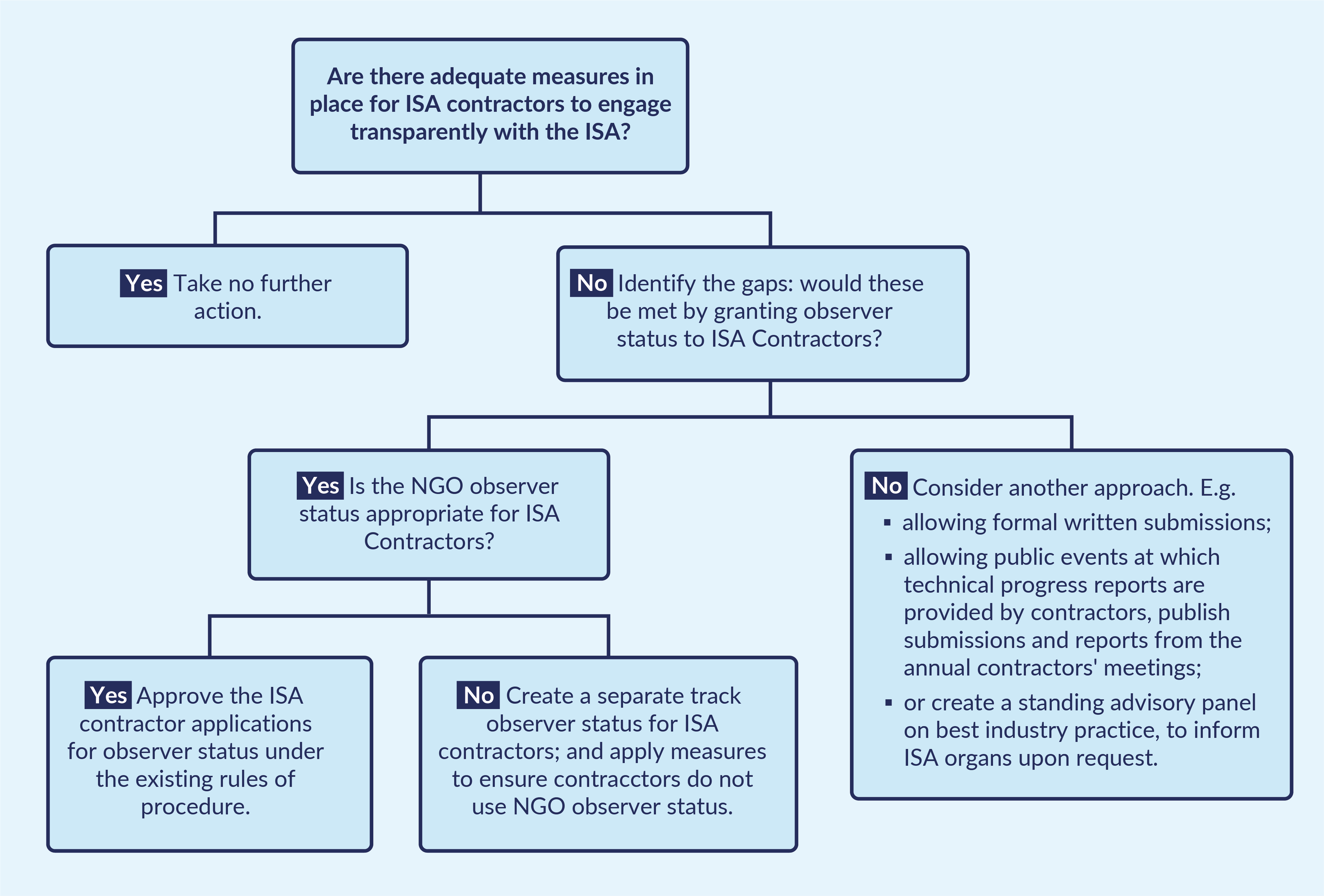
First, in considering whether to extend observer status to contractors or their affiliated organisations, the ISA Assembly would benefit from applying a structured set of objective questions to identify the specific gaps, and the best way to address these, while upholding institutional priorities. We suggest the following questions would be relevant:
- Are there adequate and transparent avenues in existence whereby contractors can engage with the ISA's work? If yes, observer status is not needed.
- If there are gaps that prevent transparent avenues of access by contractors, could they be filled only by granting observer status or by different approaches?
- If observer status is preferred, is ‘NGO observer’ status appropriate for contractors given the different characteristics of contractors and NGO observers, or is a separate contractor observer category preferable? Or;
- If a new observer status is to be established for contractors, how does this sit within, or require amendment to, the ISA’s existing RRPs? Are there other (eg, for-profit or contractor-associated) observers currently in the NGO observer category who may be more appropriately located to this other new observer status? Should restrictions be placed on contractor participation in state delegations?
- Do the existing ISA NGO Observer Guidelines adequately capture the purpose of NGO observers, and enable the Assembly to prevent inappropriate entities obtaining such status?
These questions can also be applied in a ‘decision tree’:
Figure 1. Decision tree considerations for action on granting observer status to contractors
Secondly, and separately from the observer status question, it should be noted that there are administrative measures the ISA should put in place with the aim of ensuring all ISA-contractor interaction or potential avenues for influence are transparent and managed, eg, anti-lobbying rules, conflict-of-interest management rules, cooling off periods to avoid revolving door syndrome, etc.b4dcdc240a74
4.2. Discussion
As highlighted in section 2.4. above, contractors may already have sufficient opportunity to engage with ISA processes and decision-makers, thus, it may be argued that there is no specific need to grant contractors observer status.
However, private-sector contractors do suffer some access constraints compared to other contractors, or to NGOs. In addition, a lack of formal observer status may push contractors into more informal or opaque methods of engagement, which are less transparent and more susceptible to real or perceived risks of undue influence. For example, participation in ISA proceedings by a contractor as a member of the state delegation does not transparently declare those individuals’ affiliations to other entities and can obscure the contractor’s role and influence in ISA deliberations.
If contractors are to hold observer status, similar transparency rationale suggest the ISA should avoid conflating contractor observers and NGO observers. This is because the two different types of observers serve fundamentally different institutional functions. As noted above, NGO observers exist to provide independent expertise, scrutiny, and public-interest input. Contractors are commercial entities with a direct financial stake in regulatory outcomes. Treating them as equivalent risks collapsing the distinction between public-interest oversight and private-interest advocacy, weakening the checks and balances built into the ISA system. Separating them into distinct categories also allows the ISA organs to treat them differently, eg, in the event that there are certain negotiations or processes in which NGO observers could participate without exposing the ISA to risk, but contractor observers could not due to conflict-of-interest.
One method that the Assembly could employ to differentiate between the two categories, would be to clarify that the definition of ‘NGO’ excludes for-profit organisations, and further to specify that NGO observer accreditation shall not be awarded in instances where there is vested interest, specifically private financial benefit attached to ISA decisions. That would capture not only contractors, but also entities who work for or are directly affiliated with contractors and their interests.
If this approach is taken, then the ISA Assembly would have two remaining options to deal with the existing contractor-related applications for observer status:
(i) Reject the applications and provide additional approaches and avenues for contractor engagement at the International Seabed Authority
This could include, for example, transparent and structured opportunities for contractors to provide submissions to ISA proceedings, events at which technical progress reports can be provided to ISA delegates by contractors, publication of reports from the annual contractors’ meeting, creation of a standing advisory panel populated by contractor representatives, who can provide data or advice on best industry practice to inform ISA organs upon request.
(ii) Establishing a new alternative ‘observer’ category for contractors
Where engagement occurs through such a ‘contractor observer’ category, those interactions would benefit from greater transparency. The ISA could simultaneously require that private sector contractors only participate via that observer seat, and not under a state delegation accreditation. This would prevent potential conflicts of interest that may arise from commercial actors participating from within a state delegation, where their role and influence are neither visible nor subject to observer-level safeguards.23e7a9d7ea72 Different observer categories also would allow the ISA to establish rules and practices for what access is afforded to different observer groups, based on their accurate characterisation. For example, there may be topics under negotiation upon which the Council or Assembly decides that contractor-observers will not be permitted to speak from the floor or even be present in the room, due to inherent conflict of interest. One such example might be a situation in which a contractor is litigating against the ISA, and that case needs to be discussed by the Council.
(iii) Observer status for private sector actors: Precedents from other international organisations
Accurate characterisation of participants’ roles via delegation allocation will allow the ISA to calibrate access and participation in a principled, rules-based way, reflective of the interests and risks associated with each observer category.
Nevertheless, the creation of a new, alternative ‘observer’ category for contractors would not necessarily resolve concerns regarding their participation in more informal or opaque modes of engagement within the ISA, which are less transparent and more susceptible to real or perceived risks of undue influence. Additional and different measures may also be needed in that regard.3151828c40e1
Generally, the authors did not find many useful precedents from other intergovernmental processes for managing these issues, because other international organisations generally do not have equivalent companies with whom they directly contract and regulate.
One exception, and a pertinent example of NGO observer differentiation can be seen from the World Health Organisation’s 2016 Framework for Engagement of Non-State Actors (FENSA), which represents one of the most developed attempts within the UN system to manage conflicts of interest, undue influence, and institutional capture by private interests. FENSA is explicitly designed to distinguish between engagement that enhances expertise and engagement that risks distorting public-interest decision-making, a balance that is also critical to the ISA being able to achieve its own dual mandate. While it has been critiqued as not going far enough,349d1aff7a2e for now, FENSA remains a unique model within the UN system, although it is viewed as a possible model for other international organisations wishing to strengthen and better manage engagement with non-state actors.f01392d86180
FENSA distinguishes four types of non-state actor: NGOs, private sector entities, philanthropic foundations, and academic institutions. FENSA includes international business associations as private sector entities, stating that they are ‘private sector entities that do not intend to make a profit for themselves but represent the interests of their members, which are commercial enterprises and/or national or other business associations.’52b58273a539 While FENSA guides engagement with all forms of non-state actor, there is a clear emphasis placed on the risks associated with private sector engagement. The WHO’s process to identify, assess and manage these risks, includes due diligence by the WHO into whether a non-state actor is influenced by the private sector in such a way that it should be regarded as a private sector entity even if it does not self-describe as such.fd57e1e7cec9 This is accomplished through a due diligence and risk assessment screening process to detect private sector influence381e184c02f0 and includes consideration of how the entity is funded and whether there are private sector representatives in its governance and membership, along with its nature and objectives. The WHO FENSA creates bespoke categories to avoid distorting the NGO category and enhances transparency by making different observers’ status (and vested interests) explicit. Transparency is maintained via a register of all non-state actor engagements, contributions and collaborations and those with profit motives are excluded from the formulation of policies, norms and standards, including via technical drafting sessions and specialised secretariat briefings. FENSA also allows WHO to manage secondments into the organisation, and expert selection, to exclude any individuals with commercial conflicts.
This approach could equally be applied at the ISA, by way of a bespoke private sector observer status, which would include contractors, business associations, and other for-profit observers. Such an alternative track would allow the ISA to manage more transparently the nature of engagements and weight given to interventions according to the identity of the observer. The ISA could then apply a sub-division to its for-profit category to delineate those who are ISA contractors and those who are not. This is relevant because, as regulated entities, higher risks attach to ISA-contractor relations in terms of preventing undue influence and conflict-of-interest. It is important to note, this proposal would separate public sector contractors from private sector contractors. This division however seems unavoidable, given that ISA contractors can also be governments themselves (eg ‘the Government of India’), who cannot be separated from the government as a state delegation and ISA member. The ISA may wish to consider whether such a distinction between public sector and private sector contractors in terms of observer status would amount to differential treatment that could lead to discriminatory and unfair outcomes, or whether it is a logical and justified distinction in the circumstances.
Another option in the ISA’s particular context would be to have a more specific contractor observer category, which would include contractors as well as any other observers who have financial arrangements directly with contractors or objectives to serve contractors’ interests. That category of contractor observers can also then be managed accordingly by the ISA, eg, contractor observers may be excluded from normative deliberations, or regulatory decisions that relate specifically to their own contracts. This approach would allow other private sector organisations to hold ‘NGO observer’ status.
To effect any changes that require new observer categories, the Assembly would need to establish first that such an approach is feasible under UNCLOS. This may be a matter of political will, rather than black-letter legal interpretation. UNCLOS and the Part XI Agreement contain many provisions about contractors, but nowhere do they specify that contractors may be ISA observers – but nor do they expressly prohibit it. It is interesting also that the Assembly in 2025, according to the President’s Statement, ‘decided’ that there will be no need to amend or supplement existing rules of procedure. This may be because the most expedient approach is to see ‘contractors’ as a sub-set category, distinct from but coming within rule 82(1)(e)’s general category of ‘other non-governmental organisations invited by the Assembly which have demonstrated their interest in matters under the consideration by the Assembly.’
The ISA would also need to ensure that the correct information is obtained from observer applicants to identify relevant characteristics for accurate categorisation. There may be some grey areas that the ISA will need to address in its rules, eg, not-for-profit scientific institutes who provide services under sub-contracts to contractors, or academic institutions who receive grants from contractors. Finally, thought would need to be given to re-examining existing NGO observers who may be for-profit or contractor affiliated.
Notably, the ISA Assembly’s NGO Observer Guidelines authorise the ISA to review, every five years, the list of NGOs granted observer status and to withdraw such status where appropriate. In the context of such a review, observers may be required to provide information demonstrating their continued interest in matters under consideration by the Assembly. However, both the stated basis for conducting the review and for withdrawing observer status is currently limited to whether an organisation continues to demonstrate such interest.8c3b40112431 If the ISA, in assessing contractor-affiliated NGO applicants, undertakes a broader reconsideration of the NGO Observer Guidelines (which, as has been suggested above, is likely necessary), this review mechanism should likewise be revisited to encompass criteria extending beyond mere demonstration of ongoing interest in ISA-related matters.
Conclusion
For the ISA’s regime to work and have public confidence, the ISA needs to take all appropriate steps to guard against corporate capture, conflicts of interest, undue influence, inappropriate lobbying, bribery and other corruption risks. One aspect of this is having a transparent, rules-based and consistently applied system for contractors’ participation in ISA processes.
Current practice suggests that contractors do have significant ability to access ISA processes and decision-makers. This could argue against needing additional access via an ‘observer’ accreditation. At the same time, absence of formal observer accreditation for contractors could contribute towards existing forms of contractor-ISA engagement lacking transparency.
A private sector ISA contractor, industry association, or firm providing services to a contractor, would appear to meet the minimum requirements under the ISA’s existing NGO Observer Guidelines of demonstrating their interest of matters relating to the ISA. But they are comprised of employees of private companies that intend to make profit from activities in the Area that are governed by the ISA. By contrast, other observer NGOs are not-for-profit, are not linked to organisations that are for-profit, and do not stand to gain private benefit from decisions of the ISA. Giving private-sector contractor entities the same NGO observer status as is afforded to civil society organisations may therefore not be appropriate.
While there are observer regime precedents within other multilateral processes to which the ISA can have regard, caution may need to be applied in extrapolating rules from other inter-governmental organisations where there are not the same commercial contract, common heritage stewardship, and regulatory relationships in place as exist at the ISA. The WHO does have a robust regime that carefully segregates within its non-state observer categories, according to different interests.
How this contractors-as-observers issue is handled during the ISA’s next Assembly session(s) will set an important benchmark for the ISA’s future governance. It is an early test of how the ISA navigates the delicate boundary between regulator and regulated, and how it manages actual and perceived risks of undue influence as decisions about potential exploitation draw nearer.
There are different options open to the Assembly that could help promote transparency and appropriate management of private interests, eg, managing a ‘for-profit’ observer category, or a ‘contractors’ observer category. Our analysis suggests that the ISA will uphold transparency, accountability and public confidence better, if it finds a pathway that transparently manages the different interest groups, differently.
- Article 136 and 137 (2) of UNCLOS 1982.
- Articles 139 and 153 of UNCLOS 1982.
- Article 153(4) of UNCLOS 1982.
- Understood to include treaty based and non-treaty based inter- or trans-governmental bodies.
- ISA 2025.
- Robb, Lily and Pecoraro 2024.
- Article 136 of UNCLOS 1982.
- Lily and Forster 2026.
- Ibid.
- ISA Assembly 2024.
- SMDA 2025, p. 3
- Observations from authors attending the Assembly meeting on observer delegations in July 2024 at the 2nd part of the ISA’s 29th session in Kingston, Jamaica. On file with authors. It is noted that there are no formal written records produced by the ISA of these Assembly meetings. To the best of the authors knowledge, the ISA records these sessions, and the recordings can be accessed through the ISA on request. These statements were recorded in personal written notes of the authors while attending the ISA’s meetings and cross-checked between themselves for reproduction in this paper.
- Observations from authors attending the Assembly meeting on observer delegations in July 2024 at the ISA’s 30th session in Kingston, Jamaica, particularly the morning session on 29 July 2024. On file with authors.
- Observations from authors attending the Assembly meeting on observer delegations in July 2025 at the ISA’s 30th session in Kingston, Jamaica, particularly the afternoon sessions, respectively, on 21 and 25 July 2025. On file with authors.
- Ibid.
- Rule 82, ISA Assembly 1994.
- Observations from authors attending the Assembly meeting on observer delegations in July 2024 at the ISA’s 30th session in Kingston, Jamaica, particularly the morning session on 29 July 2024. On file with authors.
- ISA Assembly 2025.
- ISA Assembly 2025.
- ISA Assembly 2026.
- IGO observers include: the Western and Central Pacific Fisheries Commission, International Copper Study Group, International Lead and Zinc Study Group, International Nickel Study Group.
- NGO observers include: the International Manganese Institute, the Cobalt Institute, the Earth Law Center, Ocean and Us, Kōrero o te ‘Ōrau, the China Oceanic Development Foundation, the World Resources Institute, and the Oceano Azul Foundation. See ISA Assembly 2025.
- See eg Dambacher et al. 2020; Clapp 2005; Bernstein 2004; Dimitrov 2020; and Lund 2013.
- Kick Big Polluters Out Coalition 2024.
- Transparency International 2026.
- InfluenceMap 2025; CIEL 2025.
- Hutchins 2026.
- See ISA 2026a.
- Authors’ own observations, based on attendance at ISA sessions from 2012-2026. Also see Morgera and Lily 2022, which quotes the ISA Secretariat report showing an average of just 13 NGO observers attending ISA annual sessions between 2015 and 2019.
- The following shows 30 NGO observers in 2020 and low actual attendance in 2019 (ISA Finance Committee 2020), compared to 67 observers in 2025 (ISA 2026a).
- Cambridge Zero and University of Bath 2025.
- Seascape Consultants 2016; Morgera and Lily 2022; Ardron, Lily, Jaeckel 2023.
- Observations by authors attending the Assembly meeting on observer delegations, particularly in July 2025 at the 2nd part of the ISA’s 30th session. On file with authors.
- ISA 2025.
- Willaert 2020.
- Seascape 2016, World Bank 2017.
- Lily and Forster 2026.
- ISA 2025.
- Annex 1 for research article, Robb et al. 2024.
- ISA Press Release 2011.
- Article 139 (1), UNCLOS.
- Rabone et al 2023; ISA 2023.
- Pickens et al 2024. See also, more recently Lassourd 2026.
- There is also an ISA contract held by an international organisation, set up for this purpose (Interocean metal Joint Organization). See ISA 2025.
- For example, ISA 2021 and ISA 2022.
- Observations by authors attending the Assembly meeting on observer delegations in Kingston, Jamaica.The ISA’s list of delegations shows ISA contractor personnel on state delegations, usually listed as an ‘adviser’ rather than a ‘representative’, see ISA 2026b.
- See, for example, ISA 2019a. This has even extended to contract applicants – During the March 2026 Council meeting, a representative from Impossible Metals who was part of the Bahrain delegation intervened from Bahrain’s seat during the Council session. Observed by the authors attending the Council meeting in March 2026.This followed previous examples in 2019 of ISA contractors speaking from their sponsoring states’ seats in 2019 for Nauru and Belgium, respectively.
- ISA Council 2020.
- Observation by authors attending the February 2020 Council meeting in Kingston, Jamaica. See IISD 2020, p. 5.
- ISA Press Release 2025a.
- ISA Press Release 2024. The data management strategy cannot be accessed on the ISA’s website.
- Global Sea Mineral Resources et al. 2025; Global Sea Mineral Resources 2026.
- Articles 187 and 188, and Annex VI of UNLCOS.
- See cases 34 and 35, and also an analysis of the applications which notes their potential motivation to exert undue influence over ISA decision-making: Lily, Pecoraro, and Singh 2026.
- See for example: Lily and Forster 2026; Hvinden 2024; Ardron, Lily, Jaeckel 2023; Bosco, Jaeckel, Singh 2023; Morgera and Lily 2022; Ardron, Ruhl, Jones 2018.
- Lily and Forster 2026; Bosco et al. 2023.
- Ardron et al. 2018. For analysis on conflict of interest risks at the ISA, see Lily and Forster 2026.
- Rules of Procedure of the Assembly, Rule 82 (1) (a), ISA Assembly 1994.
- Rule 82 (1) (b) and (c).
- Rule 82 (1) (d).
- Rule 82 (1) (e).
- Rule 82 (1) (e).
- Rules of Procedure of the Council, Rule 75 & Rules of Procedure of the Assembly, Rule 82, ISA Assembly 1994.
- Rule 82 (5), ISA Assembly 1994.
- Rule 75 and Rule 82 (5) and (6), ISA Assembly 1994.
- In 2024 a recommendation was made by the Finance Committee in its report to Council and Assembly that they should consider payment of financial contributions to the ISA by observers (Para 25, ISA Assembly 2024a). It is unclear why the Finance Committee made this suggestion. The only similar suggestion can be traced to 2020 in a note where the Secretariat noted that most international organisations do not require financial contributions from observers, but setting out potential options and inviting the Finance Committee to take note of such options (ISA Finance Committee 2020). In 2024, this suggestion was quickly rejected by member states.
- ISA Assembly 2019a.
- Paras 8-9, ISA Assembly 2019b.
- Para 12, ISA Assembly 2019b.
- Para 4, ISA Assembly 2019a.
- Raustiala 1997; Gemmill and Bamidele-Izu 2002.
- McCormick 1999; Zhao 2024.
- Gemmill and Bamidele-Izu 2002.
- Zhao 2024.
- Raustiala 1997; McCormick 1999.
- Hvinden 2024.
- See Lily and Forster 2026.
- Such conflicts of interest stem from direct commercial stakes in ISA decisions, a situation that does not typically apply to individuals associated with NGOs who may sit on state delegations.
- See Lily and Forster 2026.
- Moodie 2022; Buse and Hawkes 2016.
- Gulibaud 2024.
- Para. 10, Annex, WHO 2016.
- Para. 13, Annex, WHO 2016.
- Paras 13 and 21, Annex, WHO 2016.
- ISA Assembly 2019a, para 7 to 11.
- Question 10 in SMDA 2025.
- TMC 2025 and Greenpeace 2026.
- Greenpeace 2026.
- SMDA 2024 and SMDA 2025.
- Question 7 in SMDA 2025.
- Impossible Metals 2024.
- Impossible Metals 2026.
- ISA Press Release 2025b.
- CSA Ocean Sciences 2023.
- See the footer of CSA website: ‘CSA Ocean Sciences Inc. is a wholly owned subsidiary of Continental Shelf Associates, Inc.’, which links to Continental Shelf Associates, Inc. (CSA) is a multidisciplinary US corporation established in 1970.