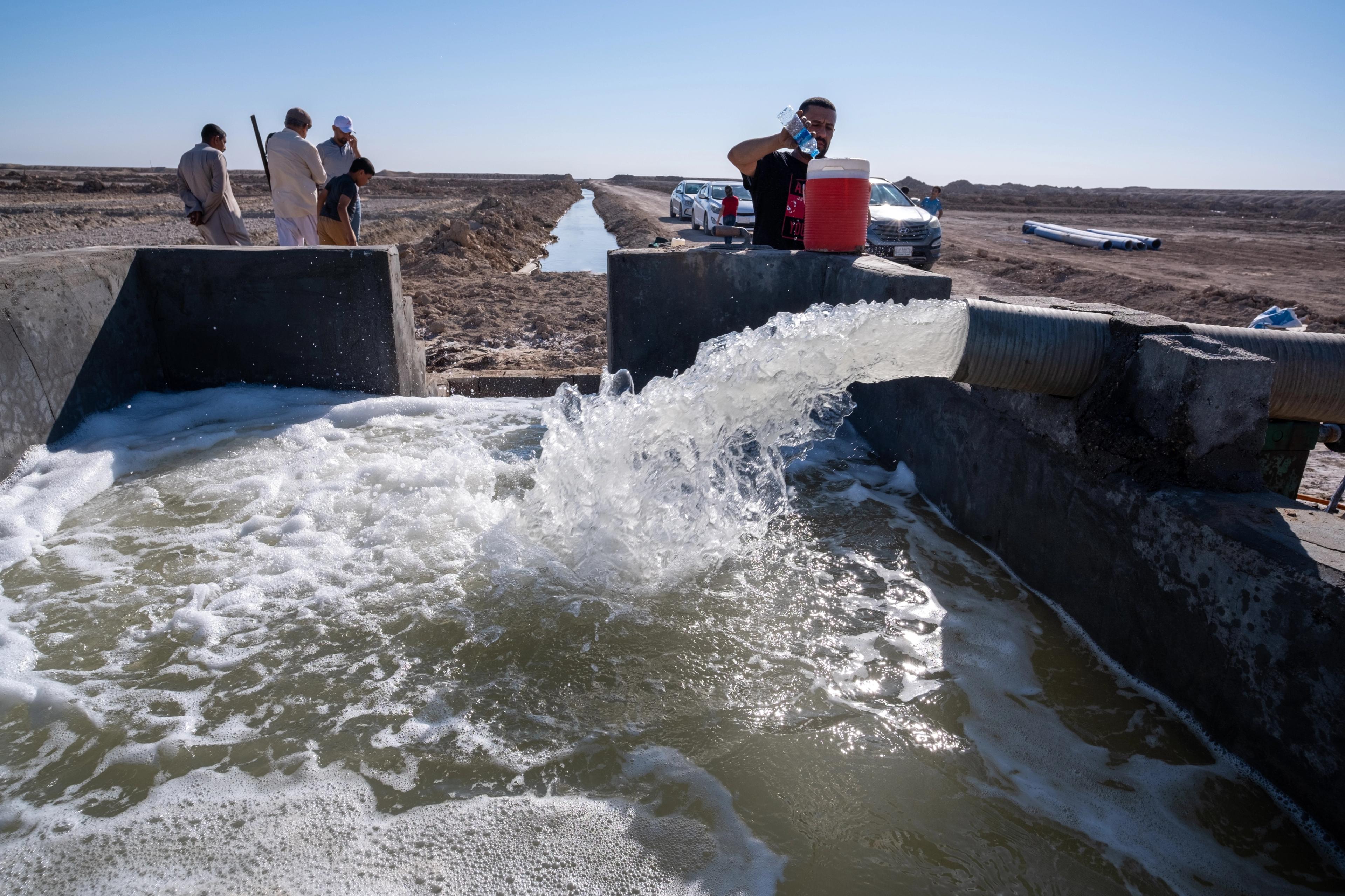
The Arab states are among the most climate vulnerable and water stressed countries on the planet. Pressure from climate change is mounting due to growing populations, state fragility, conflict, and economic decline.bb88ed93a2c2 Experts warn that the region faces temperatures rising 2.5 times faster than the global average.0d7787400f9f As noted by Khalil Gebara, '2026 should be treated as a pivotal year in which coping and adaptation move from peripheral projects to the core of economic policy, with climate risk fully integrated into fiscal planning, infrastructure investment, and social protection systems'.b394d1d41919
Despite facing some of the toughest climate challenges, the Arab states receive little funding for climate action compared to other regions. In 2022, this amounted to only 1.4% of global climate finance.59016cc7b592 Even smaller amounts of funding is directed towards climate adaptation – the projects that aim to assist people and systems cope with climate change, as opposed to mitigation, which aims to reduce carbon emissions.af0a8eaaf5e8
Current climate funding to the Arab states is insufficient to address contemporary adaptation needs. Climate adaptation is currently at the precipice: the Mutirão Declaration adopted at COP30 in 20252895c92b08a3 committed to the ‘manyfold increase in financial support’ for ‘ambitious adaptation and mitigation action aimed at achieving Article 2 of the Paris Agreement’. But as the examples from Iraq and Lebanon below show, corruption weakens climate adaptation efforts in the Arab States.
How corruption undermines climate adaptation
Within climate adaptation, corruption influences what projects are selected, how they are implemented, and impacts whether such projects benefit the people most affected by climate change.f8dab1102b73
Corruption in climate adaptation projects is not fundamentally different from corruption elsewhere. What makes it distinctive is the context these projects operate in and the consequences that follow. Cost, complexity, and the difficulties for the public to evaluate such projects, make it easier for officials or contractors to misuse funds and/or restrict oversight.
The political systems in several of the more fragile states in the Middle East are shaped by patronage, weak institutions, and elite interests, and therefore make these vulnerabilities in climate adaptation more evident. This is particularly the case in countries where climate policy and programming take ‘a backseat to more immediate fiscal and security concerns.’fc169e0da70e In fragile contexts such as Lebanon and Iraq, climate adaptation programming may often be more about serving political interests than responding to climate needs, which erodes governmental capacity to protect basic rights including access to water, food, safe housing, clean air, or protection from extreme weather.d8ac7d6214f9
Failures in climate-related infrastructure linked to corruption have contributed to public health crises and disasters in the region impacting tens of thousands of people.dfc1f54ec08c And reports have surfaced about communities that raise concerns may face intimidation by project implementers or other stakeholders.e53a8b165d7b
Because reporting on corruption is politically sensitive and civil society space is shrinking,1972dad264ef the scale of the problem in regions such as the Middle East may be greater than what is publicly known.2c6cfc6b1540 Political contexts differ across the Middle East, but the governance challenges described below appear in other fragile states in the region too.
Corruption across the adaptation project cycle – quick examples
The following cases from Lebanon and Iraq illustrate three ways corruption can undermine climate adaptation and resilience. Together, they show how political capture and weak accountability can exacerbate climate vulnerability.
Distorted project selection – The Bisri Dam (Lebanon)
In Lebanon, the Bisri Dam project (2010–2019) demonstrates how corruption may skew project selection towards high rent projects with little public benefit.24e77c51356e Presented as a major water-supply initiative, serious engineering and environmental concerns were raised regarding the dam project from its inception.aae008f81a28 The project site sat on unstable bedrock and a seismic fault line,1c08c9922a48 and building the reservoir would have destroyed farmland, forests, and archaeological sites.1c91f7bebbad An amount of €530 million of a total €1.03 billion cost of the project was added to Lebanon’s sovereign debt – among the highest globally – that would need to be repaid with interest.d9c6c5535b03 Despite these pitfalls, political leaders pushed the project forward. The dam offered high political visibility and the opportunity to direct contracts to companies with political connections, creating an incentive to ignore technical assessments and public objections.e674f043fb02
Conflicts of interest deepened public mistrust in the construction of the dam. Some companies involved in the project had ties to influential political families,347986ca4d76 and land expropriation processes were marred by undervalued compensation and pressure on residents to accept unfair terms.6ac96db86d7c Only when public protests gained momentum in light of broader civic disobedience across Lebanon, did the project come to a halt.d24d714136ff By then, large sums had already been spent, and Lebanon had lost time and resources that could have gone to more effective climate solutions.01ae2db3dcc3
The case highlights a distinct risk in climate adaptation: the selection of projects on the basis of political and economic rents rather than climate need or technical merit.
Failed implementation and lack of maintenance – Green Belt initiatives (Iraq)
The experience of Iraq’s Green Belt initiative, which started in 2006, highlights the consequences of weak oversight and poor implementation. The project was conceived with the aim of slowing desertification by planting millions of trees on the western edge of the desert.a5945510b774 This was a relatively low-cost and practical way to reduce dust storms, improve air quality, and create protective green zones, and had been suggested by planners since the 1970s.
Despite ambitious plans, only the area around the city of Karbala saw any implementation. As noted by an Iraqi scholar, ‘until now [2022], governmental involvement is very limited, because of a lack of budget allocated for climate change mitigation, lack of community knowledge about climate impacts, political unrest, and financial corruption’.a87a70875632
In Karbala, only 63% of the planned project was completed by 2012 while green spaces around the city had shrunk by a total of 60% in the same period (2006–2012).5ca7423ce8b4 Environmental violations went unpunished,5764ff3f939f and laws designed to protect green spaces were rarely enforced allowing actors with political connections in Iraq to repurpose public land for profit without facing consequences. By 2022, follow up on the green belts around Karbala showed that the project had lapsed with trees dead and pumps stolen or in disrepair.89e9ea7b8b3c
Project failure in Karbala was widely blamed on ‘financial mismanagement’ and a lack of political interest.3ed2bdc2b225 One scholar noted how the Green Belt was more likely ‘a corruption plan: money was requested, a few trees were planted, and the money disappeared’.ebe47d5407f2 The political economy of Iraq, based on sectarian power-sharing, means that politicians prioritise short-term political calculations and maximise rent seeking.617316d4df07 Karbala was likely able to follow through on the project due to the role of the hawza ʿilmiyya (the religious institutions) that, autonomous from the Iraqi state and funded independently through the collection of khums (in English: tithes52e98638f8c9), have informal influence in Karbala including land use.df9da609a1a6
Between 2006 and 2012, of the IQD 16 billion (approximately EUR 10.7 million) allocated to Karbala’s green belts, only IQD 9 billion were dispensed signalling the possibility of front-loaded rent extraction.f6c47edbfa5f After widespread reports of project failure, Karbala’s green belts have since recovered after the city’s religious institutions restored them.811916664b56 Their involvement highlights how projects can succeed when managed by actors with real commitment and closer ties to local communities. The challenges described in this session are likely to reemerge in light of governmental plans to plant five million trees across Iraq, including green belts around Baghdad and Erbil.bca4ab9343f2
Procurement capture – The Food Basket Programme (Iraq)
In another case from Iraq, the Food Basket Programme – started in 2021 – shows how corruption in procurement can undermine climate-linked resilience efforts. Although the programme was not designed as a climate adaptation project, it plays an important role in supporting food security for millions of Iraqis facing the combined pressures of drought, crop failure, and rising food prices.65683ef8a753 Its success depends on transparent purchasing and reliable delivery for a population that spends 30% of income on food with prices increasing as a result of global pressures.
However, the €6 billion programme, available to all Iraqis with an additional basket for the 5 million Iraqis under the poverty line, became a site of repeated manipulation.c4eba3ebddf8 A single company won a major supply contract through a process marked by irregularities.b5c67462b44c Prices for basic food items were inflated, and quality was often poor: in some areas, families received their rations late, incomplete, or damaged.7898477a409d Investigations found that the contractor’s financial guarantees were inadequate and that key documents came from a bank linked to the same business group.2ea5996bf68b In their analysis of the programme, Iraq’s anti-corruption body – the Parliamentary Integrity Committee – claimed monthly losses of about €130 million.43d811d48d0a
Whistleblowers who raised concerns faced retaliation, including legal action and public pressure.6ee4dc1f1636 Their treatment signals how exposing corruption carries risks even for persons with legal immunity, such as members of parliament.
Weak environmental governance shapes the environmental footprint of food provision; when agricultural livelihoods collapse the state may respond by expanding compensation as is the case of the Food Basket Programme while not addressing environmental issues. This case indicates how corruption in supply chains can directly harm vulnerable communities and weaken their ability to cope with climate-related shocks.
Climate needs alone do not drive policies
The dynamics observed in Iraq and Lebanon may be relevant to other fragile states in the Middle East, where climate adaptation initiatives often operate within similarly challenging environments characterised by political fragmentation, patronage networks, and weak institutional oversight.2a9c12dfd211 In many such states, the focus on short-term incentives by politicians in order to maintain their position overshadows long-term resilience planning.358bfa55c8ab Projects look impressive but may not adequately address climate threats to vulnerable communities. Hence, the structure of adaptation projects should be interrogated for who has access to contracts and the opportunity to distribute favours.
Another repeated pattern is weak enforcement. As noted by an interviewee, environmental laws and climate policies may exist, but institutions applying them, especially on the local level, may lack authority, funding, independence, or capacity.f7ab8f1c90c9 The specialised materials, large volumes of supplies, or technically complex services required by adaptation projects, create opportunities for price inflation and single-bid tenders. Failure to follow through mean that adaptation investments become fragile when their benefits evaporate. Over a period, such failures may reduce public trust and mean that climate programming receives less support or interest.
Lastly, closed political environments in several of the fragile states in the Middle East discourage open criticism. Civil society organisations that monitor environmental issues or expose corruption may face intimidation or legal harassment.3f4db2b0c1cc These patterns show that climate adaptation efforts in fragile states are shaped as much by the political economy of a country as by the climate needs themselves.
Recommendations
The three cases point to a common conclusion: climate adaptation outcomes depend on governance arrangements in addition to technical design or funding levels. Across the project cycle, adaptation efforts are undermined by political incentives, weak accountability, deficient oversight, and limited civil society scrutiny.
The recommendations below focus on addressing these governance vulnerabilities before they become embedded in adaptation programming.
Require political economy and corruption risk assessment before project approval
The Bisri Dam case shows how elite interests and rent-seeking may distort project selection. Mandated corruption risk assessments in the project identification stage examines who benefits from a project, potential risks in contract distribution and land acquisition, conflicts-of-interest, and affiliations of contractors, as well as an assessment of lower-cost alternatives. Such assessments strengthen protections of adaptation funding by directing them away from low-impact but politically attractive projects.
Link adaptation finance to independent monitoring and milestone-based evaluation
Project approval and the availability of funding cannot guarantee results, as evidenced by the Green Belt projects. Independent verification arrangements should be included in project design linking disbursement to clearly defined milestones and assessments of quality and beneficiary satisfaction. Possible avenues include community scorecards, satellite imagery, or third-party audits, thereby reducing opportunities for project failure or diversion.
Require long-term maintenance plans
Even if implementation takes place, the Green Belt projects show how adaptation gains may be unsustainable due to a lack of follow up. Approval of project plans should specify ownership arrangements, dedicate maintenance funding, specify the role of the community, and procedures for asset monitoring on project completion to preserve climate resilience after initial implementation.
Give communities a formal role throughout the project cycle
All three cases show the detriment of weak accountability mechanisms. Community engagement should go beyond consultation and be formalised, giving affected communities a role in project selection, budget review and implementation planning, along with feedback mechanisms that reach donors and project managers. Possible avenues include participatory budgeting, public hearings, or citizen monitoring committees, as well as community scorecards. Such efforts may improve project responsiveness and provide additional oversight.
Strengthen whistleblower protection and civic oversight
The Food Basket case shows risks faced by individuals who aim to expose wrongdoing, and how reporting on corruption is constrained by intimidation and shrinking civic space. To assist in transparency and civic oversight, donors should require open procurement processes, publication of tender documents and contract awards, and disclosure of beneficial ownership. In addition, projects should include confidential reporting mechanisms, and support for civil society organisations and other entities engaged in monitoring relevant programming. This would increase detection of corruption risks and may help to strengthen project accountability.
- Shuker 2023.
- al-Delaimy 2020, 131.
- Gebara 2026.
- Nest 2025.
- UNDP 2024.
- All Middle Eastern States are party to the UNFCCC.
- Nest et al. 2020.
- Elgendy 2025, 30.
- Bordner et al. 2023; Pacillo et al. 2024, 89.
- Nest 2025.
- Interview, 5 July 2025.
- Shafi 2025.
- Nest 2025.
- Ahmad 2020; also, Sopera 2022, 22–23 & 47–49; interview, 5 July 2025.
- Ayoub 2024.
- Basbous et al. 2022.
- Moughalian et al. 2022.
- Chamoun 2019.
- Ahmad 2020; Bulos and Yam 2021; Rabah 2020; The New Arab 2020; Van Rosse and Lambrecht 2021.
- Ahmad 2020; Bulos and Yam 2021; Asharq al-Awsat 2020.
- Moughalian et al. 2022.
- Ayoub 2024, 15.
- Moughalian et al. 2022.
- Janabi 2013.
- Kimball 2022.
- AFP 2012; Kimball 2022.
- Interview, 5 May 2025.
- AFP 2022.
- Interview, 5 May 2025.
- Jiyad 2023.
- Tithes are a portion of one’s income paid to a religious institution.
- Al-Daini et al. 2020; AFP 2022; Interview, 5 May 2025.
- AFP 2022.
- Adam and Fazekas 2023.
- IIAN 2023; Karbala News 2023.
- Rudaw 2025; al-Samarraie 2025.
- Sahar et al. 2025.
- InfoPlus Network 2023; Daoud 2023; al-Jarhi 2022.
- Daoud 2023; Info Plus Network 2023; Shafaq News 2024a.
- 964 Media 2024; Rudaw 2022.
- Daoud 2023.
- Rudaw 2022; Shafaq News 2024a; Daoud 2023.
- Shafaq News 2024b; Ahmed 2024; al-Alam al-Jadeed 2024.
- In another example raised during the author’s meeting with civil society members in Cairo, an environmental lawyer present mentioned how, when visiting the sites of supposed adaptation projects in Egypt, there was often nothing there despite documents announcing the projects (November 2024).
- MIT Center for International Studies 2025; Interviews, 25 April and 5 May 2025.
- Elgendy 2025, 29; Interview, 11 April 2025.
- Interview, 29 April 2025.